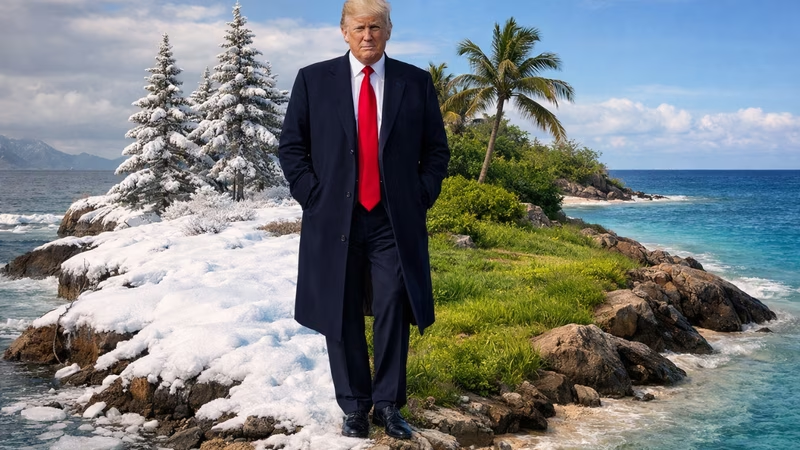
It sounds like a plot from a satirical novel—except it’s real. In early January 2026, President Donald Trump reignited his controversial campaign to buy Greenland, declaring in a press briefing that “America needs more land, and Greenland is sitting there, underutilized and strategically vital.” The announcement triggered an immediate diplomatic firestorm with Denmark, whose Prime Minister called the idea “unacceptable” and “a relic of colonial thinking.” But is this just another Trumpian headline grab—or is there a deeper, more calculated strategy at play? Welcome to Trump’s Greenland Gambit, a move that could reshape Arctic power dynamics for decades.
Table of Contents
- Why Greenland Now?
- Trump’s Greenland Gambit: What It Really Means
- The Strategic Value of Greenland
- Denmark’s Response and Allied Concerns
- Could the U.S. Actually Buy Greenland?
- Conclusion: More Than a Whim
- Sources
Why Greenland Now?
Greenland isn’t new territory on the geopolitical radar. The U.S. has maintained a critical military presence at Thule Air Base since the 1950s—an installation vital for missile warning, space surveillance, and Arctic defense . But with climate change rapidly melting Arctic ice, new shipping lanes are opening, and vast mineral deposits once locked under permafrost are becoming accessible. Rare earth elements, uranium, zinc, and iron ore lie beneath Greenland’s surface—resources essential for everything from smartphones to next-gen weapons systems .
Meanwhile, Russia and China have dramatically increased their own Arctic activities. Moscow has reopened Soviet-era military bases along its northern coast, while Beijing declared itself a “near-Arctic state” and invested heavily in polar research and infrastructure . In this context, Trump’s fixation on Greenland looks less like a whim and more like a reaction to a shifting global chessboard.
Trump’s Greenland Gambit: What It Really Means
At its core, Trump’s Greenland Gambit blends three powerful drivers: national security, economic opportunity, and personal legacy.
National Security Imperative
Control over Greenland would give the U.S. unparalleled dominance over the North Atlantic and Arctic approaches. With Thule already in place, full sovereignty would eliminate any risk of Danish policy shifts limiting U.S. access—a concern that grew during Europe’s recent debates over military neutrality.
Economic & Resource Play
Greenland holds an estimated 31 million tons of rare earth oxides—more than double China’s current reserves . For a U.S. administration desperate to break dependence on Chinese supply chains, this is a strategic goldmine. As one Pentagon official anonymously noted, “Owning Greenland isn’t about real estate—it’s about securing the materials for the next industrial revolution.”
The Symbolic Factor
Let’s not ignore Trump’s well-documented love for grand gestures. Acquiring sovereign territory would be a historic first for a modern U.S. president—a tangible “win” he could tout as expanding American greatness. In his words: “Other presidents talk. I deliver land.”
The Strategic Value of Greenland
Beyond minerals and missiles, Greenland offers something even more valuable in the 21st century: geographic leverage.
- Arctic Command Hub: A sovereign U.S. Greenland could host expanded naval and air operations, countering Russian submarine patrols.
- Data & Surveillance Advantage: Its location is ideal for monitoring satellite traffic and undersea cable routes.
- Climate Research Leadership: Control would position the U.S. at the forefront of polar science—critical for predicting global weather and sea-level rise.
Denmark’s Response and Allied Concerns
Denmark, which handles Greenland’s foreign and defense policy (though the island is autonomous), has firmly rejected any sale. In a surprising countermove, Copenhagen offered enhanced defense cooperation, including joint Arctic patrols and expanded U.S. access to Thule—without ceding sovereignty .
European allies, however, are alarmed. German and French officials worry this signals a return to 19th-century-style territorial expansionism, undermining the rules-based international order. “If the U.S. can buy Greenland, what stops China from ‘leasing’ parts of Africa?” asked a senior EU diplomat .
Could the U.S. Actually Buy Greenland?
Legally, it’s complicated. Greenland is not Denmark’s property to sell—it’s a self-governing territory with its own parliament. Any transfer would require Greenlandic consent, which currently stands firmly against it. A 2025 poll showed only 12% of Greenlanders support integration with the U.S. .
Historically, the U.S. tried—and failed—to buy Greenland before. In 1946, President Truman offered $100 million; Denmark refused. Trump’s team has reportedly explored alternatives: long-term leases, economic partnerships with massive infrastructure investment, or even supporting pro-independence movements to create a scenario where Greenland seeks U.S. annexation voluntarily.
Conclusion: More Than a Whim
While critics dismiss Trump’s Greenland Gambit as ego-driven fantasy, the underlying strategic logic is undeniable. In an era of great-power competition, the Arctic is the new frontier—and Greenland sits at its heart. Whether through purchase, partnership, or pressure, the U.S. is signaling it will not cede this critical zone to rivals. The real question isn’t whether Trump wants Greenland—it’s how far he’s willing to go to get it, and what that means for global stability.
Sources
- U.S. Department of Defense: “Thule Air Base Fact Sheet”
- U.S. Geological Survey: “Mineral Resources of Greenland”
- The Arctic Institute: “China’s Polar Silk Road”
- Congressional Research Service: “Rare Earth Elements: The Global Supply Chain”
- Reuters: “Denmark Offers U.S. Enhanced Arctic Cooperation Amid Greenland Tensions”
- Financial Times: “European Allies Warn Against U.S. Territorial Ambitions”
- Greenlandic Public Opinion Poll, Nuuk Institute (2025)
- Original Source: Times of India: Russia, minerals or whim? Why Trump is after Greenland