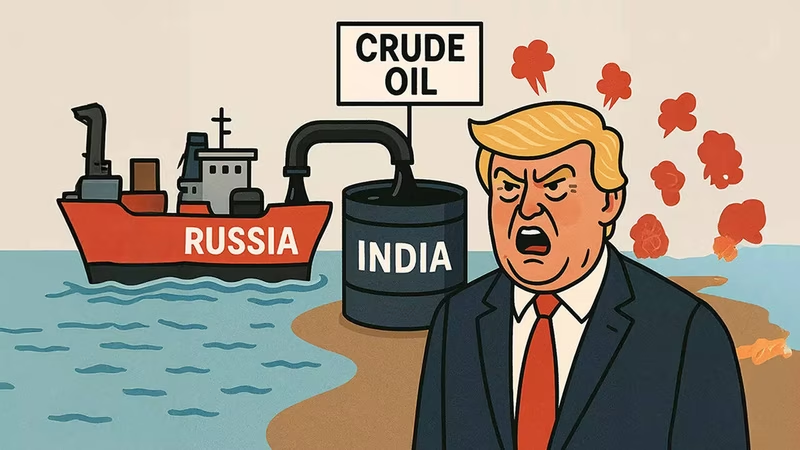
In a move that could send shockwaves through global markets, former US President Donald Trump has thrown his weight behind a controversial new bill. This legislation isn’t just about punishing Russia; it’s a direct challenge to major economies like India and China, threatening them with a staggering 500% tariff on Russian oil imports. For India, this creates an impossible dilemma: choose between its critical energy security from discounted Russian crude or its vital $131 billion trade lifeline with the United States .
Table of Contents
- The Trump-Backed Bill: What It Really Means
- India’s Russian Oil Dependency: A Double-Edged Sword
- The $131 Billion Stakes of India-US Trade
- Potential Impact on Indian Economy and Consumers
- Strategic Options for India: Navigating the Storm
- Conclusion: A Delicate Geopolitical Tightrope
- Sources
The Trump-Backed Bill: What It Really Means
The proposed legislation, often referred to as a new sanctions act, is deceptively simple in its mechanism but devastating in its potential scope. It mandates a minimum tariff of 500% on all goods imported into the United States from any country found to be “knowingly purchasing” Russian oil, gas, or uranium . This isn’t a targeted sanction on specific companies; it’s a blanket economic weapon aimed at entire national economies.
The goal is clear: to completely isolate Russia from its last major sources of hard currency by making it economically suicidal for countries like India to continue their trade. By leveraging the immense power of the US consumer market, the bill aims to force a rapid and total decoupling from Russian energy .
India’s Russian Oil Dependency: A Double-Edged Sword
Since the start of the Ukraine conflict, India has become one of the largest beneficiaries of heavily discounted Russian crude. This strategic move has been a masterstroke for India’s energy security and fiscal health, allowing it to secure vital supplies at a fraction of the global market price.
The numbers are telling. In the first half of 2025 alone, India’s imports from Russia reached a colossal $32.7 billion, with crude oil and fertilizers forming the overwhelming bulk of this trade . While there have been recent fluctuations—with a reported 38% drop in October 2025 volumes—the overall trend since 2022 shows a deep and structural reliance . Stripping out oil, the broader India-Russia trade relationship is a mere $12 billion, highlighting just how central this single commodity is to the partnership .
The $131 Billion Stakes of India-US Trade
Walking away from Russian oil would be a significant blow to India’s economy, but defying the US carries an even greater risk. The US has been India’s largest trading partner for four consecutive years. In the 2024-25 fiscal year, bilateral trade hit a record $131.84 billion .
This relationship is not just about raw numbers; it’s about high-value sectors critical to India’s future:
- Pharmaceuticals & IT Services: India is a key supplier of generic drugs and a global hub for IT outsourcing to the US market.
- Gems & Jewelry: A major export category that would be instantly crippled by a 500% tariff.
- Engineering Goods & Textiles: These labor-intensive sectors support millions of jobs in India and rely heavily on access to the US consumer.
A 500% tariff would effectively shut these industries out of the American market overnight, causing massive job losses and a sharp contraction in India’s export-driven growth .
Potential Impact on Indian Economy and Consumers
The ripple effects of this standoff would be felt far beyond corporate boardrooms. If India is forced to abandon cheap Russian oil, its import bill would skyrocket. This would put immense pressure on the Indian rupee, fuel inflation, and likely lead to higher fuel prices at the pump for every Indian citizen.
Conversely, if the US imposes the tariffs, the loss of export revenue would shrink India’s foreign exchange reserves, again weakening the rupee and making all imports—including non-Russian oil—more expensive. It’s a classic lose-lose scenario engineered by geopolitical forces beyond New Delhi’s control.
Strategic Options for India: Navigating the Storm
Faced with this existential threat, India’s policymakers are left with a few difficult paths forward:
- Diplomatic Offensive: Launch a full-court press in Washington, arguing that India’s purchases are helping to stabilize global oil prices and that a sudden cutoff would only benefit other buyers like China. [INTERNAL_LINK:india-us-diplomatic-relations]
- Gradual Diversification: Accelerate efforts to diversify its oil basket, increasing imports from traditional suppliers like Iraq, Saudi Arabia, and the US itself, though likely at a much higher cost .
- Financial Workarounds: Continue to explore alternative payment mechanisms, such as using third-country currencies or barter systems, to technically comply with the spirit of Western sanctions while maintaining the trade flow—a risky game of cat and mouse.
Conclusion: A Delicate Geopolitical Tightrope
The threat of a 500% tariff on Russian oil is more than just a trade policy; it’s a stark reminder of the complex web of modern geopolitics. India is caught in the middle, trying to balance its immediate economic needs against its long-term strategic partnership with the world’s largest economy. There are no easy answers, and any misstep could have severe consequences for its economic stability and its position on the global stage. The coming months will be a critical test of India’s diplomatic agility and economic resilience.
Sources
- Times of India: Russian oil purchase: How 500% tariff could upend India-US trade – explained
- Economic Times: Trump’s Sanctions Bill: 500% Tariffs on China, India for Buying Russian Oil
- Ministry of Commerce and Industry, Government of India: Trade Statistics
- U.S. Department of State: U.S. Relations With India