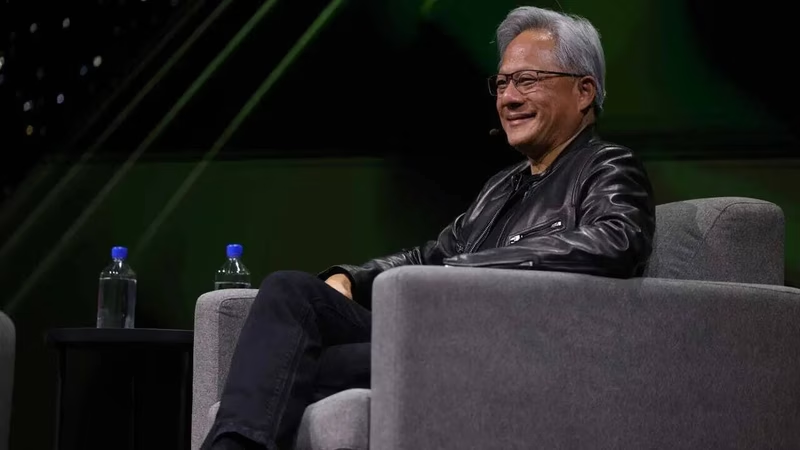
It was supposed to be a golden moment for Nvidia. CEO Jensen Huang had just declared that demand for the company’s cutting-edge **Nvidia H200 chips** was “booming” in China—the world’s largest AI market. But within days, Beijing sent a stark message: Wait. Not so fast.
In a sudden and strategic move, Chinese authorities have temporarily halted new orders for the H200, the most powerful AI accelerator in Nvidia’s current lineup. The goal? To prevent a last-minute buying frenzy while the government finalizes its official stance on whether these advanced processors should even be allowed into the country. Meanwhile, Nvidia is responding with an unusual financial twist: demanding full upfront payment with no refunds—shifting all risk onto buyers caught in this high-stakes geopolitical crossfire.
Table of Contents
- Why China Froze Nvidia H200 Chip Imports
- Nvidia’s Risk-Shifting Payment Policy
- The Bigger Picture: U.S.-China Tech Cold War
- China’s Push for Homegrown AI Chips
- What This Means for Global AI Development
- What Happens Next?
- Conclusion: Innovation vs. Sovereignty
- Sources
Nvidia H200 Chips: China’s Strategic Pause
The H200, unveiled in late 2023, is a generational leap over its predecessor—the H100—boasting 141 GB of ultra-fast HBM3e memory and unmatched performance for large language model training. For Chinese tech giants like Baidu, Alibaba, and Tencent, access to these chips is critical to staying competitive in the global AI race .
But China’s Ministry of Industry and Information Technology (MIIT) has now instructed major cloud providers and data centers to **pause all new H200 purchase orders** until further notice . This isn’t a formal ban—yet. Instead, it’s a “cooling-off” period designed to give regulators time to assess national security implications and avoid a chaotic rush that could deplete global supply before policy is set.
One insider told Reuters: “Beijing doesn’t want companies stockpiling chips like toilet paper during a pandemic. They need control.”
Nvidia’s Risk-Shifting Payment Policy
Facing uncertainty, Nvidia has adopted a hardline financial stance. According to industry sources, the company is now requiring Chinese customers to pay **100% upfront** for any H200 shipments—with a strict “no cancellation, no refund” clause .
This marks a significant shift from standard industry practice, where partial deposits or milestone-based payments are common. By doing this, Nvidia effectively transfers all financial risk to the buyer: if China bans the chips after payment, the customer eats the loss.
Analysts see this as both a defensive move and a power play. “Nvidia knows demand is insatiable,” says Priya Sharma, a semiconductor analyst at Bernstein. “They’re leveraging scarcity to lock in revenue, regardless of political fallout.”
The Bigger Picture: U.S.-China Tech Cold War
This standoff didn’t happen in a vacuum. It’s the latest chapter in an escalating tech cold war:
- 2022: U.S. imposes export controls on A100/H100 chips to China.
- 2023: Nvidia releases “China-compliant” chips (A800/H800) with reduced bandwidth.
- 2024: U.S. tightens rules again, forcing Nvidia to create the even more restricted H20.
- <2026: H200 emerges—but China hesitates, wary of dependency .
Each iteration has been a game of cat-and-mouse, with Nvidia engineering workarounds and Washington closing loopholes. Now, Beijing is refusing to play along—choosing strategic patience over immediate capability.
China’s Push for Homegrown AI Chips
Behind the import pause lies a clear ambition: **semiconductor self-reliance**. Companies like Huawei (with its Ascend 910B), Biren, and Moore Threads are racing to develop domestic alternatives that can match Nvidia’s performance .
While still 1–2 generations behind, China’s homegrown chips are improving rapidly—thanks to massive state subsidies and a “whole-nation system” approach to tech development. By slowing H200 inflows, Beijing hopes to give these local players breathing room to scale.
As one Chinese AI startup founder put it: “We’d rather train slower on our own silicon than be cut off mid-project by U.S. sanctions.”
What This Means for Global AI Development
The ripple effects extend far beyond Asia:
- Supply Chain Delays: If Chinese buyers cancel en masse, Nvidia may redirect H200s to U.S. or EU clients—but logistics take months.
- Pricing Pressure: Reduced Chinese demand could ease global shortages, lowering prices for others.
- Innovation Fragmentation: Two parallel AI ecosystems may emerge—one Western, one Chinese—each with incompatible hardware stacks [INTERNAL_LINK:global-ai-fragmentation].
For enterprises betting on AI, this means heightened volatility in hardware planning and long-term strategy.
What Happens Next?
Experts predict three possible outcomes:
- Scenario 1: China approves limited H200 imports under strict end-user monitoring.
- Scenario 2: A full ban is enacted, accelerating investment in domestic chips.
- Scenario 3: Nvidia creates a new “H200-China” variant that meets both U.S. export rules and Chinese performance needs—a delicate balancing act.
Whatever happens, one truth is clear: in the AI era, chips are not just technology—they’re geopolitical weapons.
Conclusion: Innovation vs. Sovereignty
The saga of the **Nvidia H200 chips** in China is more than a supply chain hiccup. It’s a defining moment in the battle between open innovation and technological sovereignty. For Nvidia, it’s about market access. For China, it’s about survival in a world where AI dominance equals national power. As Jensen Huang navigates this minefield, the entire tech world watches—knowing that the outcome will shape the future of artificial intelligence for decades to come.