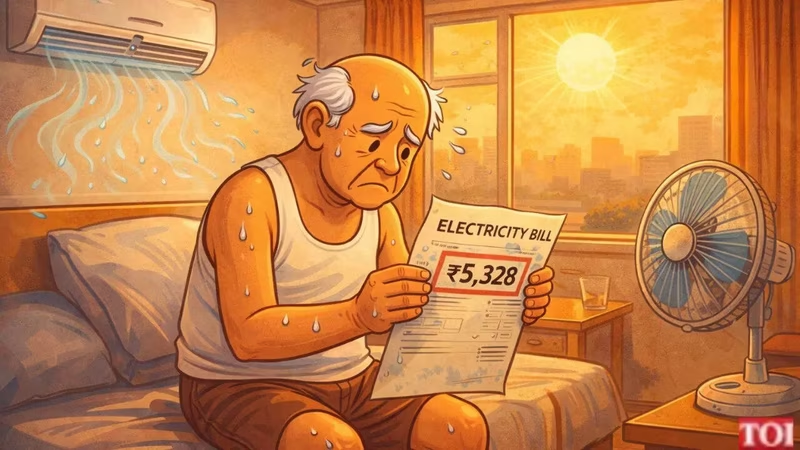
It’s the ultimate modern paradox: to survive the heat caused by climate change, we crank up our air conditioners—which then burn more fossil fuels, emit more greenhouse gases, and make the planet even hotter. This vicious feedback loop isn’t theoretical; it’s happening right now in homes, offices, and cities across India—and it’s sending electricity bills through the roof.
In 2026, as India endures one of its hottest starts to the year on record, national power demand has surged past 240 gigawatts, with peak loads driven overwhelmingly by cooling needs . The result? Higher tariffs, strained grids, and a deepening reliance on coal—the very fuel accelerating global warming. The uncomfortable truth is this: air conditioners and climate change are now locked in a self-reinforcing death spiral.
Table of Contents
- The Cooling Explosion in India
- Air Conditioners and Climate Change: The Vicious Cycle Explained
- Why Your Power Bill Is Soaring
- India’s Coal Dependency Problem
- Cleaner Solutions for a Cooler Future
The Cooling Explosion in India
Just two decades ago, air conditioners were a luxury in most Indian households. Today, they’re becoming a necessity. The International Energy Agency (IEA) projects that by 2050, India will account for nearly 40% of global growth in room air conditioners . With urban populations swelling and average temperatures rising, this trend is unstoppable—but not unmanageable.
During the May 2025 heatwave, Delhi recorded a staggering 52.3°C, while cities like Chennai and Hyderabad saw nighttime temperatures barely dip below 35°C. In such conditions, ACs aren’t just comfort devices—they’re life-saving appliances, especially for the elderly and vulnerable.
Air Conditioners and Climate Change: The Vicious Cycle Explained
Here’s how the cycle works:
- Climate change → More frequent and intense heatwaves.
- More heatwaves → Greater demand for air conditioning.
- ACs run on electricity → Most electricity in India comes from coal (over 70% as of 2025).
- Coal power plants emit CO₂ → More CO₂ worsens climate change.
But there’s another layer: many ACs use hydrofluorocarbon (HFC) refrigerants, which are potent greenhouse gases—thousands of times more damaging than CO₂ if leaked. So even the units themselves contribute to the problem .
Why Your Power Bill Is Soaring
The financial impact is immediate and personal. State electricity boards, struggling to meet unprecedented demand, are forced to buy expensive short-term power from private generators or import coal at premium rates. These costs are passed directly to consumers.
In Maharashtra and Tamil Nadu, residential tariffs have increased by 12–18% since 2024, with summer months seeing bills double or triple compared to winter . For low- and middle-income families, this “cooling poverty” creates an impossible choice: swelter in unsafe heat or face financial strain.
India’s Coal Dependency Problem
While India is the world’s third-largest installer of solar power, its grid remains heavily dependent on coal. During peak summer demand, renewable sources like solar actually underperform in the late afternoon and evening—precisely when AC usage peaks after sunset .
This mismatch forces grid operators to ramp up coal-fired plants, which are reliable but dirty. In June 2025, coal generation hit an all-time high of 120 GW, contributing to both local air pollution and global emissions. Without massive investment in battery storage and smart grid technology, renewables alone can’t break the cycle—at least not yet.
Cleaner Solutions for a Cooler Future
Breaking this loop requires a multi-pronged strategy:
- Energy-efficient ACs: Adopting models with 5-star BEE ratings can cut electricity use by 30–50%.
- Passive cooling: Better building design—white roofs, cross-ventilation, shading—can reduce indoor temps by 3–5°C without any power.
- Green hydrogen & storage: Pilot projects in Gujarat and Karnataka aim to store solar energy for evening use, reducing coal reliance.
- Policy action: India’s recently updated Cooling Action Plan targets a 25% reduction in cooling energy demand by 2030 .
As noted by the International Energy Agency, “The future of cooling must be clean, efficient, and equitable—or it will become a major driver of climate catastrophe” .
Final Summary
The relationship between air conditioners and climate change is no longer a distant concern—it’s a daily reality shaping energy bills, public health, and environmental policy in India. While cooling is essential for survival in a warming world, continuing down the current path risks locking the country into a high-emission, high-cost future. The solution lies not in abandoning ACs, but in reimagining how we cool—smarter, cleaner, and more sustainably.
Sources
- Times of India. (2026, January 8). The heat of air conditioners: How climate change is driving up power bills— a closer look. Retrieved from https://timesofindia.indiatimes.com/home/environment/the-heat-of-air-conditioners-how-climate-change-is-driving-up-power-bills-a-closer-look/articleshow/126406256.cms
- International Energy Agency (IEA). (2025). The Future of Cooling. Retrieved from https://www.iea.org
- Ministry of Power, Government of India. (2025). Annual Report on Power Sector Performance.
- Bureau of Energy Efficiency (BEE). (2026). Star Labeling Program for Room Air Conditioners.
- Central Electricity Authority (CEA). (2026). Daily Generation Report – January 2026.