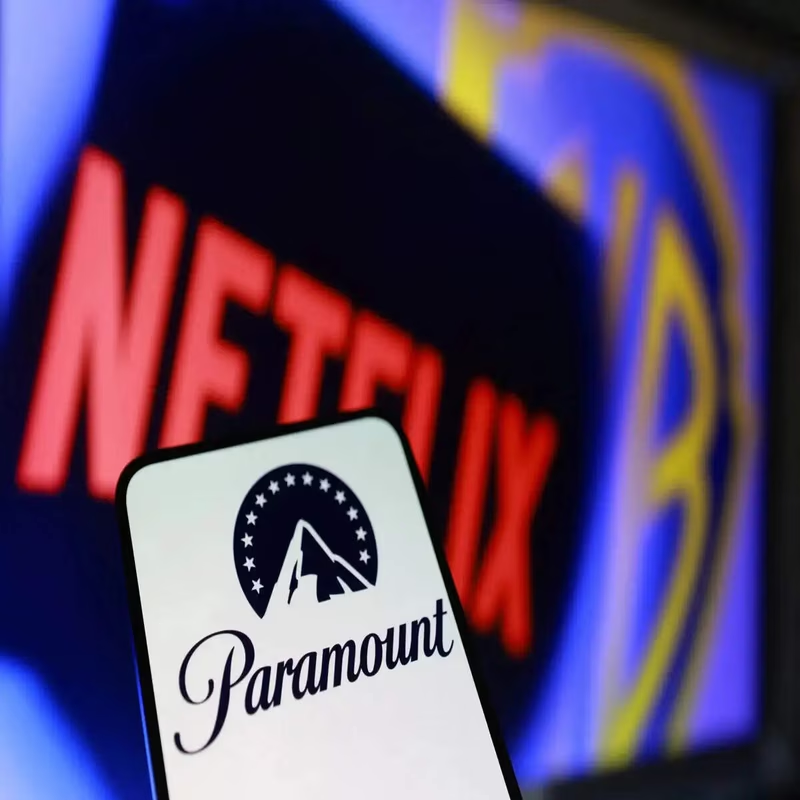
Hollywood’s high-stakes game of corporate chess just took a sharp turn. In a strongly worded letter to shareholders, Warner Bros Discovery (WBD) has delivered a definitive “no” to Paramount Global’s latest $108 billion acquisition proposal—marking the eighth time it has rebuffed overtures from CEO David Ellison and his Skydance-backed consortium .
But the real bombshell? WBD didn’t just say no—it doubled down on an entirely different vision: a “superior merger” with Netflix. The phrase “We’re not leaving Netflix” has now become the rallying cry of WBD’s leadership, signaling a tectonic shift in the streaming landscape.
This isn’t just about rejecting one deal—it’s about choosing a future. And WBD is betting big that its destiny lies not with legacy TV networks, but with the world’s most dominant subscription platform.
Table of Contents
- The Paramount Bid: Why It Failed
- Warner Bros Discovery Netflix: The Strategic Vision
- Financial Risks of the Paramount Deal
- What a WBD–Netflix Merger Could Look Like
- Industry Reaction and Market Impact
- Conclusion: The End of Old Hollywood Consolidation?
- Sources
The Paramount Bid: Why It Failed
Paramount’s offer—valued at $108 billion and backed by private equity firms including RedBird Capital and Qatar Investment Authority—was ambitious. But WBD’s board called it “insufficient in both value and execution certainty” .
Key concerns included:
- Massive debt burden: The deal relied heavily on leveraged financing, which WBD fears could cripple the combined entity.
- Regulatory hurdles: Merging two major media empires would face intense antitrust scrutiny in the U.S. and EU.
- Lack of synergy clarity: Unlike WBD’s existing content pipeline, Paramount’s CBS and Showtime assets don’t align cleanly with global streaming growth.
“For the eighth time, we’ve told Mr. Ellison: this path creates more risk than reward,” the letter bluntly stated.
Warner Bros Discovery Netflix: The Strategic Vision
While WBD hasn’t formally announced a merger with Netflix, its shareholder letter leaves little doubt about its preferred direction. The company emphasized that a partnership—or full integration—with Netflix offers “greater strategic alignment, global scale, and financial discipline.”
Consider the synergies:
- Content + Distribution: WBD owns HBO, DC, Warner Bros films, and Discovery’s non-fiction library. Netflix has 270 million subscribers and AI-driven personalization.
- Cost Efficiency: Combining marketing, tech infrastructure, and licensing could save billions annually.
- Global Reach: Netflix’s dominance in Europe, Latin America, and Asia complements WBD’s strong U.S. and English-language footprint.
[INTERNAL_LINK:streaming-wars-2026-outlook] This isn’t fantasy—it’s the logical next step in an industry where scale determines survival.
Financial Risks of the Paramount Deal
WBD’s letter highlighted a sobering reality: if the Paramount deal collapsed mid-process—as many leveraged buyouts do—the company would be liable for a $1.5 billion breakup fee and suffer severe reputational damage with creditors .
Moreover, Paramount’s own balance sheet is fragile. With declining linear TV revenue and rising streaming losses, raising $70+ billion in debt (as reportedly planned) would push its leverage ratio to unsustainable levels—a red flag for rating agencies like Moody’s and S&P.
“We won’t gamble our shareholders’ future on a house of cards,” the board wrote.
What a WBD–Netflix Merger Could Look Like
While regulatory approval would still be required, a WBD–Netflix union faces fewer antitrust issues than a Paramount merger—because Netflix doesn’t own broadcast networks or local news divisions.
Potential structure:
- Asset swap or joint venture initially, with WBD licensing its entire library to Netflix exclusively.
- Equity stake: Netflix acquires a controlling interest in WBD’s entertainment division (excluding Discovery’s factual arm).
- Full merger within 2–3 years, creating a $200B+ content and distribution powerhouse.
Such a move would instantly dethrone Disney+ and Amazon Prime Video in subscriber count and content depth.
Industry Reaction and Market Impact
Markets responded swiftly: WBD stock rose 6% on the news, while Paramount shares fell 4%. Analysts at Bloomberg called the rejection “a rational defense of long-term value over short-term spectacle.”
Meanwhile, Netflix remained silent—but insiders report “advanced discussions” have been ongoing since late 2025. If true, this could be the biggest media merger since AOL–Time Warner… only this time, with better tech and clearer strategy.
Conclusion: The End of Old Hollywood Consolidation?
Warner Bros Discovery’s firm stance against Paramount—and its clear pivot toward Warner Bros Discovery Netflix collaboration—marks a turning point. The era of merging legacy TV giants to stave off disruption is over. The future belongs to agile, global, tech-native platforms that can monetize content at scale.
As one studio insider put it: “Hollywood isn’t being saved by its past. It’s being reinvented by its future.” And that future wears a red N logo.