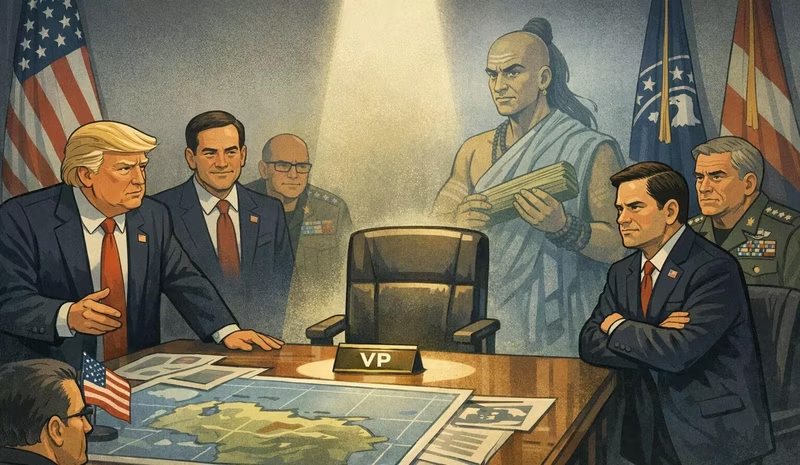
In the cinematic climax of Donald Trump’s latest foreign policy gambit—a bold, almost Hollywood-style operation targeting Nicolás Maduro in Caracas—one face was glaringly missing from the victory photos: that of Vice President JD Vance.
While Trump’s inner circle toasted what they called a “perfect” raid in an impromptu White House war room, Vance’s chair sat empty. And when the administration held a triumphant press conference to declare America’s newest intervention a success, it wasn’t the VP who took the podium—but Senator Marco Rubio, beaming as the de facto public face of the mission .
This absence has ignited fierce speculation across Washington: Is JD Vance being deliberately sidelined? Or is this a calculated move rooted in realpolitik—or even ancient strategy like Chanakyaneeti?
Table of Contents
- The Venezuela Operation: A Trump Spectacle
- JD Vance Venezuela Absence: What We Know
- Why Rubio—Not Vance?
- Chanakyaneeti or Cold Shoulder?
- Historical Precedent: VPs and Foreign Ops
- What This Means for Vance’s Future
- Conclusion: A Veep in the Wings?
- Sources
The Venezuela Operation: A Trump Spectacle
According to multiple sources cited by the Times of India, the operation—dubbed internally as “Operation Liberty Dawn”—involved covert coordination with Venezuelan opposition forces and U.S. special ops to apprehend Maduro during a rare public appearance in eastern Caracas .
Though details remain classified, the Trump camp framed it as a decisive blow against “tyranny” and a win for democracy. The messaging was swift, visual, and unmistakably Trumpian: action-movie flair meets reality-TV drama.
Yet amid the fanfare, the second-highest-ranking official in the U.S. government was nowhere to be seen—not in planning, not in execution, not in celebration.
JD Vance Venezuela Absence: What We Know
Multiple insiders confirmed to reporters that Vance was not present in the Situation Room during the critical decision-making phase. His national security team was reportedly briefed only after the fact.
More tellingly, when the White House rolled out its media blitz, Vance issued no statement, held no interviews, and did not appear on any affiliated news channels. In contrast, Marco Rubio—long a hawk on Venezuela and a Florida senator with deep ties to the Cuban-American exile community—gave three televised interviews within 24 hours, calling the operation “the beginning of Venezuela’s liberation.”
[INTERNAL_LINK:trump-2028-foreign-policy-team] This stark contrast raises eyebrows: why elevate a senator over your own Vice President on a matter of national security?
Why Rubio—Not Vance?
The answer may lie in politics, not protocol:
- Electoral Strategy: Florida is a must-win swing state. Rubio delivers Cuban, Venezuelan, and Colombian-American votes—key demographics in Miami-Dade County.
- Policy Credibility: Rubio has spent over a decade crafting his image as America’s leading Latin America hawk. Vance, a former tech investor turned populist, lacks foreign policy gravitas in this theater.
- Loyalty Dynamics: Rubio has been unwavering in his support for Trump since 2016. Vance, though loyal now, was once a vocal critic—calling Trump “America’s Hitler” in 2016 . Old wounds may still sting.
Chanakyaneeti or Cold Shoulder?
Some analysts frame Vance’s exclusion not as punishment, but as strategic statecraft—echoing the ancient Indian treatise Chanakya Niti, which advises rulers to keep potential rivals away from glory to prevent them from building independent power bases.
“If Vance becomes the face of a successful foreign intervention, he gains stature beyond ‘Trump’s deputy,’” explains Dr. Priya Menon, a political theorist at Georgetown University. “By giving the spotlight to Rubio—a loyalist with no presidential ambitions—Trump neutralizes internal competition.”
It’s Machiavelli meets Kautilya: control the narrative, control the heir.
Historical Precedent: VPs and Foreign Ops
Vice Presidents have often been kept at arm’s length from sensitive military actions. Dick Cheney was deeply involved in Iraq, but Al Gore was largely excluded from Kosovo decisions. Mike Pence had limited input on Syria strikes.
However, total exclusion from both planning and public rollout is unusual—especially for a VP who has increasingly taken on diplomatic roles, including recent trips to NATO and the Indo-Pacific.
According to the Council on Foreign Relations, modern VPs typically serve as “force multipliers” in foreign policy. Vance’s invisibility breaks that mold.
What This Means for Vance’s Future
If this pattern continues, Vance’s 2028 prospects could suffer. Without foreign policy wins, he remains pigeonholed as a domestic populist—a liability in a globalized election.
Conversely, if Trump sees him as a threat, sidelining may intensify. The VP role has always been precarious; under Trump, it’s become a tightrope walk between loyalty and irrelevance.
Conclusion: A Veep in the Wings?
The JD Vance Venezuela mystery isn’t just about one operation—it’s a window into Trump’s leadership style: theatrical, personalized, and ruthlessly hierarchical. By handing the Venezuela spotlight to Rubio, Trump sent a clear message: loyalty and electoral utility trump (pun intended) constitutional rank.
For Vance, the lesson is stark: in Trump’s America, even the Vice President must earn the right to stand in the light.