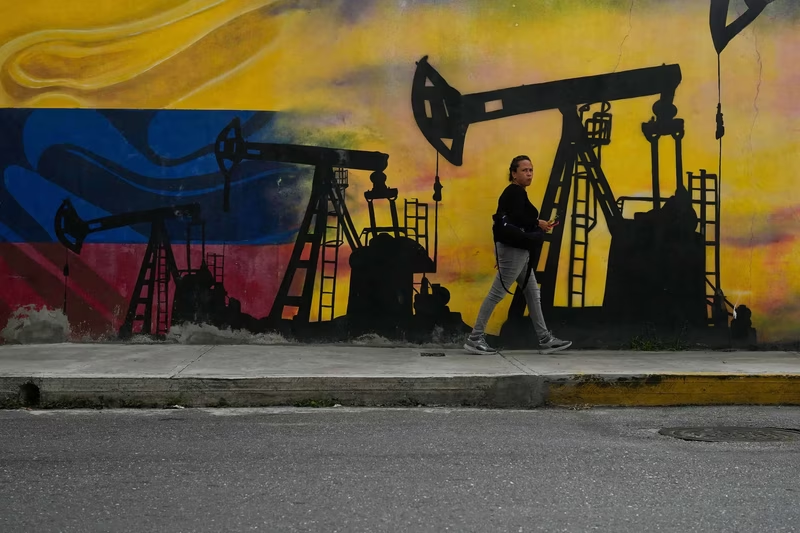
Americans are finally catching a break at the pump. After years of watching petrol prices soar due to pandemic-era inflation and global supply shocks, a welcome dip has arrived. Now, a bold new idea is floating through Washington: could importing oil from Venezuela—the very nation under heavy US sanctions—be the key to locking in this relief and making fuel even cheaper? On the surface, it sounds like a simple solution. But the reality of the Venezuelan crude US petrol prices connection is far more complex than a headline suggests.
Table of Contents
- The Current State of US Petrol Prices
- Venezuelan Crude & US Petrol Prices: The Proposed Link
- Why Venezuela Now? Timing is Everything
- The Sanctions Labyrinth: A Major Hurdle
- Global Oil Markets: Not a Simple Pipe
- Conclusion: Will You See Cheaper Fuel?
- Sources
The Current State of US Petrol Prices
As of early January 2026, the national average for regular petrol in the US has fallen to around $3.10 per gallon, a significant drop from the peak of over $5.00 seen in mid-2022 . This relief is the result of several converging factors: a well-supplied global oil market, strategic releases from the US Strategic Petroleum Reserve (SPR), and a slight softening in global demand forecasts. Consumers are understandably eager to see these lower prices become permanent.
Venezuelan Crude & US Petrol Prices: The Proposed Link
The core argument for lifting sanctions on Venezuelan oil is straightforward: Venezuela has the world’s largest proven oil reserves. Its heavy crude is a perfect complement to the refining infrastructure along the US Gulf Coast, which was historically built to process just this type of oil. By allowing US companies to import this crude again, the theory goes, domestic supply would increase, putting further downward pressure on the price of petrol at the pump .
Proponents frame it as a pragmatic move to secure a stable, nearby source of oil, reducing reliance on more volatile regions and potentially insulating American drivers from future price spikes.
Why Venezuela Now? Timing is Everything
The push to re-engage with Venezuela isn’t happening in a vacuum. It’s a direct response to the current market conditions. With oil prices already under pressure globally, adding a new source of supply like Venezuela’s could tip the scales further. The “pitch,” as noted in the original report, is being sold as a way to “lock that relief in” .
However, this timing also reveals a critical flaw in the logic. If prices are already falling due to ample supply, how much additional impact can one country’s oil really have? The marginal effect might be smaller than advertised.
The Sanctions Labyrinth: A Major Hurdle
It’s crucial to remember that US sanctions on Venezuela are not just about oil; they are a comprehensive tool aimed at pressuring the authoritarian regime of Nicolás Maduro over human rights abuses and the erosion of democracy. Any move to lift them would be highly controversial and politically fraught.
Even if a limited license were granted for oil imports, it would likely come with strict conditions and oversight. The process would be slow, bureaucratic, and subject to intense political scrutiny. This means the flow of Venezuelan crude wouldn’t be a sudden flood, but a carefully controlled trickle, limiting its immediate impact on the market .
Global Oil Markets: Not a Simple Pipe
This is perhaps the most important point for consumers to understand: the oil market is a single, interconnected global system. The price of petrol in your local town isn’t determined by where your specific refinery gets its crude. It’s set by the global benchmark price (like Brent or WTI).
Here’s what that means in practice:
- If the US starts buying Venezuelan oil, that crude simply replaces another barrel from somewhere else (like Canada or Saudi Arabia) in the global mix.
- The overall global supply increases only slightly, which may have a modest, long-term dampening effect on prices.
- Local petrol prices are also heavily influenced by state taxes, refining margins, and distribution costs—factors completely unrelated to the origin of the crude oil .
For a deeper understanding of how global energy markets function, resources from the International Energy Agency (IEA) provide authoritative insights into supply-demand dynamics.
Conclusion: Will You See Cheaper Fuel?
So, will the Venezuelan crude US petrol prices narrative deliver on its promise? The honest answer is: probably not in any dramatic or immediate way. While the return of Venezuelan oil to the market could contribute to a more stable, well-supplied global environment over the long term, it is unlikely to be the magic bullet that slashes prices at your local gas station overnight.
The current price relief is primarily due to broader market forces, not a policy shift that hasn’t even fully happened yet. American consumers should enjoy the current dip, but they shouldn’t bank on Venezuelan oil as the reason their next fill-up will be significantly cheaper. The real story here is less about cheap petrol and more about the complex interplay of geopolitics, global economics, and energy security. For more on how global events affect your wallet, check out our [INTERNAL_LINK:global-energy-market-impact] analysis.
Sources
- Times of India: Explained: Will Venezuelan crude lead to cheap petrol for American consumers? [[2], [3]]
- AAA Gas Prices: Current US national and state average fuel prices
- US Department of Treasury: Information on Venezuela-related sanctions
- International Energy Agency (IEA): Analysis of global oil market fundamentals