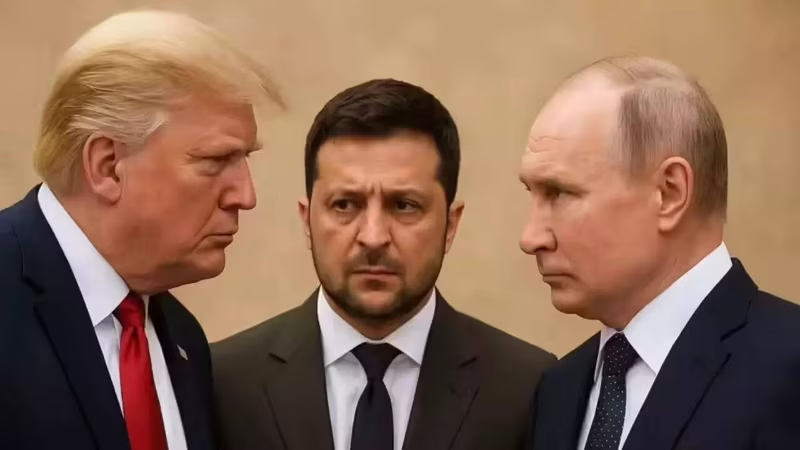
Tensions in the ongoing Russia-Ukraine war have spiked to a dangerous new level. Moscow has issued a stark and unambiguous warning to the European Union and its NATO allies: any foreign peacekeeping forces deployed in Ukraine after a potential ceasefire will be considered “legitimate military targets.” This aggressive stance comes in direct response to emerging Western plans to guarantee Ukraine’s long-term security—a move Russia brands not as peacebuilding, but as warmongering.
Table of Contents
- The “Axis of War” Rhetoric
- Russia-Ukraine Peacekeeping Force Plans Explained
- Moscow’s Military Threat: A Legal or Strategic Bluff?
- US-Russian Tanker Seizure Escalates Economic War
- What This Means for Ukraine’s Future Security
- Conclusion: A Dangerous New Phase
- Sources
The “Axis of War” Rhetoric
In a fiery statement that echoes Cold War-era propaganda, Russian officials have rebranded the coalition supporting Ukraine—not as defenders of sovereignty, but as an “axis of war.” This deliberate framing is designed to shift global perception, painting the West as the aggressor seeking to prolong the conflict through institutionalized military presence on Russian borders .
The term is a clear counter to the historical “Axis powers” of WWII, attempting to cast the US, EU, and Ukraine in a similarly villainous light. It’s a narrative tool aimed at both domestic audiences and non-aligned nations, suggesting that Western involvement is destabilizing rather than protective.
Russia-Ukraine Peacekeeping Force Plans Explained
The immediate trigger for Moscow’s outburst is a series of high-level discussions among European leaders about establishing a robust, multinational peacekeeping or security assistance force for Ukraine once active hostilities subside. While details remain fluid, the core idea is to deter future Russian aggression by embedding a visible international military presence within Ukrainian territory .
This plan is part of broader security guarantees being negotiated between Kyiv and its allies, which could include rapid-response protocols, intelligence sharing, and joint military exercises. From the Kremlin’s perspective, this isn’t peacekeeping—it’s the permanent militarization of a neighboring state by its adversaries, a direct threat to its national security.
Moscow’s Military Threat: A Legal or Strategic Bluff?
Russia’s declaration that foreign peacekeepers would be “legitimate targets” is a serious violation of international humanitarian law. Under the Geneva Conventions, peacekeepers operating under a UN mandate are protected persons. However, if such a force were deployed without a UN Security Council resolution (which Russia would veto), its legal status becomes murky.
Strategically, the threat serves multiple purposes:
- Deterrence: To scare European nations away from committing troops.
- Escalation Control: To signal that any deeper Western involvement risks direct confrontation.
- Narrative Warfare: To reinforce the idea that the West is an active belligerent, not a neutral party.
Experts at the International Crisis Group warn that such rhetoric significantly raises the risk of miscalculation and unintended escalation .
US-Russian Tanker Seizure Escalates Economic War
Adding fuel to the fire, the United States has seized a Russian-flagged oil tanker, the Pegasus, in a move Moscow claims is a blatant act of piracy. The US Justice Department alleges the vessel was involved in a sanctions-busting scheme to ship Russian oil above the G7 price cap .
Russia’s Foreign Ministry responded furiously, stating the seizure “will not go unanswered” and accusing Washington of “openly escalating tensions.” This incident underscores how the conflict has expanded far beyond the battlefield into a full-spectrum economic and legal war, with global shipping lanes becoming a new front.
What This Means for Ukraine’s Future Security
Kyiv now faces a complex dilemma. On one hand, formal security guarantees from the West are essential for its survival and reconstruction. On the other, any arrangement that involves foreign boots on the ground could provoke the very Russian aggression it’s meant to prevent. Ukrainian officials are likely to push for a model that maximizes deterrence while minimizing provocation—perhaps focusing on training missions, air defense support, and rapid-reaction pledges rather than a static, large-scale peacekeeping deployment.
The situation also highlights the limitations of European defense capabilities. Without a unified command structure or sufficient troop commitments, the EU’s peacekeeping vision may remain more aspirational than operational—at least in the short term.
Conclusion: A Dangerous New Phase
The Kremlin’s reaction to the proposed Russia Ukraine peacekeeping force marks a perilous evolution in the conflict. By explicitly threatening to attack foreign troops, Moscow has drawn a red line that could trap the West in a lose-lose scenario: back down and abandon Ukraine, or proceed and risk a direct military clash. Combined with the seizure of the Russian tanker, we are witnessing a dangerous convergence of military, economic, and rhetorical escalation. The path to a stable peace just got a lot narrower, and the world must watch closely to see if cooler heads can prevail before it’s too late. For more on geopolitical risk analysis, see our [INTERNAL_LINK:global-conflict-watch] section.
Sources
- Times of India: ‘Axis of war’: Russia warns EU over peacekeeping force in Ukraine [[1], [2]]
- International Crisis Group: Analysis on Ukraine conflict dynamics and escalation risks
- US Department of Justice: Press release on seizure of Russian tanker Pegasus
- Various diplomatic statements from Russian Foreign Ministry and EU officials [[3], [4]]