ED Accuses Mamata Banerjee of Obstructing Probe: The Coal Scam Raids Spark Political Firestorm
In a dramatic escalation of tensions between India’s financial crime watchdog and one of its most powerful regional leaders, the Enforcement Directorate (ED) has leveled a stunning accusation against West Bengal Chief Minister Mamata Banerjee: that she personally obstructed a federal money-laundering investigation. The incident, tied to an alleged coal smuggling syndicate, unfolded during a series of high-profile raids on January 8, 2026—and has since ignited a fierce political battle. At the heart of this storm is the Mamata Banerjee ED raid controversy, which has now become a flashpoint in national discourse.
Table of Contents
- The ED’s Explosive Allegation: What Exactly Happened?
- Mamata Banerjee’s Fiery Rebuttal
- Behind the Raids: The Coal Smuggling & Money Laundering Case
- Why the I-PAC Office Became a Target
- The Wider Political Fallout and Public Reaction
- Conclusion: A Clash of Institutions and Power
- Sources
The ED’s Explosive Allegation: What Exactly Happened?
According to an official statement from the Enforcement Directorate, on the morning of January 8, 2026, its officers were conducting a lawful search at a private residence in Kolkata as part of an ongoing probe into an illegal coal mining and smuggling operation in the state. The investigation, which traces its roots to a 2023 FIR, is focused on suspected money laundering involving shell companies and political operatives linked to the ruling Trinamool Congress (TMC).
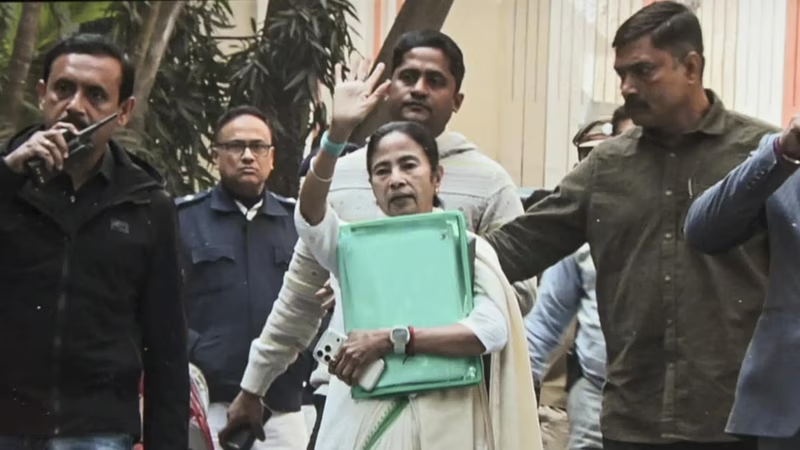
The situation took a volatile turn when, as per the ED, Chief Minister Mamata Banerjee arrived at the scene—accompanied by Kolkata Police personnel—and allegedly entered the premises without authorization. The agency claims she seized sensitive documents and electronic devices that were in the process of being collected as evidence. Later the same day, a similar scene reportedly unfolded at the state headquarters of the Indian Political Action Committee (I-PAC), a strategic consultancy closely associated with the TMC’s election campaigns.
The ED has formally accused Banerjee of obstructing a federal investigation, a serious charge that could carry legal consequences under the Prevention of Money Laundering Act (PMLA).
Mamata Banerjee’s Fiery Rebuttal
Chief Minister Banerjee has flatly denied all allegations. In a press conference held hours after the raids, she called the ED’s actions a politically motivated “witch hunt” orchestrated by the central government to destabilize her administration ahead of upcoming elections.
“Everything was peaceful until I arrived,” she stated, directly quoting the ED’s own phrase to turn it against them. She alleged that the real motive behind the searches was not to investigate coal smuggling—but to seize TMC’s election strategy documents housed at the I-PAC office.
“They are not after coal—they are after our voter data, our campaign blueprints, our democratic rights,” Banerjee declared, framing the raids as an assault on federalism and state autonomy.
Behind the Raids: The Coal Smuggling & Money Laundering Case
The current controversy stems from a long-running investigation into illegal mining and transportation of coal from West Bengal’s Raniganj and other coalfields. The ED alleges that a syndicate—operating with alleged political protection—smuggled coal using fake permits and laundered the proceeds through a web of shell companies.
Key figures already under scrutiny include mid-level TMC functionaries and a few private logistics firms. The agency claims financial trails lead to significant cash transactions and property purchases that cannot be legally justified.
This case is part of a broader pattern of ED investigations into regional parties, raising questions about the autonomy of investigative agencies in a politically charged environment.
Why the I-PAC Office Became a Target
The raid on the I-PAC (Indian Political Action Committee) office has drawn particular attention because of the organization’s high-profile role in Indian elections. I-PAC has worked with multiple parties—including the TMC, BJP, and AAP—to design data-driven campaign strategies.
The ED claims it had intelligence suggesting that funds from the alleged coal syndicate were routed to I-PAC for “strategic political consulting,” possibly to influence local elections. However, critics argue that seizing materials from a political consultancy sets a dangerous precedent for free and fair electoral competition.
Mamata’s camp insists that any financial transactions with I-PAC were transparent and part of legitimate campaign expenditures.
The Wider Political Fallout and Public Reaction
The Mamata Banerjee ED raid has triggered a nationwide debate:
- Opposition parties (including Congress and AAP) have rallied behind Banerjee, calling the raids “institutional bullying.”
- BJP leaders have countered that no one is above the law, urging the CM to cooperate fully with the investigation.
- Legal experts are divided—some see a clear case of obstruction, while others warn against the weaponization of central agencies.
- Citizens in West Bengal are polarized, with many viewing the event through the lens of state vs. center politics.
Public protests have erupted in parts of Kolkata, while social media is flooded with hashtags from both #EDUnderBJP and #HandsOffMamata.
Conclusion: A Clash of Institutions and Power
The Mamata Banerjee ED raid is more than just a law enforcement operation—it’s a pivotal moment in India’s evolving democratic landscape. On one side stands a federal agency asserting its legal authority; on the other, a powerful chief minister defending her state’s sovereignty and political integrity. As the investigation unfolds, the case will test the boundaries of federalism, the independence of investigative bodies, and the resilience of democratic norms. One thing is certain: this confrontation is far from over.
Sources
- The Times of India: “‘Peaceful till CM came’: ED’s big charge against Mamata”
- Enforcement Directorate (Official Website)
- Mint – For expert legal and political analysis on PMLA cases.
- [INTERNAL_LINK:mamata-banerjee-political-career] – A comprehensive profile of the West Bengal CM.
- [INTERNAL_LINK:ed-investigations-in-india] – An overview of recent Enforcement Directorate actions across states.