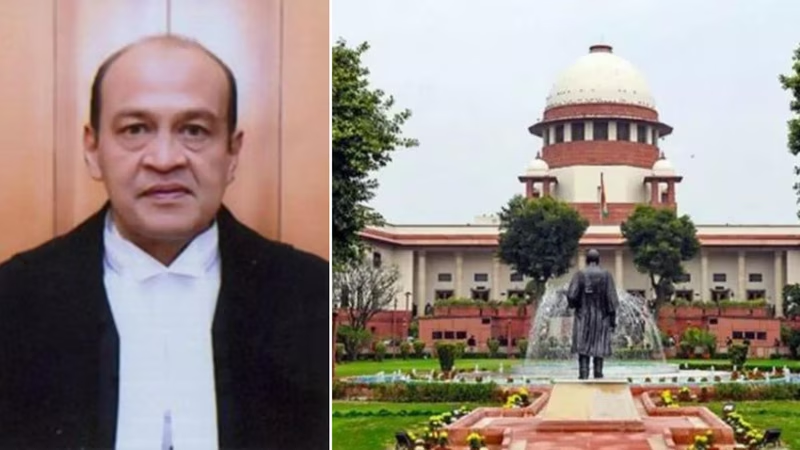
The hallowed halls of India’s highest court have become the final battleground for Justice Yashwant Varma, a sitting High Court judge whose career now hangs in the balance. The Supreme Court has just reserved its judgment on his urgent plea, marking a pivotal moment in a scandal that has gripped the nation: the discovery of a staggering amount of unaccounted cash at his official residence .
This isn’t just a legal tussle; it’s a profound test of judicial independence, accountability, and the very systems designed to protect them. At the heart of the storm is Justice Varma’s desperate fight to quash an in-house inquiry and an impending impeachment motion, all stemming from a fire and the subsequent, controversial cash recovery on March 14, 2025 [[8], [13]].
Table of Contents
- The Cash Seizure Incident: What Happened?
- Who is Justice Yashwant Varma? A Career in Review
- Justice Yashwant Varma’s Supreme Court Battle
- The Impeachment Threat: A Constitutional Nuclear Option
- Legal and Ethical Implications for the Judiciary
- Conclusion: A Waiting Game with High Stakes
- Sources
The Cash Seizure Incident: What Happened?
The controversy erupted in March 2025 following a fire at Justice Yashwant Varma’s official residence in Delhi [[8], [13]]. In the aftermath, a large sum of currency—reportedly around ₹3 crore—was allegedly discovered. The circumstances of this discovery and its legitimacy have been fiercely contested by Justice Varma himself, who has denied that the cash was “unaccounted” .
The discovery triggered an immediate and severe reaction. His judicial work was swiftly withdrawn by the Chief Justice of the Delhi High Court, a rare and serious step that signaled the gravity of the situation . The event quickly escalated from an administrative concern into a potential scandal of national importance, raising uncomfortable questions about the personal finances of a serving judge.
Who is Justice Yashwant Varma? A Career in Review
Before the scandal, Justice Yashwant Varma, aged 56, was a respected figure on the bench. A graduate of Hansraj College, Delhi University, and holding an LLB from Rewa University, he enrolled as an advocate in 1992 [[22], [24]]. His legal career spanned over two decades, primarily at the Allahabad High Court, where he handled complex constitutional and civil matters and even served as Special Counsel [[23], [25]].
He was elevated to the bench in 2015 and has served for nearly a decade as a High Court judge, first in Delhi and later being transferred to the Allahabad High Court . At the time of the incident, he was the third most senior judge at the Delhi High Court, a position that underscores his long-standing service to the judiciary . This established background makes the current allegations and their potential consequences all the more dramatic.
Justice Yashwant Varma’s Supreme Court Battle
Facing an in-house inquiry committee and a growing political storm, Justice Varma took his fight to the Supreme Court. His core legal argument challenges the very constitution and procedures of the inquiry committee, claiming they are flawed and prejudicial .
The legal journey in the SC has been intense. On December 16, 2025, the Court agreed to hear his plea and issued notices to the respondents . The hearing culminated on January 8, 2026, when a Vacation Bench, led by Chief Justice Surya Kant, reserved its judgment . Crucially, the Court also denied Justice Varma’s request for a time extension to file his reply to the inquiry committee, a setback that adds to the pressure .
His legal team has been working against a tight deadline, with the final submission date set for January 12, 2026 . The reserved order from the SC is now the community’s most anticipated legal development, as it will determine the fate of his challenge to the inquiry process. A loss here would clear the path for the proceedings against him to move forward swiftly. You can read more about judicial conduct inquiries in our explainer on [INTERNAL_LINK:judicial-accountability-india].
The Impeachment Threat: A Constitutional Nuclear Option
Compounding his legal woes is a direct threat from Parliament. On July 21, 2025, an impeachment motion against Justice Yashwant Varma was formally initiated . Impeachment is the ultimate constitutional tool for removing a judge, requiring a two-thirds majority in both houses of Parliament—a high bar that has never been successfully crossed in Indian history.
The existence of this motion, however, casts a long shadow. It is a powerful political signal that the controversy has transcended the judicial sphere and entered the realm of high-stakes governance. Justice Varma’s plea in the Supreme Court is, in part, a race against this political clock, an attempt to have the foundational inquiry invalidated before the impeachment process can gain unstoppable momentum.
Legal and Ethical Implications for the Judiciary
The Justice Yashwant Varma case is far more than a personal crisis; it’s a stress test for India’s entire judicial accountability framework. It forces a critical examination of two key mechanisms:
- The In-House Procedure: This is the primary, internal mechanism for dealing with allegations against judges. The current case has brought its opacity and potential for bias under intense scrutiny. Is it truly equipped to handle such serious financial misconduct allegations?
- The Role of the Supreme Court: The SC is now in the difficult position of overseeing the oversight of its own brethren. Its judgment will set a crucial precedent on how much judicial autonomy is balanced against the need for transparent and fair accountability.
The outcome will have a lasting impact on public trust in the judiciary. A fair and robust process, regardless of its conclusion, is essential to maintaining that trust. For an authoritative perspective on judicial ethics, the official website of the Supreme Court of India provides foundational documents on judicial conduct.
Conclusion: A Waiting Game with High Stakes
As the nation awaits the Supreme Court’s reserved order, Justice Yashwant Varma’s future remains suspended in a legal and political limbo. His plea is a desperate bid to reclaim his narrative and his career, to prove that the system designed to protect judicial independence isn’t being used to undermine his right to a fair hearing. The discovery of cash at a judge’s residence is a seismic event, but the true judgment will be on the strength and fairness of India’s institutions in the face of such a crisis. The coming weeks will be decisive, not just for one man, but for the very principles that underpin the judiciary.
Sources
- Times of India: SC reserves order on Justice Varma’s plea; denies time extension to reply [[8], [13]]
- Live Law: Supreme Court Reserves Judgment On Justice Yashwant Varma’s Plea Challenging In-House Probe [[10], [11], [12], [14], [15], [17], [18]]
- India Today: Who is Justice Yashwant Varma? [[3], [20], [22], [24], [25]]
- Supreme Court of India