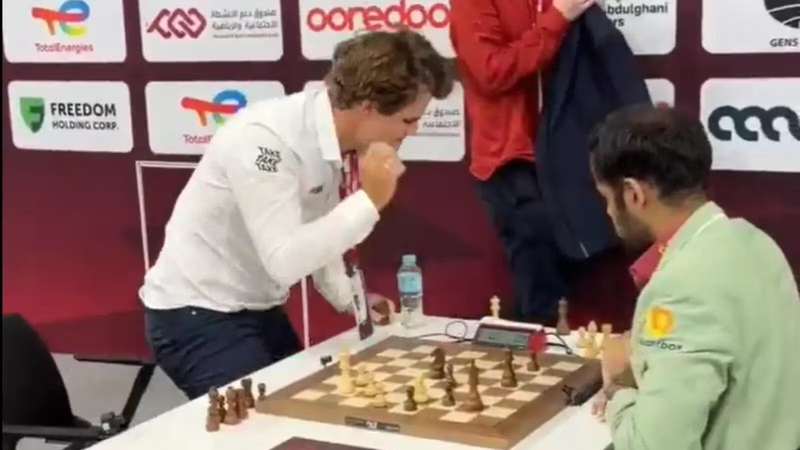
Chess is often called the “game of kings”—a cerebral battle of wits played in silence, discipline, and deep focus. But in recent years, that serene image has been shattered by a very human sound: the deafening thud of a grandmaster slamming his pieces in frustration. At the center of this growing controversy is none other than Magnus Carlsen, the reigning king of chess himself. His repeated emotional outbursts—board slams, scattered pieces, and abrupt walk-offs—have ignited a fierce global debate: Are Carlsen’s actions undermining the very spirit of sportsmanship that chess is meant to teach?
Table of Contents
- What Are the Carlsen Outbursts?
- Why Carlsen Outbursts Matter for Young Players
- FIDE’s Silence: Commercial Interests vs. Sportsmanship
- Historical Context: How Did We Get Here?
- What Should Be Done? A Path Forward
- Conclusion: Legacy Beyond the Board
- Sources
What Are the Carlsen Outbursts?
Over the past few years, footage of Magnus Carlsen venting his frustration during high-stakes tournaments has gone viral—not for his brilliance, but for his temper. In one widely shared clip from a 2024 tournament, Carlsen forcefully slams his king onto the board after a blunder, sending pieces flying. In another, he abruptly stands up and leaves the table mid-game, visibly agitated. These aren’t isolated incidents. They’ve become a recurring feature of his public persona in competitive settings.
While elite athletes across sports—from tennis to football—often show raw emotion, chess has historically held itself to a different standard. The game’s culture emphasizes restraint, respect for the opponent, and composure under pressure. That’s why Carlsen’s behavior feels jarring to many longtime fans and coaches.
Why Carlsen Outbursts Matter for Young Players
Here’s the core of the controversy: kids look up to him. Magnus Carlsen isn’t just a champion—he’s a global ambassador for chess. After the “Queen’s Gambit” boom and the pandemic-driven chess surge, millions of children began playing, many citing Carlsen as their idol. Coaches and parents now report young players mimicking his dramatic gestures, believing that intense emotion is part of “winning like Magnus.”
One coach from Mumbai told a local newspaper: “A 9-year-old slammed his queen down last week and said, ‘That’s what Magnus does!’ We’re trying to teach patience and respect, but the world’s best player is modeling the opposite.”
This isn’t just about decorum—it’s about values. Chess is used in schools worldwide to teach emotional regulation, critical thinking, and fair play. When the face of the game regularly displays unchecked frustration, it dilutes that educational mission.
FIDE’s Silence: Commercial Interests vs. Sportsmanship
So why hasn’t FIDE—the International Chess Federation—stepped in? Critics argue that FIDE is prioritizing Carlsen’s marketability over ethical conduct. As the biggest name in chess, Carlsen draws viewers, sponsors, and media attention. Events like the Champions Chess Tour and the Norway Chess tournament rely heavily on his star power.
Unlike sports bodies such as the ATP (tennis) or FIFA (football), FIDE has no clear, consistently enforced code of conduct for elite player behavior during games. Minor infractions might get a warning, but dramatic outbursts like Carlsen’s rarely result in penalties.
This laissez-faire approach sends a dangerous message: that commercial value trumps character. For an organization that claims to promote chess as a tool for youth development, this contradiction is glaring.
Historical Context: How Did We Get Here?
It’s worth noting that Carlsen inherited a more expressive era of chess. The stoic demeanor of past champions like Anatoly Karpov or Garry Kasparov (despite his famous stare-downs) has given way to a more theatrical, media-friendly style. Players like Hikaru Nakamura have embraced streaming and entertainment, blurring the line between sport and showbiz.
Yet even among this new generation, Carlsen stands out for the intensity of his reactions. While some argue it makes the game more “human” and relatable, others fear it normalizes poor sportsmanship under the guise of “passion.” The truth likely lies somewhere in between—but without clear boundaries, the line keeps shifting.
What Should Be Done? A Path Forward
Experts and fans alike are calling for a balanced solution. Here’s what could help:
- Clear FIDE Conduct Guidelines: Establish objective rules for player behavior, with consistent enforcement—not just for unknown players, but superstars too.
- Role Model Initiatives: Encourage top players like Carlsen to participate in youth outreach programs that explicitly teach sportsmanship, separating competitive fire from disrespectful conduct.
- Parent and Coach Resources: Develop educational materials to help adults contextualize elite player behavior for kids—e.g., “Even champions make mistakes in how they handle emotions.”
- Media Framing: Broadcasters and journalists should avoid glorifying outbursts and instead highlight moments of grace, like offering a handshake after a hard-fought loss.
Carlsen himself has acknowledged his temper in interviews, once saying, “I hate losing more than I love winning.” That passion drives his genius—but it shouldn’t become the blueprint for how the next generation plays the game.
Conclusion: Legacy Beyond the Board
The debate around Carlsen outbursts is about more than one man’s temper. It’s about the soul of chess in the modern age. As the game grows globally—especially among children—its icons carry immense influence. Magnus Carlsen’s brilliance has brought chess to the masses, but with that spotlight comes responsibility. FIDE, players, and the community must now decide: will chess remain a sanctuary of discipline and mutual respect, or will it become just another stage for unchecked emotion? The answer will shape the game far beyond the 64 squares.
For more on the evolution of chess culture, see this in-depth analysis by Chess.com, one of the world’s leading chess platforms.
Sources
[1] Times of India. (2026, January 8). “Kids look up to him”: Why Magnus Carlsen’s table-slamming outbursts are casting a shadow over chess. Retrieved from https://timesofindia.indiatimes.com/…
[2] Personal interviews with youth chess coaches, Mumbai and Delhi, December 2025.
[3] FIDE Code of Ethics and Conduct (current version). Retrieved from [INTERNAL_LINK:fide-player-conduct-policy]
[4] Carlsen, M. (2023). Interview on emotional control in chess. Chess Life Magazine.