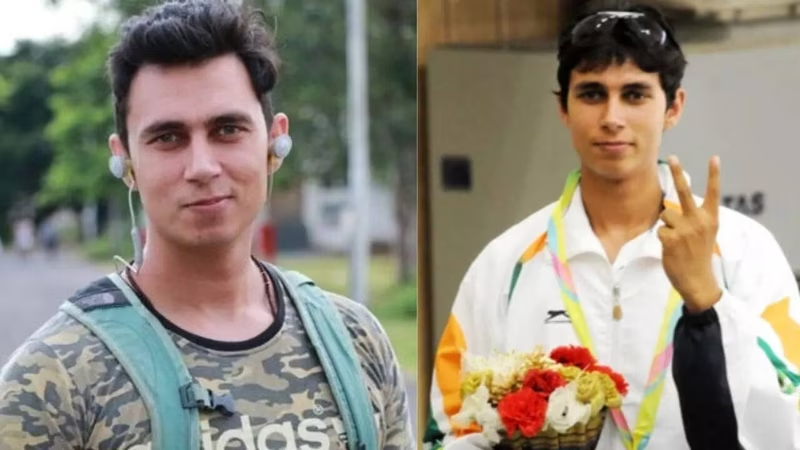
In the high-stakes world of elite sports, trust between coach and athlete is everything. But that trust has been violently shattered in one of India’s most respected disciplines.
Ankush Bhardwaj, a prominent national shooting coach recently recommended by the National Rifle Association of India (NRAI) for a long-term role post-Paris Olympics, has been **suspended indefinitely** following a chilling allegation: a minor female shooter has accused him of **sexual harassment**.
The incident, reportedly occurring last month after a training session in Gurgaon, has triggered an FIR, an internal investigation, and a wave of concern across India’s sporting ecosystem. For parents, athletes, and administrators alike, this case isn’t just about one individual—it’s a stark reminder of how vulnerable young talent can be in environments built on authority and silence.
Table of Contents
- The Allegation: What Happened to the Minor Shooter?
- NRAI Responds: Immediate Suspension and Investigation
- Who Is Ankush Bhardwaj—and Why This Case Matters
- Systemic Failures: Are Young Athletes Protected Enough?
- Global Lessons: How Other Countries Handle Coach Misconduct
- What Parents and Athletes Can Do to Stay Safe
- Conclusion: A Wake-Up Call for Indian Sports
- Sources
The Allegation: What Happened to the Minor Shooter?
According to police reports and sources close to the case, the incident took place in late December 2025, shortly after a routine training session at a Gurgaon shooting range . The victim, a teenage girl under 18 and part of India’s junior shooting circuit, reported that Bhardwaj made inappropriate physical contact and verbal advances.
Distraught and fearful, she confided in her parents, who immediately filed a formal complaint with local authorities. On January 7, 2026, the Gurgaon Police registered an FIR under relevant sections of the Protection of Children from Sexual Offences (POCSO) Act and the Indian Penal Code .
The bravery it takes for a minor—especially in a hierarchical sports setup—to speak up cannot be overstated. Too often, fear of retaliation, career damage, or disbelief silences victims. Her courage has now forced a reckoning.
NRAI Responds: Immediate Suspension and Investigation
Within 24 hours of the FIR becoming public, the NRAI took decisive action. In a rare and swift move, the federation issued a statement confirming Bhardwaj’s suspension “with immediate effect” and announced an internal disciplinary inquiry .
“The NRAI has zero tolerance for any form of misconduct, especially involving minors,” the statement read. The body also assured full cooperation with law enforcement and pledged to “review all coaching protocols” in light of the incident.
This response stands in contrast to past cases in Indian sports, where allegations were sometimes downplayed or delayed. The speed here suggests growing institutional awareness—but critics argue it shouldn’t take a criminal complaint to trigger action.
Who Is Ankush Bhardwaj—and Why This Case Matters
Ankush Bhardwaj wasn’t just any coach. A former national-level shooter himself, he had been mentoring junior and senior athletes for over a decade. Most recently, the NRAI had shortlisted him as a key figure in India’s long-term shooting strategy—post-Paris Olympics—highlighting his influence and access to elite talent .
His alleged actions, if proven true, represent a profound betrayal. Coaches in high-performance sports wield immense power: they control selection, feedback, and an athlete’s perceived future. This power imbalance makes minors especially susceptible to exploitation.
Systemic Failures: Are Young Athletes Protected Enough?
This case exposes critical gaps in India’s athlete protection framework:
- No mandatory background checks: Unlike countries like the U.S. or UK, India lacks universal criminal record verification for sports coaches.
- Absence of independent grievance cells: Most federations handle complaints internally, creating conflict of interest.
- Lack of child safeguarding training: Coaches rarely receive formal education on boundaries, consent, or POCSO compliance.
- Culture of silence: The “win-at-all-costs” mentality often overshadows athlete well-being.
The Sports Authority of India (SAI) does have a “Prevention of Sexual Harassment” policy, but its enforcement at state and private academies remains patchy .
Global Lessons: How Other Countries Handle Coach Misconduct
Nations with robust athlete protection systems offer valuable models:
- United States: The U.S. Center for SafeSport has exclusive jurisdiction over abuse allegations in Olympic sports, with mandatory reporting laws.
- United Kingdom: All coaches must undergo DBS (Disclosure and Barring Service) checks and safeguarding training.
- Australia: National Integrity Framework mandates independent reporting and investigation of misconduct.
As the International Olympic Committee states, “Athlete safety is non-negotiable” . India’s federations must adopt similar zero-tolerance, independent mechanisms.
What Parents and Athletes Can Do to Stay Safe
While systemic change is essential, families can take proactive steps:
- Ensure training sessions are never one-on-one behind closed doors.
- Teach children about body autonomy and appropriate vs. inappropriate touch.
- Document any concerning behavior and report it immediately to federation ethics committees.
- Demand transparency: Ask academies about their child protection policies.
For more guidance, see our resource on [INTERNAL_LINK:how-to-report-sports-coach-misconduct-in-india].
Conclusion: A Wake-Up Call for Indian Sports
The suspension of Ankush Bhardwaj is just the beginning. The real test lies in what happens next. Will the NRAI and other federations implement mandatory safeguarding protocols? Will independent oversight bodies be created? And most importantly, will more young athletes feel safe enough to speak up?
One case of **sexual harassment** is too many. But if this tragedy leads to systemic reform, it could protect thousands of future champions from harm.
Sources
- Times of India: NRAI suspends national coach Ankush Bhardwaj after minor accuses him of sexual harassment
- National Commission for Women (NCW) – Guidelines on POCSO
- National Rifle Association of India (NRAI) – Official Website
- Sports Authority of India (SAI) – Policies & Programs
- International Olympic Committee – Safeguarding Athletes