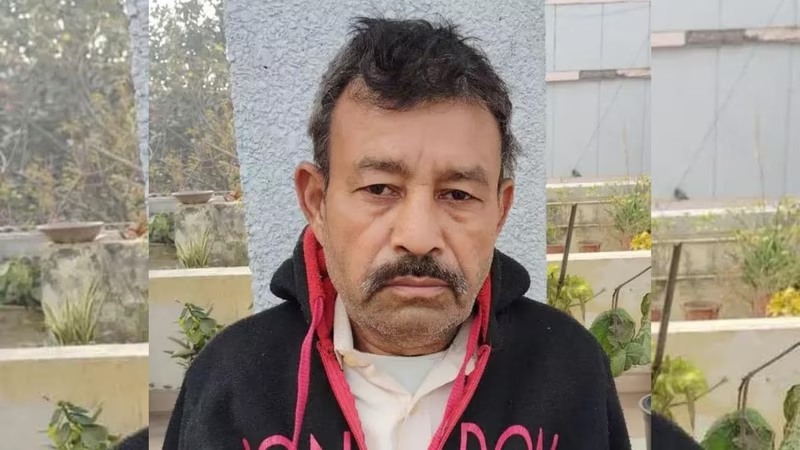
He fixed furniture, spoke in a soft Punjabi dialect, and kept to himself. To his neighbors in a quiet Ludhiana neighborhood, he was just another hardworking carpenter—unassuming, polite, and utterly ordinary.
But his real name wasn’t Rajesh Kumar. And his past was anything but ordinary.
Behind that calm exterior was a man convicted of one of the most heinous crimes imaginable: the 1992 murder of his own wife. After being sentenced, he was granted parole in 2000—and vanished. For **26 years**, he evaded law enforcement, reinventing himself under a false identity while the victim’s family waited for closure.
Now, in a dramatic turn of events, **Delhi Police** have apprehended the fugitive, ending a decades-long manhunt that underscores both the persistence of justice and the lengths criminals will go to disappear.
Table of Contents
- The Crime and Conviction: The 1992 Wife Murder
- The Great Escape: How He Jumped Parole in 2000
- Life in Hiding: A Carpenter’s False Identity in Ludhiana
- How Police Tracked Down the Wife Killer
- Why Fugitives Like Him Can Hide for Decades
- Broader Implications for Parole and Criminal Tracking
- Conclusion: Justice Delayed, But Not Denied
- Sources
The Crime and Conviction: The 1992 Wife Murder
In 1992, a young woman in Delhi was found dead under suspicious circumstances. An investigation revealed signs of foul play, and her husband—then in his early 30s—quickly became the prime suspect. Evidence, including witness testimony and forensic reports, pointed to a domestic dispute that turned fatal.
Court records from the time show he was convicted of murder and sentenced to life imprisonment. The case, while not widely publicized nationally, left a deep scar on the local community and the victim’s family, who never stopped seeking justice .
The Great Escape: How He Jumped Parole in 2000
Eight years into his sentence, the convict was granted temporary parole—a common practice in India for good behavior or family emergencies. But instead of returning to prison as required, he disappeared without a trace in 2000 .
For over two decades, he remained off the grid. No bank accounts under his real name. No phone registered to him. No social media. He had effectively erased his former identity.
Life in Hiding: A Carpenter’s False Identity in Ludhiana
According to Delhi Police, the fugitive relocated to Ludhiana in Punjab around 2012. There, he adopted the alias “Rajesh Kumar” and took up carpentry—a trade that required little documentation and allowed him to work in cash.
Neighbors described him as reserved but friendly. He spoke fluent Punjabi, attended local gatherings occasionally, and never drew attention to himself. “He was just another worker,” one neighbor told investigators. “No one suspected a thing” .
This ability to blend in is a hallmark of long-term fugitives. As the National Crime Records Bureau (NCRB) notes, many offenders who vanish after parole use informal labor sectors—like construction, domestic help, or small workshops—to stay invisible .
How Police Tracked Down the Wife Killer
The breakthrough came from an unexpected source: a tip-off.
Earlier this month, Delhi Police’s Special Cell received intelligence suggesting a man matching the fugitive’s description was living in Ludhiana. Using vintage prison photographs and biometric cross-references, they launched a surveillance operation.
After days of monitoring, officers confronted him at his workshop. When asked his real name, he reportedly fell silent—then confessed. “He knew it was over,” a senior officer shared anonymously. “He’d been waiting for this moment for 26 years” .
He has since been formally arrested and will be produced before a Delhi court to serve the remainder of his life sentence.
Why Fugitives Like Him Can Hide for Decades
This case raises critical questions about India’s parole and fugitive tracking systems. How can a convicted murderer vanish for a quarter-century?
Experts point to several systemic gaps:
- Limited inter-state coordination: Parole monitoring is often handled at the district level, with poor data sharing between states.
- Informal economy loopholes: Millions work in cash-based, unregistered jobs—ideal for those avoiding digital footprints.
- Aging biometric databases: Many older convicts lack updated photos or fingerprints in central systems.
- Social invisibility: Single, low-profile individuals in rented accommodations rarely trigger suspicion.
For more on criminal justice reform in India, see our analysis on [INTERNAL_LINK:challenges-in-indian-parole-system].
Broader Implications for Parole and Criminal Tracking
The arrest of this wife killer isn’t just a win for one case—it’s a wake-up call. The Ministry of Home Affairs has been pushing for the National Automated Facial Recognition System (NAFRS) to help identify fugitives in public spaces, but rollout has been slow .
Meanwhile, states like Maharashtra and Karnataka have piloted digital parole tracking apps that require daily check-ins via GPS-enabled smartphones. Could such tools have prevented this 26-year evasion? Possibly.
As Dr. Anjali Gupta, a criminologist at Delhi University, explains: “Long-term fugitives survive not because they’re masterminds, but because the system isn’t designed to catch the ordinary-looking ones” .
Conclusion: Justice Delayed, But Not Denied
The capture of this wife killer after 26 years is a testament to both the patience of law enforcement and the enduring pursuit of justice. While his victim can never be brought back, her family now has the closure that eluded them for decades.
More importantly, this case should ignite urgent reforms in how India monitors parolees and tracks fugitives. Because in a nation of 1.4 billion, even the quietest carpenter might be hiding the darkest secret.