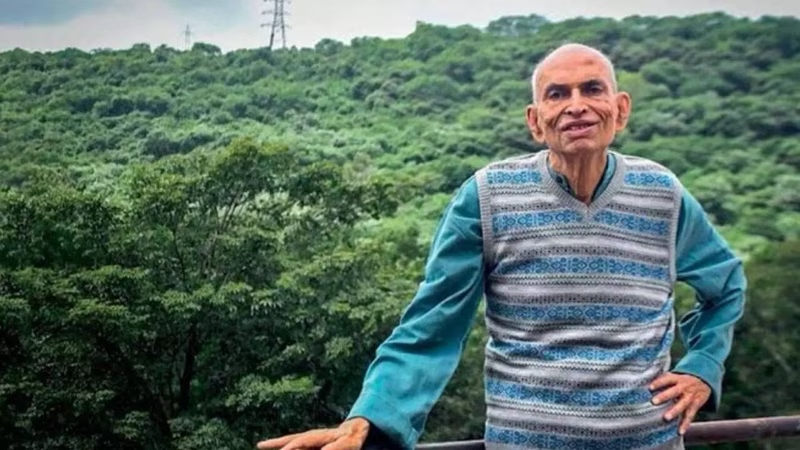
India has lost one of its most visionary environmental voices. Renowned ecologist **Madhav Gadgil**, the man whose name became synonymous with the conservation of the Western Ghats, passed away in Pune on January 7, 2026, at the age of 83. His death marks the end of an era in Indian ecology—one defined by scientific rigor, fearless advocacy, and an unwavering commitment to protecting the planet’s biodiversity hotspots. Just months before his passing, Gadgil was honored by the United Nations with the prestigious **Champions of the Earth** award in 2024, the highest environmental distinction bestowed by the global body, recognizing his lifelong dedication to safeguarding the Western Ghats .
Table of Contents
- Who Was Madhav Gadgil?
- The Landmark Gadgil Report and Its Controversy
- Scientific Legacy and Community-Based Conservation
- Global Recognition: UN Champions of the Earth
- Impact on Indian Environmental Policy
- Tributes from Scientists, Activists, and Leaders
- Conclusion: A Legacy That Lives in Every Green Hill
- Sources
Who Was Madhav Gadgil?
Born in 1942, Madhav Gadgil was not just an academic—he was a bridge between complex ecological science and grassroots environmental action. A Harvard-trained evolutionary biologist and former professor at the Indian Institute of Science (IISc), Bangalore, Gadgil co-developed the **Gadgil-Mahalanobis model** for sustainable resource use, a framework that emphasized local knowledge and democratic participation in conservation. But he is best known for chairing the **Western Ghats Ecology Expert Panel (WGEEP)** in 2010, appointed by the Ministry of Environment, Forest and Climate Change .
His lifelong mission was to protect the Western Ghats—a UNESCO World Heritage Site and one of the world’s eight “hottest hotspots” of biodiversity—home to over 30% of India’s plant, mammal, bird, and amphibian species.
The Landmark Gadgil Report and Its Controversy
In 2011, Gadgil submitted a groundbreaking 180-page report recommending that 64% of the Western Ghats be declared **Ecologically Sensitive Areas (ESAs)** with strict regulatory controls on mining, dams, and industrial projects. The report advocated for decentralized governance, empowering local communities and gram sabhas to manage their natural resources.
However, the **Gadgil Report** faced fierce opposition from state governments (especially in Goa, Karnataka, and Kerala) and industry lobbies, who argued it would stifle development. It was eventually sidelined in favor of the more industry-friendly **Kasturirangan Report**, which reduced the ESA zone to just 37% .
Despite this setback, Gadgil never wavered. He continued to speak out, calling the dilution of his recommendations a “betrayal of future generations.” Over the past decade, devastating floods, landslides, and biodiversity loss in the region have lent grim validation to his warnings.
Scientific Legacy and Community-Based Conservation
Madhav Gadgil’s approach was revolutionary because it rejected top-down environmentalism. He believed that conservation must be rooted in **people’s knowledge**. His work with the **People’s Biodiversity Registers (PBRs)** empowered villages across India to document local flora, fauna, and traditional ecological practices—a model now adopted in over 250,000 gram panchayats.
Key pillars of his philosophy included:
- Decentralization: Environmental decisions should be made locally.
- Precautionary principle: When in doubt, err on the side of ecological protection.
- Interdisciplinarity: Ecology must integrate history, sociology, and ethics.
Global Recognition: UN Champions of the Earth
In October 2024, the United Nations Environment Programme (UNEP) awarded Gadgil the **Champions of the Earth** award in the “Lifetime Achievement” category—placing him among global icons like Sir David Attenborough. The citation praised him for “championing science-based, community-led conservation in one of the planet’s most critical ecosystems” .
This recognition was not just personal—it was a global endorsement of the Indian model of participatory ecology that Gadgil pioneered.
Impact on Indian Environmental Policy
Though his report was initially rejected, the **Madhav Gadgil** legacy has seeped into policy over time. Courts have cited his work in rulings against illegal mining in the Western Ghats. Environmental impact assessments now routinely consider biodiversity corridors he identified. And a new generation of activists—many of whom call themselves “Gadgil’s children”—are using his frameworks to challenge destructive projects.
His greatest impact may be cultural: he made ecological sensitivity a mainstream conversation in India.
Tributes from Scientists, Activists, and Leaders
News of Gadgil’s passing triggered an outpouring of tributes. Renowned biologist Dr. Raman Sukumar called him “the conscience of Indian ecology.” Environmentalist Sunita Narain said, “He gave us the language to speak for the hills.” Even political opponents acknowledged his integrity—Kerala’s Chief Minister described him as “a scientist who never compromised on truth.”
His family confirmed he will be cremated with state honors in Pune, his hometown and lifelong base of scientific work.
Conclusion: A Legacy That Lives in Every Green Hill
Madhav Gadgil may be gone, but his vision endures. Every time a community halts a dam, every time a court protects a forest fragment, every time a student chooses ecology over engineering—Gadgil’s spirit lives on. In an age of climate crisis, his life reminds us that science without conscience is empty, and development without sustainability is suicide. As he often said: “The Earth does not belong to us. We belong to the Earth.”
Sources
- UNEP Champions of the Earth 2024 Announcement: United Nations Environment Programme
- Original Gadgil Report (WGEEP): Ministry of Environment, Forest and Climate Change, India
- Comparative Analysis: Gadgil vs. Kasturirangan Reports: Down To Earth Magazine
- [INTERNAL_LINK:western-ghats-biodiversity-hotspot-explained]
- [INTERNAL_LINK:people-biodiversity-registers-india-pbr]