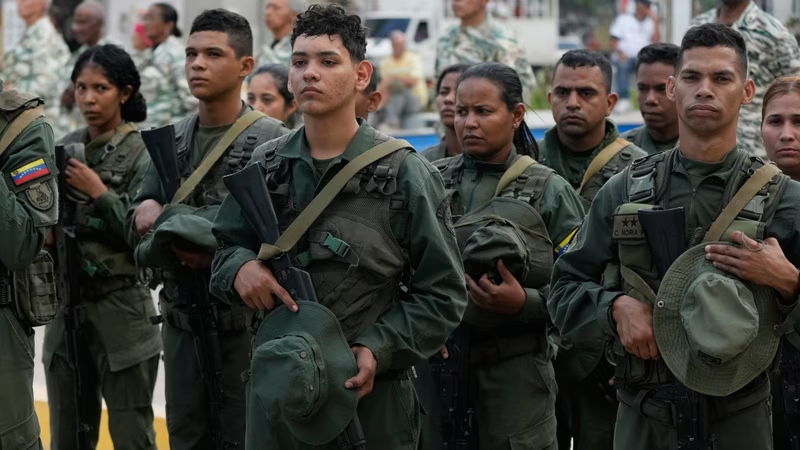
In a dramatic and highly contested turn of events, Venezuela’s Interior Minister claims that a covert US operation in Venezuela has resulted in the wounding of President Nicolás Maduro and the deaths of 100 people “in cold blood.” The announcement, made amid nationwide mourning, comes just as the United States seized two oil tankers—including one Russian-flagged vessel—linked to Caracas, signaling a fierce new phase in Washington’s campaign to cripple Venezuela’s oil-dependent economy. While the U.S. government has not confirmed any military action, the Venezuelan government’s explosive allegations have ignited a geopolitical firestorm with far-reaching implications for Latin America, U.S.-Russia relations, and the future of one of the world’s most sanctioned regimes .
Table of Contents
- Venezuela’s Allegations: What They Claim Happened
- The US Response and Oil Tanker Seizures
- Maduro’s Condition and Political Fallout
- Russia-Venezuela Oil Alliance Under Fire
- Historical Context: US Intervention in Latin America
- Global Reactions and Diplomatic Ramifications
- Conclusion: A Dangerous Escalation or Propaganda Play?
- Sources
Venezuela’s Allegations: What They Claim Happened
According to Venezuela’s Interior Minister, a joint operation involving U.S. special forces and opposition-linked mercenaries targeted a presidential convoy near Caracas on January 6, 2026. The attack, they allege, left President Maduro with non-life-threatening injuries and resulted in the deaths of 100 Venezuelan soldiers and civilians. The government has declared a week of national mourning and labeled the incident a “state-sponsored assassination attempt” .
Crucially, **no independent media or international observers have verified these claims**. The U.S. State Department has issued a blanket denial of any military involvement, calling the allegations “baseless disinformation designed to distract from Maduro’s own failures.” However, the timing—coinciding with aggressive U.S. energy enforcement actions—has fueled speculation and fear across the region.
The US Response and Oil Tanker Seizures
While denying any kinetic operation, the U.S. has dramatically escalated its economic pressure. On the same day as Venezuela’s announcement, U.S. authorities, acting under the 2023 Venezuela Oil Sanctions Enforcement Act, seized two tankers: the *Caribe Star* (Venezuelan-linked) and the Russian-flagged *Arctic Sea*. Both were allegedly transporting crude in violation of U.S. sanctions that prohibit the purchase of Venezuelan oil outside a tightly controlled licensing framework .
This move is part of what experts call “Max Pressure 2.0”—a strategy that combines financial sanctions, maritime interdiction, and diplomatic isolation to force political change in Caracas. The seizure of a **Russian-flagged vessel** directly ties this action to the broader U.S. campaign against Moscow’s global energy partnerships, echoing recent moves in Europe.
Maduro’s Condition and Political Fallout
Venezuelan state television broadcast brief footage of Maduro addressing a closed-door meeting of loyalist generals, appearing visibly bruised but coherent. “They tried to silence us with bullets,” he said, “but Venezuela will not bow.” His survival, if confirmed, likely strengthens his grip in the short term, allowing him to rally nationalist sentiment against a “foreign aggressor.”
However, the opposition, led by figures like María Corina Machado, has condemned both Maduro’s regime and the alleged U.S. strike, warning that external intervention only deepens the country’s crisis. The incident has paralyzed an already fragile political dialogue aimed at organizing free elections in 2027.
Russia-Venezuela Oil Alliance Under Fire
The seizure of the Russian-flagged tanker underscores the deepening energy partnership between Moscow and Caracas. Since 2022, Russia has provided Venezuela with critical diluents, refining technology, and shipping logistics to bypass U.S. sanctions. In return, Venezuela offers discounted crude and a strategic foothold in the Western Hemisphere.
Key elements of this alliance include:
- Rosneft’s shadow operations: Russian oil giant maintains a network of intermediaries to handle Venezuelan crude.
- Military-technical cooperation: Beyond oil, Russia supplies radar systems and spare parts for Venezuela’s aging air force.
- Diplomatic cover: Both nations consistently vote against each other’s sanctions in international forums.
Washington’s latest move is a direct challenge to this axis, aiming to sever one of its last remaining lifelines.
Historical Context: US Intervention in Latin America
The allegations of a US operation in Venezuela immediately evoke a painful history of U.S. covert actions across Latin America—from the 1954 coup in Guatemala to the 1973 overthrow of Chile’s Salvador Allende. While U.S. policy has officially shifted toward democracy promotion, the legacy of intervention fuels deep suspicion in the region. Maduro’s regime has long used this history to delegitimize its domestic opponents as “U.S. puppets,” and this latest claim, true or not, fits neatly into that narrative .
Global Reactions and Diplomatic Ramifications
The international response has been sharply divided. Russia and China immediately condemned the alleged strike as “imperialist aggression.” The European Union called for an independent investigation but stopped short of endorsing Venezuela’s version of events. Meanwhile, regional powers like Brazil and Colombia have urged restraint, fearing a spillover of instability.
For the U.S., the situation is a diplomatic minefield. Denying involvement while simultaneously seizing assets creates a perception of contradiction that adversaries are eager to exploit.
Conclusion: A Dangerous Escalation or Propaganda Play?
Whether the deadly incident in Caracas was a real US operation in Venezuela or a carefully staged propaganda effort by the Maduro regime remains unverified. What is undeniable is the accelerating tempo of confrontation. With oil tankers being seized, sanctions tightening, and rhetoric heating up, the risk of miscalculation is higher than it has been in years. For the 28 million Venezuelans caught in the middle, the stakes couldn’t be higher—caught between an authoritarian regime and a superpower whose actions, real or alleged, could determine their nation’s fate.
Sources
- Venezuelan Government Statement: Ministry of Popular Power for Foreign Relations, Venezuela
- U.S. Treasury Sanctions Announcement: U.S. Department of the Treasury
- Historical Analysis of U.S. Policy in Latin America: Council on Foreign Relations (CFR)
- Original Reporting: Times of India
- [INTERNAL_LINK:impact-of-us-sanctions-on-venezuela-economy]
- [INTERNAL_LINK:russia-global-oil-strategy-post-ukraine-war]