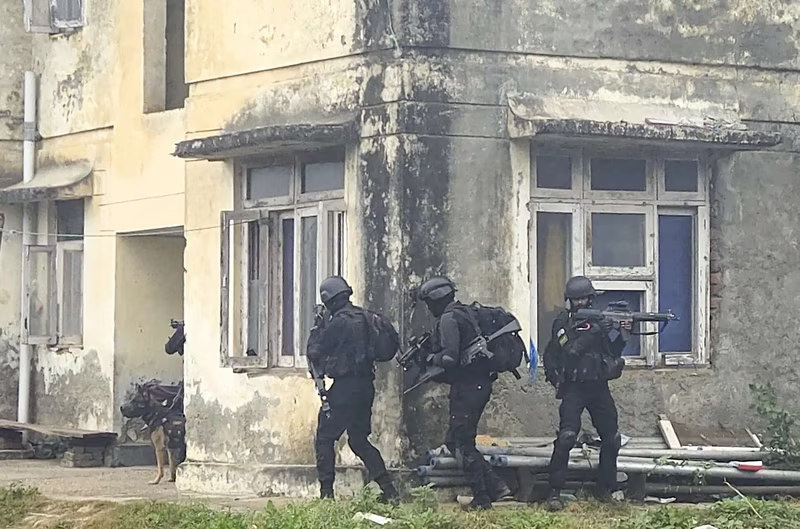
The tranquil hills of Kathua were shattered on Wednesday by the sharp crackle of gunfire as Indian security forces clashed with suspected terrorists in the thickly forested terrain of Billawar. What began as a routine intelligence tip about suspicious movement quickly escalated into a high-stakes, close-quarters encounter—part of a broader surge in counter-terror operations across Jammu and Kashmir. The intense Kathua gunfight has once again brought the region’s fragile security landscape into sharp focus, underscoring the persistent threat posed by infiltrating militants even in areas long considered relatively stable .
Table of Contents
- What Happened in Billawar?
- Who Are the Suspected Terrorists?
- Why Kathua Is a New Frontline in J&K’s Security Battle
- Security Response and Tactical Challenges
- Broader Counter-Terror Operations in J&K
- Impact on Local Civilians
- Conclusion: A Persistent Threat in Shifting Terrain
- Sources
What Happened in Billawar?
Acting on credible intelligence about the presence of 2–3 heavily armed ultras in the remote Billawar forest belt, a joint team of the Jammu and Kashmir Police and central security forces launched a cordon-and-search operation early Wednesday morning. As troops closed in, the suspects opened fire, triggering an intense gunfight that lasted for several hours amidst dense foliage and rugged terrain .
The area was swiftly cordoned off, and aerial surveillance drones were deployed to track movement. While official updates confirm the encounter is ongoing, sources indicate no casualties among security personnel so far. The operation highlights the constant state of vigilance required to prevent terror cells from regrouping in difficult-to-access zones.
Who Are the Suspected Terrorists?
Though identities remain unconfirmed, initial assessments suggest the group may be linked to Pakistan-based outfits like Lashkar-e-Taiba (LeT) or Jaish-e-Mohammad (JeM)—both of which have intensified infiltration attempts in the Jammu region over the past year. Unlike the Kashmir Valley, where militancy has deep local roots, the Jammu division—particularly districts like Kathua, Rajouri, and Poonch—has seen a rise in externally sponsored attacks aimed at destabilizing the region and reviving fear among minority communities .
Security agencies believe these operatives are often dropped across the Line of Control (LoC) and guided through forest corridors to avoid detection—a tactic that has made the Shivalik foothills a new corridor for infiltration.
Why Kathua Is a New Frontline in J&K’s Security Battle
Historically, Kathua—a district bordering Punjab and Himachal Pradesh—was considered a low-risk zone. But its strategic location near the international border and its dense, unguarded forest tracts have made it increasingly attractive to terror networks looking to avoid the heavily monitored Kashmir Valley.
Key reasons for this shift include:
- Reduced military footprint: Fewer checkpoints compared to the Valley allow easier movement.
- Soft targets: Vulnerable religious and civilian sites can be used to incite communal tension.
- Logistical routes: Forest paths connect to Punjab and Himachal, enabling further dispersal.
This evolution demands a recalibration of India’s counter-insurgency doctrine—one that treats Jammu with the same operational seriousness as Kashmir.
Security Response and Tactical Challenges
Engaging terrorists in dense forests like Billawar presents unique challenges. Limited visibility, uneven ground, and the risk of ambushes force security forces to rely on specialized units trained in jungle warfare—such as the Rashtriya Rifles and the Central Reserve Police Force’s (CRPF) CoBRA commandos.
The ongoing Kathua gunfight showcases the high-risk nature of such operations. Soldiers must advance slowly, often under fire, while coordinating with drone teams and snipers. One wrong step can mean casualties—not just from bullets, but from booby traps or improvised explosive devices (IEDs) often laid by retreating militants.
Broader Counter-Terror Operations in J&K
This encounter is not isolated. In the first week of January 2026 alone, security forces have conducted over a dozen search operations across Rajouri, Poonch, and now Kathua. The Indian Army’s “Operation All Out” has been intensified, with a clear directive: deny terrorists any safe haven, no matter how remote.
According to India’s Ministry of Home Affairs, infiltration attempts in 2025 rose by 27% compared to the previous year, with the Jammu region accounting for nearly 40% of all new incursions . This data confirms a deliberate strategic pivot by terror groups—and a matching response from Indian forces.
Impact on Local Civilians
While security operations are necessary, they inevitably disrupt civilian life. Schools and markets in nearby villages were temporarily shut, and locals reported anxiety over renewed violence in an area that had seen relative calm for years. However, many residents have also expressed support for the forces, recognizing that short-term inconvenience is preferable to long-term instability.
Community cooperation remains vital—local informants often provide the first tip-offs that lead to encounters like the one in Billawar.
Conclusion: A Persistent Threat in Shifting Terrain
The Kathua gunfight is a stark reminder that terrorism in Jammu and Kashmir has not been eradicated—it has merely adapted. As militants shift tactics and terrain, India’s security apparatus must stay one step ahead. The bravery of the troops in Billawar’s forests exemplifies this relentless commitment. But lasting peace will require not just bullets and boots on the ground, but intelligence, community trust, and strategic foresight to close every corridor terrorists might exploit.
Sources
- Official Statement from J&K Police: Jammu and Kashmir Police
- Encounter Details & Timeline: Times of India
- Analysis of Militant Infiltration Trends: South Asia Terrorism Portal (SATP)
- Infiltration Statistics: Ministry of Home Affairs, Government of India
- [INTERNAL_LINK:history-of-terror-in-jammu-region]
- [INTERNAL_LINK:indian-armys-counter-insurgency-strategies]