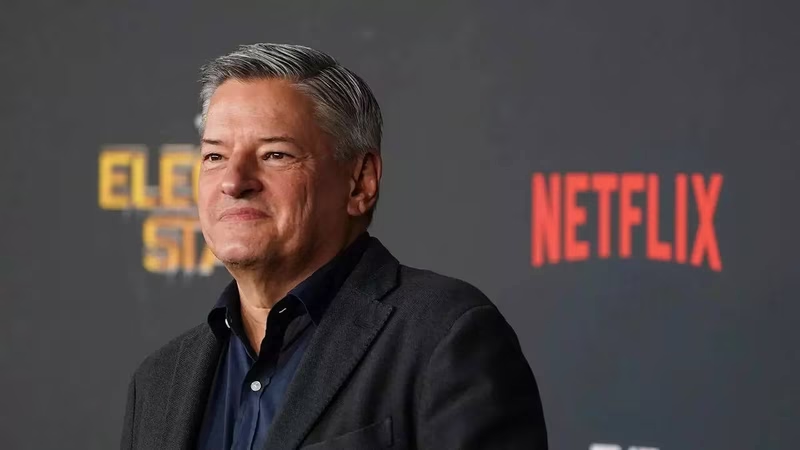
Imagine spending $100 million of your company’s money—without asking your boss. Now imagine that boss is Reed Hastings, the disciplined, data-driven founder of Netflix. And the year is 2011, when Netflix was still largely known as a DVD-by-mail service trying to pivot into streaming.
That’s exactly what Ted Sarandos, then Chief Content Officer and now co-CEO of Netflix, did. He greenlit two full seasons of House of Cards—a political thriller starring Kevin Spacey and directed by David Fincher—for a jaw-dropping **$100 million**, all without Hastings’ prior approval .
This wasn’t just a bold move. It was a career-ending risk wrapped in a velvet gamble. Yet, it became the cornerstone of Netflix’s transformation from a content distributor into a global entertainment powerhouse. The story behind this decision reveals not just how streaming was born, but how trust, vision, and a little bit of rebellion can redefine an entire industry.
Table of Contents
- Netflix House of Cards $100 Million Gamble: The Unauthorized Deal
- Why Sarandos Took the Risk
- Hastings’ Reaction: Trust Over Titles
- How House of Cards Changed Streaming Forever
- The Legacy of the Gamble: Sarandos’s Leadership Philosophy
- What Happened to House of Cards?
- Conclusion: Dare to Bet Big
- Sources
Netflix House of Cards $100 Million Gamble: The Unauthorized Deal
In 2011, Netflix was at a crossroads. DVD rentals were declining, and its streaming library relied heavily on licensed content from studios—content it didn’t own and could lose at any moment. Sarandos knew the future lay in original programming, but convincing a cost-conscious board and a founder steeped in algorithmic efficiency wasn’t easy .
When the opportunity arose to partner with Media Rights Capital (MRC) on House of Cards—a remake of the acclaimed BBC series—Sarandos saw his moment. Rather than negotiate season-by-season, he made an unprecedented offer: **$100 million for two full seasons, upfront, with no pilot**. Even more audaciously, he didn’t run it by Reed Hastings first.
As Sarandos later recounted, he simply told Hastings after the deal was done: “I just spent $100 million.” Hastings’ legendary reply? “That’s a bet I would have made too.”
Why Sarandos Took the Risk
Sarandos wasn’t flying blind. His decision was rooted in deep industry insight and strategic foresight:
- Data-Backed Instinct: Netflix’s internal data showed that users who watched David Fincher’s films or political dramas were highly engaged—and often overlapped .
- Creative Prestige: Landing Fincher and Spacey, two Oscar-caliber talents, would instantly elevate Netflix’s brand from “convenient” to “essential.”
- Ownership Advantage: By funding the entire series, Netflix would own global streaming rights—a model that would later become its core strategy .
He bet that quality, not just quantity, would drive subscriptions in the long run.
Hastings’ Reaction: Trust Over Titles
Hastings’ calm acceptance wasn’t just gracious—it was strategic. It signaled a cultural shift within Netflix: empowerment over hierarchy. In his famous “Freedom & Responsibility” culture memo, Hastings had already laid the groundwork for employees to “act in Netflix’s best interest” without excessive oversight .
Sarandos’ gamble validated that philosophy. Rather than punishing him, Hastings embraced the decision as proof that Netflix’s culture was working. This mutual trust became the bedrock of their decades-long partnership—and the engine behind Netflix’s content arms race with Amazon, Disney, and Apple.
How House of Cards Changed Streaming Forever
When House of Cards premiered on February 1, 2013, it did more than win Emmys (it won three in its first season). It rewrote the rules:
- Drop-All-Episodes Model: Netflix released all 13 episodes at once, birthing the “binge-watch” era .
- Originals as Growth Levers: Subscriptions surged by over 2 million in Q1 2013 alone, directly attributed to the show .
- Studio Disruption: Traditional networks realized they were no longer the only gatekeepers of prestige TV.
Overnight, every tech and media giant realized: the future of entertainment wasn’t in distribution—it was in creation.
The Legacy of the Gamble: Sarandos’s Leadership Philosophy
Today, as co-CEO, Sarandos credits the Netflix House of Cards $100 million gamble with shaping his leadership ethos. In interviews, he emphasizes “trusting creative talent” and “making bold bets on vision, not just data” .
That philosophy has driven Netflix’s investments in global hits like Squid Game, Stranger Things, and The Crown—all expensive, high-risk projects that paid off spectacularly. Sarandos believes that in creative industries, “the biggest risk is playing it safe.”
For more on how data and creativity intersect in entertainment, explore our deep dive on [INTERNAL_LINK:netflix-data-driven-content-strategy]. You can also read the original “Netflix Culture Deck” that inspired this fearless approach.
What Happened to House of Cards?
The show ran for six seasons, though its final chapter was cut short by the 2017 sexual misconduct allegations against Kevin Spacey. Netflix quickly pivoted, releasing a shortened sixth season focused on Robin Wright’s character. Despite the controversy, the series remains a landmark—not for its ending, but for its beginning.
Conclusion: Dare to Bet Big
The story of the Netflix House of Cards $100 million gamble is more than corporate lore. It’s a masterclass in leadership, timing, and conviction. Sarandos didn’t just buy a TV show—he bought a future. And in doing so, he taught the entire entertainment world that sometimes, the safest path is the riskiest of all.
Sources
[1] Times of India. (2026, January 7). What Netflix founder Reed Hastings told co-CEO Ted Sarandos when he spent $100 million on House of Cards series without seeking his permission. https://timesofindia.indiatimes.com/…
[2] Historical context on Netflix’s 2011 business model transition.
[3] Netflix’s use of viewing data to inform House of Cards development.
[4] Analysis of Netflix’s global rights acquisition strategy.
[5] Reed Hastings’ “Netflix Culture: Freedom & Responsibility” document.
[6] Impact of binge-releasing on viewer behavior and industry standards.
[7] Netflix Q1 2013 subscriber growth reports linked to House of Cards.