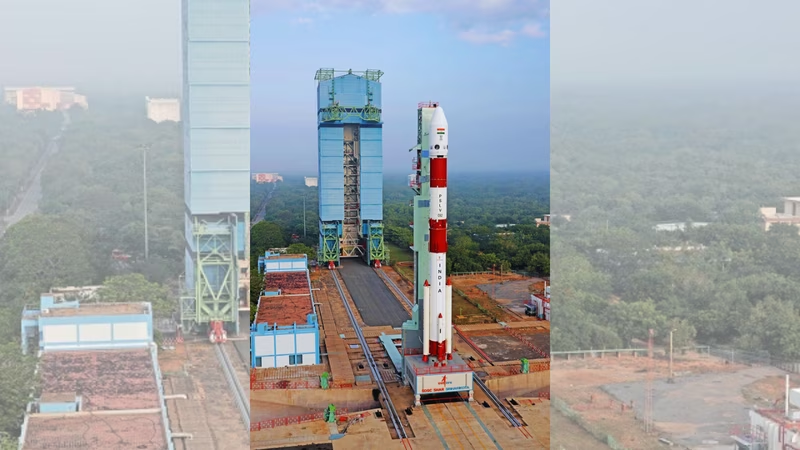
Get ready for a historic start to 2026 in space. On January 12th, India’s space agency, ISRO, will light up the skies over Sriharikota with the PSLV-C62 mission—a launch packed with strategic importance, cutting-edge technology, and international partnership. This isn’t just another satellite deployment; it’s a multi-faceted mission that signals India’s growing prowess in defense, commercial space tech, and its role as a regional space leader .
Table of Contents
- PSLV-C62 Mission Overview: The Primary Payload
- The Eyes in the Sky: DRDO’s Anvesha (EOS-N1)
- Revolutionizing Spaceflight: OrbitAID’s AyulSAT
- A Moment for Nepal: The Munal Satellite
- The Full Payload Manifest: A Global Effort
- Why This Mission Matters for India and Beyond
- Sources
PSLV-C62 Mission Overview: The Primary Payload
Scheduled for launch on January 12, 2026, at 10:17 AM IST from the First Launch Pad at SDSC SHAR, Sriharikota, the PSLV-C62 will be the first of many for ISRO this year . This mission, the 64th flight of the reliable Polar Satellite Launch Vehicle, has a primary objective that’s of critical national importance: deploying the advanced Earth observation satellite, EOS-N1, also known as Anvesha .
The Eyes in the Sky: DRDO’s Anvesha (EOS-N1)
The star of the show is undoubtedly the Anvesha satellite, a strategic asset built by India’s Defence Research and Development Organisation (DRDO) . This isn’t your average imaging satellite. Anvesha is a hyperspectral imaging platform, a technology that allows it to “see” in hundreds of different wavelengths of light, far beyond what the human eye or standard cameras can detect .
This incredible capability means Anvesha can identify the specific materials on the ground—from the type of camouflage used on a vehicle to the composition of soil or minerals. For military and strategic surveillance, this is a game-changer, offering unprecedented advantages in monitoring adversary movements and activities . Its ability to detect camouflaged targets makes it a high-priority asset for national security .
Revolutionizing Spaceflight: OrbitAID’s AyulSAT
Riding alongside the powerful Anvesha is a small but revolutionary payload from Chennai-based startup OrbitAID Aerospace: the AyulSAT. This satellite’s mission is to test a groundbreaking technology: on-orbit refuelling .
Imagine a world where satellites don’t just run out of fuel and become space junk after a few years. Instead, they could be refuelled in orbit, extending their operational life indefinitely. This is the future OrbitAID is building. Their AyulSAT carries the Standard Interface Docking and Refuelling Port (SIDRP), a sophisticated system that integrates a docking mechanism with a fill/drain valve for highly efficient propellant transfer .
By qualifying this technology on the PSLV-C62 mission, OrbitAID aims to provide flight heritage that will make in-space refuelling a commercial reality, paving the way for more sustainable and cost-effective space operations .
A Moment for Nepal: The Munal Satellite
The PSLV-C62 mission also carries a significant diplomatic and collaborative element: Nepal’s own Earth observation satellite, Munal. This deployment marks a proud moment for Nepal’s nascent space program, giving the nation its own sovereign capability to monitor its territory for agriculture, disaster management, and urban planning .
ISRO’s support for its neighbors through its commercial arm, NewSpace India Limited (NSIL), reinforces India’s position as a reliable and friendly space partner in South Asia, contrasting sharply with other global space powers.
The Full Payload Manifest: A Global Effort
Beyond these headline payloads, the PSLV-C62 is a true rideshare mission, demonstrating ISRO’s commercial launch prowess. In total, the rocket will deploy a constellation of 19 satellites, including 13 other co-passenger satellites from a mix of Indian and international customers . This multi-satellite deployment showcases the PSLV’s flexibility and reliability as a workhorse for the global small satellite market.
Why This Mission Matters for India and Beyond
The PSLV-C62 launch is a masterclass in strategic space planning. It simultaneously advances three critical fronts:
- National Security: The Anvesha satellite significantly boosts India’s intelligence, surveillance, and reconnaissance (ISR) capabilities.
- Commercial Innovation: By hosting OrbitAID’s AyulSAT, ISRO is actively fostering a domestic NewSpace ecosystem focused on cutting-edge, sustainable technologies.
- Regional Leadership: Launching Nepal’s Munal satellite strengthens diplomatic ties and establishes India as the go-to launch provider for its region.
This single mission encapsulates India’s ambition to be not just a space-faring nation, but a space power that leads in defense, drives innovation, and builds partnerships. It’s a powerful start to a pivotal year in space.
For more on India’s defense space ambitions, check out our deep dive on [INTERNAL_LINK:india-military-satellites]. To learn about the future of sustainable spaceflight, read our feature on [INTERNAL_LINK:in-orbit-servicing-technologies].
Sources
[1] ISRO. “PSLV-C62/EOS-N1 Mission.”
[5] News18. “ISRO set for first 2026 launch with PSLV C62 mission.”
[6] The Week. “Isro to kick off 2026 with PSLV-C62 EOS-N1 Anvesha launch on January 12.”
[11] RocketLaunch.Live. “EOS-N1 Mission (PSLV).”
[12] Times of India. “Year’s 1st space mission on January 12 to launch Military Satellite.”
[19] The Hindu. “ISRO Set to Launch PSLV-C62 with Strategic EOS-N1 Satellite.”
[20] The Economic Times. “India Prepared for Strategic Space Launches in Early 2026.”
[21] OrbitAID Aerospace. “OrbitAID to launch AyulSAT on-orbit refueling mission.”
[23] Times of India. “Year’s 1st space mission on January 12 to launch Military Satellite.”
[27] Business Standard. “OrbitAID to launch AyulSAT on-orbit refueling mission on PSLV-C62 flight.”