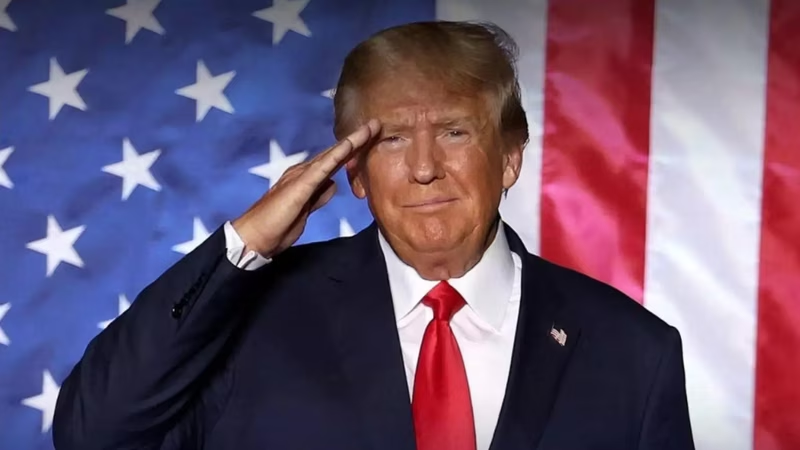
In a move that sent shockwaves through Wall Street and the Pentagon, Donald Trump has unveiled a radical new policy for America’s defense industry. Citing a need to ensure “maximum military readiness” and “fiscal responsibility,” the former president has blocked all major defense contractors from paying dividends or conducting stock buybacks. Even more dramatically, he has imposed a hard cap of **$5 million** on total executive compensation for executives at these firms .
The immediate market reaction was brutal. Shares of industry titans like Lockheed Martin, Raytheon (RTX), and Northrop Grumman tumbled, wiping out billions in shareholder value in a single day. This executive order, which blurs the line between national security policy and corporate governance, represents one of the most direct government interventions into private sector operations in recent history.
Table of Contents
- The Trump Decree: What the Order Actually Says
- Market Mayhem: Defense Stocks Tumble
- The Logic Behind the Trump Defense Dividends Ban
- The $5 Million Pay Cap: A Symbolic or Substantive Move?
- Legal Challenges and Industry Backlash
- Broader Implications for US Defense and Investors
- Conclusion: A High-Stakes Gamble with National Security
- Sources
The Trump Decree: What the Order Actually Says
The core of the executive action has two main pillars:
- Dividend and Buyback Ban: All companies holding major US defense contracts are prohibited from using their capital to pay cash dividends to shareholders or to repurchase their own stock. This capital, the order states, must be redirected towards “research, development, and manufacturing capabilities essential for national defense.”
- Executive Compensation Cap: The total annual compensation for any executive at these firms—including salary, bonuses, stock options, and other benefits—is now legally capped at $5 million. This is a significant reduction from the tens of millions often earned by CEOs in this sector .
The policy appears to be retroactive and applies immediately to all future payouts and compensation packages.
Market Mayhem: Defense Stocks Tumble
Investors reacted with panic to the news. The rationale is simple: dividends and buybacks are a primary reason many income-focused and institutional investors hold defense stocks. These companies are seen as stable, cash-generative “blue chips.” By removing this key return mechanism, the order fundamentally alters their investment thesis.
On the day of the announcement, the Trump defense dividends ban caused an immediate sell-off:
- Lockheed Martin (LMT) shares fell by over 7%.
- RTX (formerly Raytheon) dropped by nearly 6%.
- Northrop Grumman (NOC) saw its stock price decline by 5.5%.
This collective plunge erased tens of billions of dollars in market capitalization, demonstrating the immense power of a single policy decision to disrupt financial markets.
The Logic Behind the Trump Defense Dividends Ban
Trump’s stated justification for this dramatic move is rooted in his long-standing “America First” and military-strength platform. He argues that when the US government is pouring hundreds of billions of dollars into these companies through defense contracts, that money should be used solely to build weapons and strengthen the military—not to enrich executives or prop up stock prices .
His administration’s view is that these firms have become “financialized,” prioritizing shareholder returns over genuine innovation and production capacity. By forcing them to reinvest all profits, the policy aims to create a leaner, more capable, and more responsive defense industrial base, ready to meet any future threat. This echoes past sentiments from both political parties about the need for a robust domestic manufacturing capability for critical defense technologies [INTERNAL_LINK:us-defense-industrial-base-reform].
The $5 Million Pay Cap: A Symbolic or Substantive Move?
While a $5 million salary is still an enormous sum by any standard, it represents a steep cut for defense CEOs. For context, in 2023, the CEO of Lockheed Martin received a total compensation package worth over $23 million .
This cap is a clear political signal. It taps into widespread public anger over executive compensation, especially in industries perceived as being on the public dole. The figure of $5 million is also a callback to a long-standing provision in the US tax code (Section 162(m)), which historically disallowed tax deductions for public companies for executive pay over $1 million, with exceptions for performance-based pay. Trump’s order effectively reinstates a much stricter version of this principle for the defense sector.
Legal Challenges and Industry Backlash
The defense industry is not taking this lying down. Major trade groups and the companies themselves are already preparing legal challenges. Their primary arguments are likely to be:
- Government Overreach: They will argue that the federal government has no legal authority to dictate how a private company uses its own profits or structures its executive pay, as long as it fulfills its contractual obligations.
- Breach of Contract: The sudden change in terms could be seen as a breach of the implied covenant of good faith in existing government contracts.
- Unconstitutional Taking: Some legal scholars may argue that the policy constitutes an unconstitutional taking of private property (shareholder value) without just compensation.
The outcome of these legal battles will determine whether this policy becomes a new norm or a short-lived political stunt.
Broader Implications for US Defense and Investors
For the defense industry, the long-term impact could be profound. A sustained ban on buybacks and dividends might make these stocks far less attractive to a large segment of the market, potentially leading to a permanent de-rating of their valuations. This could, in turn, make it harder and more expensive for them to raise capital in the future.
For national security, the gamble is that the forced reinvestment will lead to tangible gains in military capability. However, critics warn that mismanaged capital can be just as wasteful as shareholder returns. Without strong oversight, the extra funds might simply disappear into bloated overhead or unproductive projects, failing to achieve the stated goal of a stronger military. As the Congressional Budget Office has often noted, efficient defense spending is a complex challenge that cannot be solved by simple capital allocation rules alone.
Conclusion: A High-Stakes Gamble with National Security
The Trump defense dividends ban is a classic example of his disruptive, “take-no-prisoners” approach to policy. It is a direct attack on Wall Street practices within a sector he views as critical to American power. While the populist appeal of reining in corporate excess is undeniable, the policy’s success hinges on its legal survivability and its actual impact on military readiness. For now, it has created massive uncertainty for investors and a new, high-stakes battle between the federal government and some of its most powerful corporate partners.
Sources
- Times of India: Trump blocks defence dividends and buybacks, executive pay capped at $5 million; stocks tumble
- U.S. Securities and Exchange Commission (SEC): Executive Compensation Disclosures
- Congressional Budget Office (CBO): National Security and Defense Analysis
- Internal Revenue Code Section 162(m): Limitation on Excessive Employee Remuneration