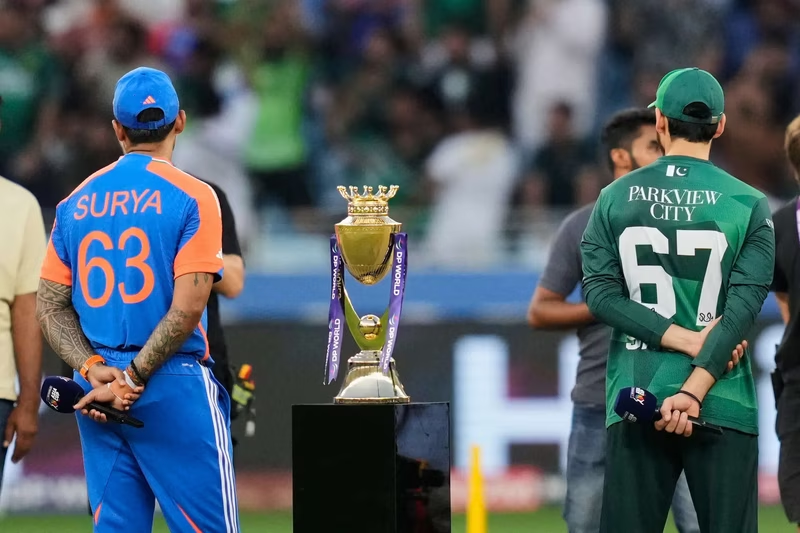
Jason Holder Slams ‘Excessive’ India-Pakistan Rivalry After Asia Cup Trophy Snub
Cricket is a sport built on fierce rivalries—but when does passion cross into toxicity? West Indies all-rounder and former captain Jason Holder has thrown a spotlight on what he calls the “too much” intensity of the India-Pakistan cricket rivalry, following the dramatic aftermath of the 2025 Asia Cup final. Holder, speaking candidly in a recent interview, expressed discomfort with the on-field theatrics, the political undercurrents, and a now-infamous moment: Indian players refusing to accept the trophy from Pakistan’s Interior Minister, Mohsin Naqvi .
Table of Contents
- The Asia Cup Trophy Controversy
- Jason Holder’s Full Critique of the Rivalry
- Beyond the Pitch: How Politics Hurts Pakistani Players
- Is the Rivalry Really ‘Too Much’?
- Global Perspectives on India-Pakistan Cricket
- Conclusion: Where Do We Go From Here?
- Sources
The Asia Cup Trophy Controversy
The 2025 Asia Cup final in Colombo saw India defeat Pakistan in a tense, high-stakes clash. But the real drama unfolded post-match. Instead of the usual trophy presentation by a neutral official, Pakistan’s Interior Minister Mohsin Naqvi—also head of the Pakistan Cricket Board (PCB)—was on hand to present the silverware.
Footage from the event showed Indian captain Rohit Sharma and his teammates visibly hesitating. Eventually, they accepted the trophy—but only after a noticeable delay and without direct handshake or eye contact. Social media erupted: Pakistani fans called it disrespectful; Indian fans defended it as a stand against political interference in sports.
For neutral observers like Holder, however, the incident symbolized a deeper problem: cricket being hijacked by geopolitics.
Jason Holder’s Full Critique of the Rivalry
Holder didn’t mince words. “It’s too much,” he stated bluntly. “The emotion, the noise, the theatrics—it’s gone beyond sport. Cricket should unite people, not divide them.”
He pointed to several on-field behaviors that trouble him:
- Exaggerated celebrations directed at opponents
- Verbal sparring captured by stump mics
- The performative nature of tension during India-Pakistan matches
“I get that it’s a historic rivalry,” Holder added. “But when players can’t even accept a trophy without it becoming a political statement, something’s wrong.”
Beyond the Pitch: How Politics Hurts Pakistani Players
One of Holder’s most poignant points was about opportunity—or the lack thereof. “Look at the IPL,” he said. “Some of the world’s best Pakistani players—Shaheen Afridi, Babar Azam—can’t play because of political tensions. Meanwhile, Indian players dominate every global T20 league.”
This imbalance has real career consequences:
- Pakistani stars miss out on high-profile exposure and earnings (IPL contracts can exceed $2 million)
- They get fewer chances to adapt to varied playing conditions and team dynamics
- Young talents in Pakistan see a ceiling on their global aspirations
Holder emphasized that this isn’t just unfair—it weakens the overall quality of world cricket. “When the best can’t play against each other regularly, the game suffers,” he noted.
Is the Rivalry Really ‘Too Much’?
Holder’s comments have sparked fierce debate. Supporters argue he’s right: the India-Pakistan cricket rivalry has become a proxy for decades of political hostility, turning matches into high-anxiety national events rather than sporting contests.
Critics, however, say the intensity is organic—a product of genuine fan passion, not manufactured drama. They point out that rivalries like England-Australia (The Ashes) or Brazil-Argentina in football are equally fierce, yet not labeled “toxic.”
Yet the key difference, as noted by analysts at ESPNcricinfo, is the near-total absence of bilateral cricket between India and Pakistan due to government restrictions. This scarcity amplifies every encounter, turning a single match into a geopolitical flashpoint.
Global Perspectives on India-Pakistan Cricket
Holder isn’t alone. Several international players and former officials have echoed similar concerns:
- Michael Vaughan (England): Called for “more matches, less politics” to normalize the rivalry.
- Darren Sammy (West Indies): Stressed that “cricket should be a bridge, not a barrier.”
- Ricky Ponting (Australia): Acknowledged the passion but warned against “nationalism overriding sportsmanship.”
Even within South Asia, voices are emerging. Sri Lankan legend Kumar Sangakkara has spoken about how neutral venues like Colombo or Dubai could help depoliticize future contests.
Conclusion: Where Do We Go From Here?
Jason Holder’s critique of the India-Pakistan cricket rivalry isn’t an attack—it’s a plea for balance. Cricket thrives on emotion, yes, but not at the cost of inclusivity, sportsmanship, or player opportunity. The trophy snub was a symptom, not the disease. The real issue is a system where sport and state are so entangled that athletes become unwilling diplomats.
As fans, we must ask: do we want cricket to reflect our divisions—or help heal them? The answer will shape the game’s future. For more on how geopolitics affects sports, see our deep dive on [INTERNAL_LINK:how-politics-impacts-international-cricket-tours].
Sources
- Times of India: ‘It’s too much’: India questioned for not collecting Asia Cup trophy
- ESPNcricinfo: Analysis on India-Pakistan Cricket Relations
- BBC Sport: Interviews with Jason Holder
- The Guardian: The Politics of India-Pakistan Cricket