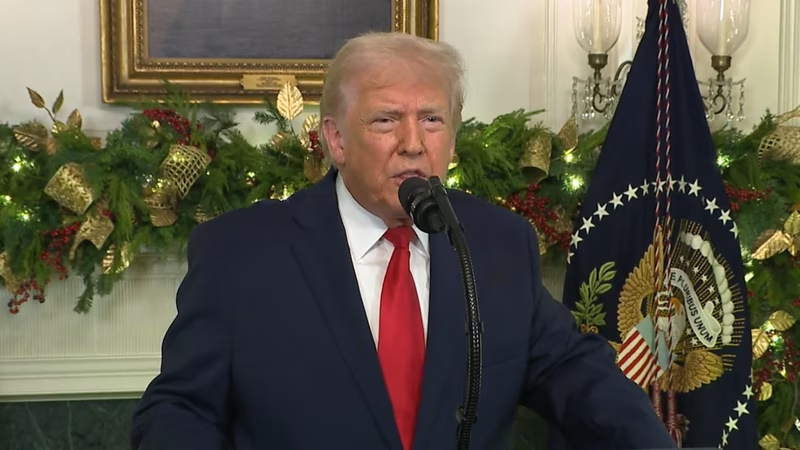
In one of the most dramatic reconfigurations of American global engagement in modern history, the Trump administration systematically pulled the United States out of 66 international bodies, agreements, and partnerships. From landmark climate accords to obscure UN research institutes, these Trump withdrawals weren’t random—they were a deliberate execution of a nationalist foreign policy that prioritized sovereignty over multilateralism.
This mass exit reshaped America’s role on the world stage, drawing sharp criticism from allies and praise from domestic supporters who saw it as a necessary correction to decades of perceived overreach. Now, with global challenges mounting, the legacy of these departures continues to reverberate.
Table of Contents
- Why Trump Withdrew from Global Bodies
- The Full Scope of Trump Withdrawals
- Key Withdrawals That Made Headlines
- Quiet Exits: The Lesser-Known Withdrawals
- Global and Domestic Reactions
- What Changed After Biden Took Office
- Conclusion: The Lasting Impact
- Sources
Why Trump Withdrew from Global Bodies
At the heart of the Trump withdrawals was the “America First” philosophy—a belief that multilateral institutions often constrained U.S. freedom of action, imposed unfair financial burdens, or promoted agendas misaligned with national interests.
President Trump frequently criticized international deals as “bad for America,” arguing they allowed other countries to “take advantage” of U.S. generosity. He viewed organizations like the World Health Organization (WHO) and the United Nations as bloated, inefficient, and sometimes hostile to American values .
This wasn’t just rhetoric. His administration formalized exits with bureaucratic precision, often citing treaty clauses that allowed for unilateral withdrawal after a notice period.
The Full Scope of Trump Withdrawals
While the exits from the Paris Agreement and the World Health Organization grabbed headlines, the full list includes 66 distinct entities—ranging from high-profile treaties to technical UN panels. These can be broadly grouped into categories:
- Environmental & Climate Agreements** (e.g., Paris Agreement, Open Skies Treaty)
- United Nations Programs & Agencies** (e.g., UN Human Rights Council, UN Relief and Works Agency)
- Educational & Research Bodies** (e.g., United Nations University, International Renewable Energy Agency)
- Security & Arms Control Treaties** (e.g., Intermediate-Range Nuclear Forces Treaty)
- Trade & Economic Forums** (e.g., Trans-Pacific Partnership)
Key Withdrawals That Made Headlines
The Paris Climate Agreement
In 2017, Trump announced the U.S. would leave the Paris Agreement—the landmark 2015 global pact to combat climate change. The formal exit took effect in November 2020, making the U.S. the only nation to withdraw. The move was condemned by scientists and world leaders but cheered by fossil fuel advocates .
World Health Organization (WHO)
Citing mismanagement and China’s influence, Trump halted U.S. funding to the WHO in April 2020 during the height of the pandemic and initiated withdrawal procedures—a decision that drew bipartisan criticism for undermining global health coordination .
UN Human Rights Council
In 2018, the U.S. exited the UN Human Rights Council, calling it a “hypocritical and self-serving” body that showed “chronic bias” against Israel. The move was seen as a blow to U.S. moral leadership on human rights .
Quiet Exits: The Lesser-Known Withdrawals
Beyond the big names, the Trump administration quietly terminated U.S. participation in several low-profile but symbolically significant bodies:
- United Nations University (UNU)** – a Tokyo-based academic arm of the UN focused on sustainable development and peace research.
- International Seabed Authority Observer Status** – ended U.S. observer role in deep-sea mining governance.
- UN Committee on the Peaceful Uses of Outer Space** – reduced U.S. engagement in space policy dialogues.
- Several UNESCO-affiliated education and science programs** – following the broader 2017 exit from UNESCO itself.
While these may seem technical, they signal a broader retreat from global knowledge-sharing and norm-setting forums.
Global and Domestic Reactions
Internationally, the Trump withdrawals were widely perceived as a retreat from global leadership. Allies like Germany and France expressed disappointment, warning that U.S. disengagement would create power vacuums filled by rivals like China and Russia.
Domestically, reactions split sharply along partisan lines. Conservatives hailed the moves as long-overdue corrections, while Democrats and foreign policy experts warned of long-term strategic costs. As former Secretary of State John Kerry put it, “You can’t lead the world if you’re not at the table” .
What Changed After Biden Took Office
On his first day in office in January 2021, President Joe Biden began reversing course. He immediately rejoined the Paris Agreement and the WHO. Later, the U.S. sought—and won—a seat on the UN Human Rights Council in 2021.
However, not all exits have been undone. Some technical or symbolic withdrawals, like the one from the United Nations University, remain in place. The Biden administration has adopted a more selective multilateralism—rejoining key forums while maintaining skepticism toward others.
Conclusion: The Lasting Impact
The Trump withdrawals fundamentally altered the U.S. relationship with the international system. Even as some rejoinings occur, the episode demonstrated that American participation in global institutions is no longer guaranteed—a precedent with profound implications for future crises, from pandemics to climate change. The world learned that U.S. engagement can be transactional, temporary, and subject to the political winds at home.
Sources
- The White House Archives: Paris Agreement Withdrawal (2017)
- U.S. Department of State: UN Human Rights Council Exit (2018)
- Council on Foreign Relations: Timeline of Trump’s Foreign Policy Actions
- World Health Organization: U.S. Withdrawal Notification (2020)
- Brookings Institution: The Impact of Trump’s Withdrawals