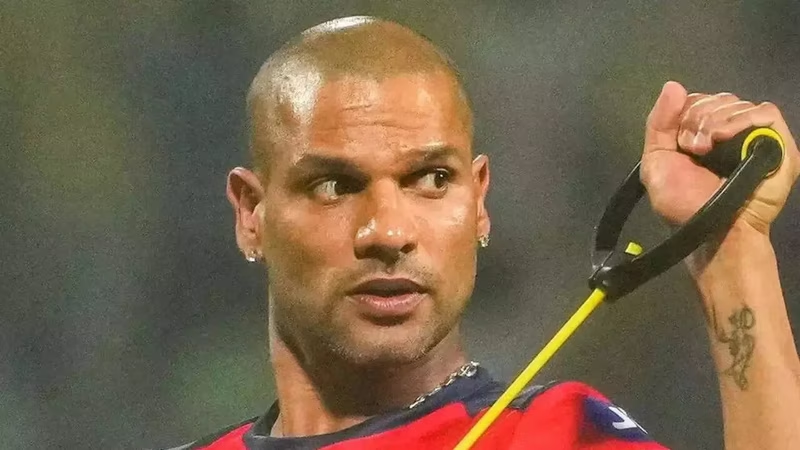
In a powerful statement that bridges sport and human rights, former Indian cricket star Shikhar Dhawan has publicly denounced the recent violent attack on a Hindu widow in Bangladesh, labeling it “unacceptable.” His condemnation comes amid a sharp deterioration in India-Bangladesh relations—tensions that have now spilled directly into the cricketing arena, threatening player exchanges, IPL participation, and even the logistics of the upcoming T20 World Cup. What began as a horrific act of communal violence has now ignited a diplomatic firestorm with real consequences for one of the world’s most passionate sporting rivalries—and friendships .
Table of Contents
- Dhawan’s Strong Stance: A Voice from the Cricketing World
- Shikhar Dhawan Condemns Bangladesh Attack: What Happened?
- Rising Attacks and Minority Fears in Bangladesh
- Cricket Caught in the Crossfire
- IPL and T20 World Cup Fallout
- ICC Response and the Way Forward
- Conclusion: When Sport Reflects Society
- Sources
Dhawan’s Strong Stance: A Voice from the Cricketing World
Known for his affable on-field persona, Shikhar Dhawan rarely wades into political or social controversies. That makes his unequivocal statement all the more significant. “Such acts of violence are completely unacceptable,” Dhawan said, referring to the assault. “No one should live in fear because of their faith or identity.” His words echo a growing concern among Indians—across politics, civil society, and now sports—about the safety of religious minorities in neighboring Bangladesh .
By speaking out, Dhawan joins a chorus of Indian public figures who see the attack not as an isolated crime, but as part of a worrying pattern that demands accountability.
Shikhar Dhawan Condemns Bangladesh Attack: What Happened?
While official details remain limited, reports indicate that a Hindu widow was subjected to a brutal physical assault in a rural area of Bangladesh. The incident, allegedly motivated by religious animosity, has sparked outrage among minority communities and human rights groups both in Bangladesh and India .
Such attacks are not new. Hindu and other minority communities in Bangladesh have long reported incidents of land grabbing, intimidation, and violence, particularly around politically sensitive times. However, the latest assault has struck a raw nerve, coming at a time of heightened scrutiny on regional stability and minority rights.
Rising Attacks and Minority Fears in Bangladesh
Human rights organizations, including Amnesty International and Human Rights Watch, have repeatedly documented a pattern of targeted violence against religious minorities in Bangladesh. The Hindu community—the largest minority group—often bears the brunt during periods of political unrest or religious festivals .
The perception in India is that the Bangladeshi government has failed to provide adequate protection or deliver swift justice in such cases. This sentiment has been amplified by social media and mainstream news coverage, fueling public anger and putting pressure on Indian policymakers to respond.
Cricket Caught in the Crossfire
Historically, cricket has served as a bridge between India and Bangladesh—a space for fierce competition but mutual respect. Iconic moments like the 2007 World Cup upset or Shakib Al Hasan’s IPL stints have built deep fan connections. But that goodwill is now under severe strain.
The fallout has been swift and tangible:
- Mustafizur Rahman’s IPL Exit: The star Bangladeshi pacer, who was expected to be a key asset for his franchise, has reportedly withdrawn from the 2026 Indian Premier League due to security concerns and political pressure at home .
- Dwindling Fan Enthusiasm: Indian fans, once eager to watch Bangladeshi stars, are now expressing reluctance, with some calling for boycotts of bilateral series.
- Diplomatic Chilling Effect: Cricket boards are now forced to navigate not just logistics, but geopolitics—a role they were never designed for.
IPL and T20 World Cup Fallout
The repercussions extend beyond individual players. The Bangladesh Cricket Board (BCB) has formally requested the International Cricket Council (ICC) to consider relocating Bangladesh’s group-stage matches for the 2026 T20 World Cup, which is scheduled to be held in India . Citing “security concerns and the prevailing environment,” the BCB is seeking assurances that its players and staff will be safe and welcomed.
This is a significant development. The T20 World Cup is a global spectacle, and any change in venue logistics would be a major disruption. It also sends a clear signal that political tensions are directly impacting the sport’s biggest events.
ICC Response and the Way Forward
The ICC has responded with a statement of reassurance. “We are in close contact with the BCB and have offered our full cooperation to address any concerns,” an ICC spokesperson said. “Our priority is to ensure the safe and smooth participation of all teams in the tournament .”
However, the ICC’s role is limited to event management; it cannot resolve underlying political or social issues. The long-term solution lies in diplomatic dialogue between New Delhi and Dhaka to restore trust and ensure the protection of all citizens, regardless of faith.
Conclusion: When Sport Reflects Society
Shikhar Dhawan’s condemnation is more than just a celebrity opinion—it’s a reflection of a broader societal unease. Cricket, often called a religion in South Asia, cannot exist in a vacuum. When communities feel unsafe, when minorities are targeted, and when diplomatic trust erodes, the playing field inevitably feels the tremors. The Shikhar Dhawan condemns Bangladesh attack moment is a stark reminder that sport is woven into the fabric of society—and when that fabric tears, everyone feels the strain. The hope now is that dialogue, not retaliation, will prevail, so that the spirit of cricket can once again unite, rather than divide. For more on the intersection of sports and geopolitics, read our analysis on [INTERNAL_LINK:cricket-diplomacy-in-south-asia].
Sources
- Times of India: ‘Unacceptable’: Dhawan condemns ‘brutal assault on a Hindu widow in Bangladesh’
- BBC News: Violence Against Minorities in Bangladesh: A Growing Concern
- Human Rights Watch: Bangladesh Country Page
- ESPNCricinfo: BCB Seeks ICC Assurance Over T20 World Cup Security
- ICC Official Statement on Bangladesh Participation