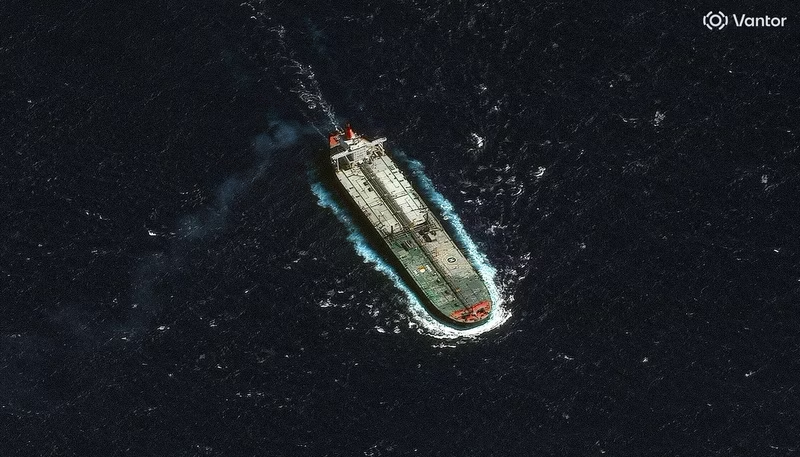
In the vast expanse of the North Atlantic, a high-stakes game of cat-and-mouse came to a dramatic end. After a pursuit that lasted weeks, US military forces have successfully seized a Russian-flagged oil tanker with deep ties to the Venezuelan regime . This isn’t just another maritime interception; it’s the second such seizure in a matter of days and a clear signal that the US’s self-declared ‘complete blockade’ of sanctioned Venezuelan oil is now in full, aggressive effect .
Table of Contents
- The High-Seas Chase and Seizure
- How the US Seizes Oil Tanker Strategy Works
- The Sinister Web: Venezuela, Russia, and Hezbollah
- Two Tankers Down: Skipper and Centuries
- The “Stateless” Ship and Russian Claims
- Conclusion: A New Era of Maritime Enforcement?
- Sources
The High-Seas Chase and Seizure
The operation was a textbook example of modern maritime law enforcement. The US Coast Guard Cutter Munro tracked the elusive vessel across international waters in the North Atlantic. The pursuit, which stretched over several weeks, culminated in a boarding action executed by US forces under the authority of a federal court warrant . The ship, which had been trying to evade capture, was ultimately commandeered by the US military . This was a complex and dangerous operation, highlighting the lengths to which the US is willing to go to enforce its sanctions regime.
How the US Seizes Oil Tanker Strategy Works
The seizure is a direct result of a sweeping policy announced last month: a “complete blockade” on all sanctioned oil tankers associated with Venezuela . This strategy aims to completely cut off the illicit revenue streams that prop up the Maduro regime. The blockade isn’t just a passive measure; it’s an active, aggressive campaign of interdiction. The US sanctions program specifically targets tankers that engage in deceptive shipping practices, such as turning off their transponders to hide their location and cargo . By physically taking control of these vessels, the US sends a powerful deterrent message to the entire illicit oil network. The goal is simple: make the cost of doing business with sanctioned Venezuelan entities far too high.
The Sinister Web: Venezuela, Russia, and Hezbollah
The seized tanker isn’t just any cargo ship. US authorities sanctioned it in 2024 for its alleged role in a sophisticated smuggling operation. The vessel is accused of transporting cargo for a company with direct links to the Lebanese militant group Hezbollah . This connection transforms the issue from a simple sanctions violation into a matter of national security. It paints a picture of a complex, international network where Venezuelan oil is used as a commodity to fund a wide array of illicit activities, including those of a designated terrorist organization. This intricate web often involves other state actors, like Russia, which provides a flag of convenience for these tankers, offering them a thin veneer of legitimacy.
Two Tankers Down: Skipper and Centuries
The recent seizure is not an isolated incident. It is, in fact, the second such action taken by the US Coast Guard since December 10th. The first vessel, named the Skipper, was seized in the Caribbean, and the latest one, the Centuries, was captured in the North Atlantic . This two-pronged approach—operating in both the Caribbean and the wider Atlantic—demonstrates a comprehensive strategy to close all escape routes for these sanctioned ships. Together, these seizures are a powerful statement of intent from Washington. They show a coordinated, multi-region effort to dismantle the entire logistical chain that supports Venezuela’s illicit oil trade .
The “Stateless” Ship and Russian Claims
A key point of contention in this operation is the legal status of the seized vessel. Although it was flying a Russian flag, the US government has declared the ship to be stateless. This is a critical legal maneuver. By arguing that the ship’s registration was invalid or that Russia had effectively abandoned it, the US strengthens its legal position for the seizure under international maritime law. This directly counters any potential claims from Moscow, which may have previously asserted its protection over the vessel. The US stance essentially says that a flag of convenience cannot shield a ship engaged in serious criminal and terrorist-linked activities.
Conclusion: A New Era of Maritime Enforcement?
The US seizes oil tanker operations in the Atlantic and Caribbean mark a significant escalation in the economic pressure campaign against the Venezuelan government. It’s a strategy that blends financial sanctions with direct, physical enforcement on the high seas. While the immediate impact is the loss of two tankers and their valuable cargo, the long-term goal is far grander: to dismantle a global network that uses oil as a weapon of financial and political influence. This aggressive posture sets a new precedent for how powerful nations might enforce sanctions in the future, moving beyond paperwork to direct action. The success of this blockade could reshape the rules of international maritime commerce and have ripple effects across global energy markets. For more on the geopolitical implications of energy sanctions, see our deep dive on [INTERNAL_LINK:global-energy-politics].
Sources
- Times of India: From Atlantic to Caribbean: US seizes 2 Venezuela-linked oil tankers; ‘blockade’ in full effect
- Reuters: US military seizes Venezuela-linked Russian oil tanker in North Atlantic
- BBC News: US forces seize oil tanker linked with Russia, Venezuela
- The Wall Street Journal: U.S. Seizes Second Venezuela-Linked Oil Tanker as Blockade Intensifies [[3], [13]]
- U.S. Department of State: Briefing on Venezuela Sanctions Enforcement
- U.S. Treasury: Sanctions Target Hezbollah-Linked Oil Smuggling Network