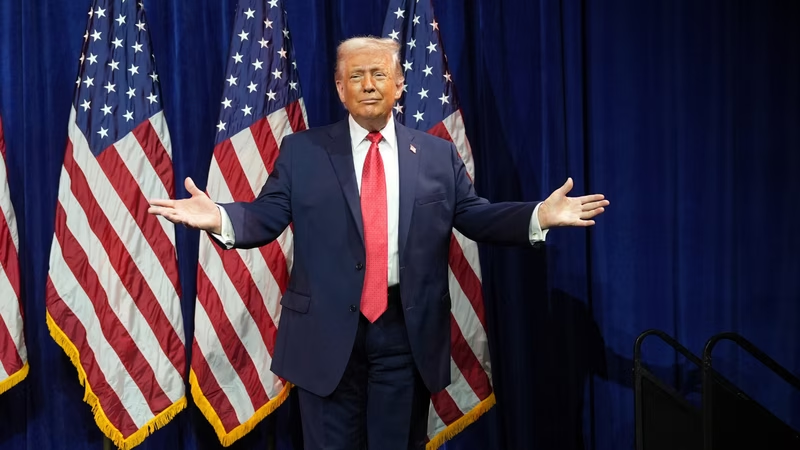
It sounds like the plot of a geopolitical thriller—but it’s real. Former President Donald Trump is reportedly weighing drastic options to bring Greenland under American control, including a potential purchase or even military intervention. In recent private discussions, Trump has allegedly said, “The military is always an option,” reigniting a controversy that first made headlines in 2019. This time, however, the stakes may be higher as Arctic competition heats up.
Why does Trump Greenland keep resurfacing? And what would it mean for U.S. foreign policy, NATO unity, and global security? Let’s unpack the facts, the fiction, and the very real strategic interests at play in one of Earth’s most remote—and increasingly valuable—territories.
Table of Contents
- Why Does Trump Want Greenland?
- Trump Greenland: A History of the Idea
- Could the U.S. Actually Buy Greenland?
- “The Military Is Always an Option”—What Does That Mean?
- Greenland and Denmark’s Firm Response
- Geopolitical Implications: The Arctic Power Game
- What This Means for U.S. Foreign Policy in 2026
- Summary: Is Greenland the Next Flashpoint?
- Sources
Why Does Trump Want Greenland?
To understand the Trump Greenland fixation, you have to look at the map—and the minerals. Greenland sits at the crossroads of the North Atlantic and Arctic Ocean, making it a critical node for future shipping lanes, missile defense, and undersea surveillance.
More importantly, the island is believed to hold vast untapped reserves of rare earth elements—crucial for everything from smartphones to fighter jets. China has already shown interest in mining projects there, raising alarms in Washington. For Trump and his national security advisors, controlling—or at least influencing—Greenland is seen as essential to countering Beijing’s Arctic ambitions.
Trump Greenland: A History of the Idea
This isn’t the first time Trump has floated the idea. In 2019, during his first term, he publicly suggested the U.S. should “buy Greenland,” comparing it to real estate deals. The proposal was met with ridicule in Europe. Denmark’s then-Prime Minister Mette Frederiksen called it “absurd,” and Trump canceled a state visit in protest.
Now, as he campaigns for a potential 2028 return to the White House, the idea is back—with a more aggressive edge. Sources tell The Times of India that Trump and his inner circle are exploring “all options,” including association agreements, economic pressure, or even invoking national security to justify a stronger U.S. presence.
Could the U.S. Actually Buy Greenland?
Legally? Almost certainly not. Greenland is an autonomous territory within the Kingdom of Denmark. While it handles its own domestic affairs, foreign policy and defense remain under Danish control. Any transfer of sovereignty would require:
- Consent from the Greenlandic government (which has a parliament and prime minister).
- Ratification by the Danish Folketing (parliament).
- Compliance with international law, including the UN Charter’s prohibition on territorial acquisition by force.
Greenland’s leaders have been clear: they see themselves as a nation on a path to eventual independence—not a commodity to be sold. “We belong to ourselves,” said Premier Múte Egede in a recent statement.
“The Military Is Always an Option”—What Does That Mean?
Trump’s reported comment has sparked global concern. While it may be rhetorical bluster, it echoes a dangerous precedent. The U.S. already operates Thule Air Base in northern Greenland—one of its most important Arctic military installations, used for space surveillance and missile early-warning systems.
Some analysts suggest Trump isn’t advocating invasion but rather leveraging the U.S. military presence to negotiate greater control or exclusive rights. Still, invoking “military options” against a NATO ally’s territory crosses a diplomatic red line and risks fracturing the Western alliance at a time when unity against Russia and China is paramount.
Greenland and Denmark’s Firm Response
Both Copenhagen and Nuuk have issued unequivocal rejections. Denmark’s Foreign Ministry stated: “Greenland is not for sale, not now, not ever.” Greenland’s government emphasized its right to self-determination under international law and called any talk of U.S. acquisition “colonialist thinking.”
Notably, even U.S. allies are uneasy. A senior EU diplomat told Reuters that “such rhetoric undermines the rules-based order we all depend on.”
Geopolitical Implications: The Arctic Power Game
The real story behind the Trump Greenland saga is the scramble for the Arctic. As climate change melts ice caps, new sea routes and resource zones are opening. Russia has militarized its Arctic coast. China declared itself a “near-Arctic state” and is investing heavily. The U.S., by contrast, has lagged in Arctic infrastructure.
Trump’s focus on Greenland reflects a growing U.S. realization: if America doesn’t secure influence in the Arctic now, it may lose strategic ground for decades. But the method matters. Coercion or purchase isn’t the only path—cooperation through the Arctic Council or joint scientific missions could yield influence without backlash.
What This Means for U.S. Foreign Policy in 2026
Whether Trump returns to office or not, the Greenland issue won’t disappear. The Biden administration has quietly increased diplomatic engagement with Nuuk, opening a consulate in 2023—the first U.S. diplomatic post on the island. This suggests a bipartisan recognition of Greenland’s strategic value.
However, Trump’s “America First” approach favors transactional deals over diplomacy. If re-elected, he may push for exclusive mineral rights, expanded base access, or even a formal “strategic partnership” that stops short of purchase—but still alarms Denmark. For more on U.S.-Arctic strategy, see our deep dive on [INTERNAL_LINK:us-arctic-policy-2026].
Summary: Is Greenland the Next Flashpoint?
The Trump Greenland narrative is equal parts strategy, symbolism, and spectacle. While a U.S. takeover remains legally and politically impossible in the near term, the renewed focus underscores a critical truth: the Arctic is the next frontier of global power competition. How the U.S. navigates its relationship with Greenland—and its NATO ally Denmark—will reveal whether it chooses partnership or provocation in this frozen new world.
Sources
Times of India – ‘Military is always an option’: Trump weighs how US could acquire Greenland
U.S. Department of State – U.S. Relations With Greenland
Arctic Council – Official Website
BBC – Trump’s 2019 Greenland Proposal