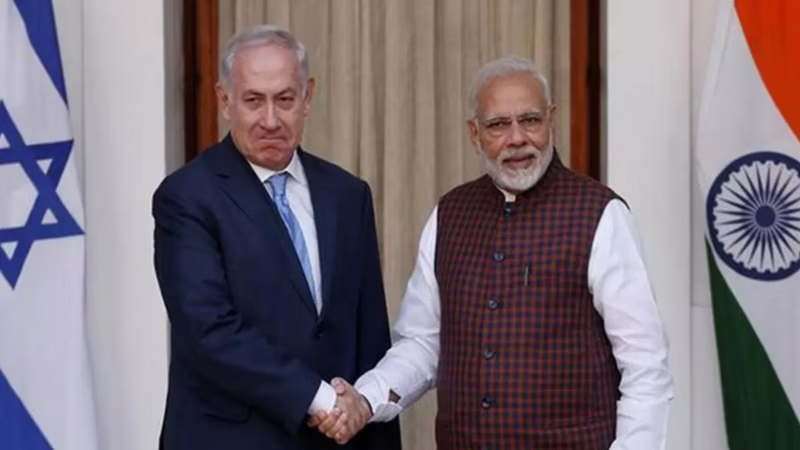
“Glad to speak with my friend.”
With those simple but loaded words, Prime Minister Narendra Modi signaled more than just New Year pleasantries in his recent phone call with Israeli Prime Minister Benjamin Netanyahu. Against a backdrop of rising geopolitical volatility—from the Red Sea crisis to tensions in West Asia—the Modi Netanyahu call was a calibrated display of strategic alignment between two nations that have quietly transformed their relationship over the past decade.
Officially, the conversation covered New Year greetings, regional developments, and a joint commitment to combat terrorism. But read between the lines, and it’s clear: India and Israel are no longer just partners—they’re strategic allies navigating a fractured world order together. From defense tech to agricultural innovation, the bilateral agenda is expanding fast. And this call, coming just weeks into 2026, sets the tone for what could be the most consequential year yet in India-Israel relations.
Table of Contents
- Key Takeaways from the Modi Netanyahu Call
- Why This Call Matters Now: The Global Context
- Defense & Security: The Bedrock of the Partnership
- Beyond Defense: Tech, Agriculture, and Innovation
- Counter-Terrorism & Regional Stability: A Shared Mission
- India’s Diplomatic Tightrope: Israel, Palestine, and the Global South
- What to Expect in India-Israel Relations in 2026
- Conclusion: A Friendship Forged in Strategy
- Sources
Key Takeaways from the Modi Netanyahu Call
According to a statement from the Prime Minister’s Office (PMO), the January 6, 2026, call between PM Modi and PM Netanyahu covered several critical areas:
- Exchange of New Year greetings and reaffirmation of personal rapport.
- Commitment to deepen the India-Israel strategic partnership across sectors.
- Strong condemnation of terrorism in all forms and a pledge to enhance security cooperation.
- Discussion on the evolving regional situation, particularly in West Asia.
- Recognition of the robust people-to-people ties and shared democratic values .
Notably, Modi referred to Netanyahu as “my friend”—a phrase he reserves for a select few global leaders, including the UAE’s Sheikh Mohammed bin Zayed and the US President. This personal touch underscores the trust built over multiple in-person meetings since 2017.
Why This Call Matters Now: The Global Context
The timing is far from coincidental. The world is witnessing:
- Ongoing Houthi attacks in the Red Sea disrupting global shipping.
- Heightened Iran-Israel tensions following cyber and drone skirmishes.
- India’s growing energy and trade dependence on Middle Eastern stability.
In this environment, Israel’s intelligence capabilities and India’s strategic location make them natural allies. As noted by the Middle East Institute, “India sees Israel not just as a defense supplier, but as a knowledge partner in asymmetric warfare and homeland security” .
Defense & Security: The Bedrock of the Partnership
Defense remains the cornerstone of India-Israel ties. Israel is India’s **second-largest arms supplier** after Russia, with deals spanning:
- Barak-8 missile systems for naval defense.
- Spike ATGMs for the Indian Army.
- Phalcon AWACS surveillance aircraft.
- Drone technology, including the recently approved Harop loitering munitions.
Crucially, cooperation has shifted from buyer-seller to co-development. Projects like the Medium Range Surface-to-Air Missile (MRSAM)—jointly built by DRDO and Israel Aerospace Industries—showcase this evolution . The Modi Netanyahu call likely reinforced commitments to expand such joint ventures in 2026.
Beyond Defense: Tech, Agriculture, and Innovation
While defense grabs headlines, quieter sectors are booming:
- Agriculture: Over 30 Israel-India Centers of Excellence help Indian farmers boost yields using drip irrigation and protected cultivation.
- Water Tech: Israeli desalination and wastewater recycling models are being piloted in Rajasthan and Gujarat.
- Startups: The India-Israel Industrial R&D Foundation (I4F) has funded 70+ joint tech ventures since 2018.
These initiatives align perfectly with Modi’s Atmanirbhar Bharat (Self-Reliant India) vision—using Israeli innovation to solve Indian challenges.
Counter-Terrorism & Regional Stability: A Shared Mission
Both nations have suffered brutal terrorist attacks—Mumbai 2008 and the Hamas-led assault on Israel in October 2023 being stark reminders. This shared trauma fuels their counter-terrorism synergy.
Intelligence sharing between India’s IB and Israel’s Mossad has intensified, particularly on:
- Tracking terror financing networks.
- Monitoring radicalization on social media.
- Securing critical infrastructure like ports and power grids.
During the call, both leaders “reaffirmed their resolve to fight terrorism with greater determination”—a clear signal to adversaries that India and Israel stand united.
India’s Diplomatic Tightrope: Israel, Palestine, and the Global South
India’s closeness to Israel is carefully balanced with its historical support for Palestine. New Delhi continues to fund Palestinian development projects and voted in favor of Palestinian observer status at the UN.
However, under Modi, India’s stance has become more pragmatic. It no longer automatically condemns Israel at international forums and abstained on several anti-Israel resolutions in 2025—drawing criticism from some Global South allies but praise from Washington and Tel Aviv .
What to Expect in India-Israel Relations in 2026
Experts anticipate several milestones this year:
- A possible state visit by Netanyahu to India (his first since 2017).
- Finalization of a Free Trade Agreement (FTA) that’s been under negotiation since 2023.
- Launch of a joint AI & cybersecurity task force.
- Expanded collaboration on space tech through ISRO and Israel Space Agency.
As one Indian diplomat told [INTERNAL_LINK:india-middle-east-policy-2026], “Israel is no longer a ‘quiet’ partner. It’s central to India’s West Asia strategy.”
Conclusion: A Friendship Forged in Strategy
The Modi Netanyahu call may have begun with “Happy New Year,” but its substance revealed a relationship built on mutual trust, shared threats, and strategic ambition. In an era where alliances are fragile and global order is uncertain, India and Israel are betting big on each other—not just as friends, but as indispensable partners for the 21st century.
Sources
- Times of India: ‘Glad to speak with my friend’: PM Modi holds talks with Israeli PM Netanyahu
- Prime Minister’s Office, India: Official Statement on PM Modi-Netanyahu Call
- Middle East Institute: India-Israel Defense Ties: A New Era
- Ministry of External Affairs: India-Israel Bilateral Relations Overview
- DRDO-ISRO Joint Reports: MRSAM and Space Collaboration Updates