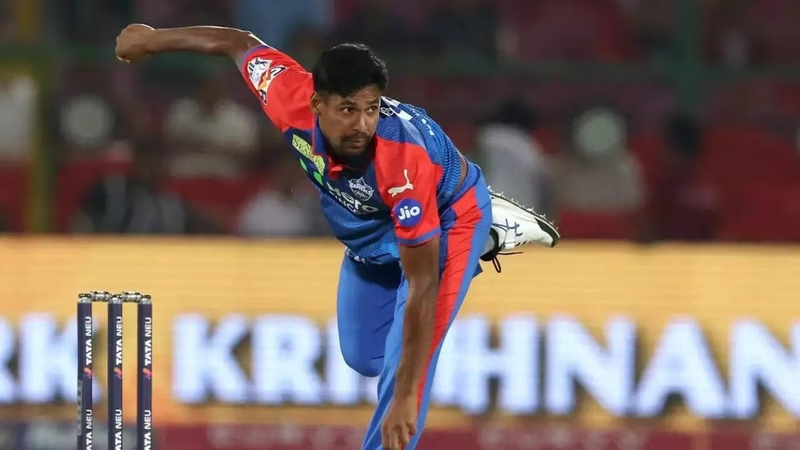
Cricket is supposed to unite nations—not tear them apart. But the recent Mustafizur Rahman IPL row has laid bare a harsh truth: when geopolitics and sport collide, it’s the players and fans who suffer, while powerful boards look away. And now, one of the game’s most respected voices has had enough.
England all-rounder Moeen Ali didn’t mince words. In a fiery statement, he blasted cricket’s governing bodies for allowing political tensions between India and Bangladesh to dictate roster decisions at the IPL, calling the release of Mustafizur Rahman from Kolkata Knight Riders (KKR) a “very rubbish thing to do.” Ali went further, saying the sport is “in danger” and expressing deep sympathy for Mustafizur—a player caught in a storm he didn’t create .
As diplomatic clouds gather over South Asia, this incident raises urgent questions: Should the IPL, often hailed as a global sporting spectacle, be subject to real-world political pressures? And why are major cricketing nations staying silent while one of the game’s finest fast bowlers is sidelined?
Table of Contents
- What Actually Happened in the Mustafizur Rahman IPL Row?
- Moeen Ali’s Scathing Critique: ‘Politics Is Killing Cricket’
- Why Was Mustafizur Released? The India-Bangladesh Context
- The Deafening Silence of Cricket’s Power Brokers
- Who Really Loses? The Human Cost of Cricket Politics
- Is the IPL Becoming a Tool of Soft Power?
- What’s Next for Mustafizur Rahman?
- Conclusion: Cricket Must Choose—Sport or Politics?
- Sources
What Actually Happened in the Mustafizur Rahman IPL Row?
In early January 2026, just weeks before the IPL 2026 auction, Kolkata Knight Riders announced the release of Bangladeshi pace sensation Mustafizur Rahman from their squad. Officially, KKR cited “logistical and scheduling constraints.” But multiple sources, including TOI, confirmed the decision was influenced by rising diplomatic friction between India and Bangladesh over regional trade and water-sharing disputes .
Mustafizur, a two-time IPL champion and fan favorite, had been with KKR since 2023 and was widely expected to return. His sudden exit—not due to performance or injury, but external pressures—sent shockwaves through the cricketing world.
Moeen Ali’s Scathing Critique: ‘Politics Is Killing Cricket’
Moeen Ali, who has played alongside Mustafizur in franchise leagues and for England against Bangladesh, pulled no punches. “It’s a very rubbish thing to do,” he said, referring to the bowler’s removal. “Cricket is in danger… I feel sorry for Mustafizur. He’s a great bowler, a great guy. He doesn’t deserve this.”
Ali’s frustration goes beyond one player. He accused “powerful cricket boards” of pushing “agendas” that have nothing to do with sport. “The people who suffer are the fans and the players,” he added, highlighting the emotional and professional toll on athletes whose careers hinge on these opportunities.
Why Was Mustafizur Released? The India-Bangladesh Context
While no official statement linked the release to politics, the timing is telling. India and Bangladesh have seen a cooling in relations since late 2025, with disagreements over the Teesta River water-sharing agreement and trade tariffs . In such an environment, high-profile cultural exchanges—including sports—often become collateral damage.
Historically, Pakistani players have faced similar IPL exclusions during India-Pakistan tensions. Now, Bangladesh—a nation with deep cricketing ties to India—appears to be entering the same precarious zone. This sets a dangerous precedent: if bilateral relations sour, should athletes lose their livelihoods?
The Deafening Silence of Cricket’s Power Brokers
Perhaps most troubling is who *hasn’t* spoken up. The ICC, BCCI, and even the ECB have remained silent on the issue. No public statement. No defense of the player. No stance on keeping politics out of sport.
As noted by ESPNcricinfo, this silence reflects a broader reluctance among cricket’s elite to challenge geopolitical realities, especially when major revenue streams like the IPL are involved . The message is clear: commercial interests outweigh player welfare.
Who Really Loses? The Human Cost of Cricket Politics
Mustafizur isn’t just a cricketer—he’s a symbol of hope for millions in Bangladesh. His IPL earnings support his family, funds local academies, and inspire young seamers in a spin-dominated nation. Losing this platform impacts more than his bank balance—it dims a beacon for an entire cricketing community.
For fans, it’s equally painful. IPL viewers in Bangladesh and India alike lose the joy of watching one of the game’s most skillful bowlers execute the “Fizz Doosra” under pressure. Sport becomes less about competition and more about control.
Is the IPL Becoming a Tool of Soft Power?
The IPL was once marketed as a “global village of cricket.” But recent years show a shift:
- No Pakistani players since 2008.
- Afghan players increasingly absent despite talent.
- Now, Bangladeshi stars like Mustafizur face uncertainty.
This pattern suggests the IPL, while commercially brilliant, is increasingly aligned with India’s foreign policy posture—a reality that contradicts its “global” branding. As Moeen Ali implies, this isn’t just unfair—it’s unsustainable for the sport’s long-term health.
What’s Next for Mustafizur Rahman?
Despite the setback, Mustafizur remains in demand. He’s expected to play in the Bangladesh Premier League (BPL) and could feature in other T20 leagues like the SA20 or The Hundred. His international career with the Tigers remains unaffected—for now. But the IPL absence is a blow to his global profile and earning potential.
For KKR, the move may appease certain stakeholders, but it risks alienating a massive South Asian fanbase that values inclusivity. Other franchises, like Royal Challengers Bangalore, have previously championed regional unity through player selection—a contrast worth noting.
Conclusion: Cricket Must Choose—Sport or Politics?
The Mustafizur Rahman IPL row is more than a roster change—it’s a litmus test for cricket’s soul. Moeen Ali’s candid remarks remind us that sport should transcend borders, not reinforce them. If governing bodies continue to let diplomacy dictate team sheets, they risk turning cricket into a pawn of politics. And in that game, everyone loses—except the silence.
Sources
- Times of India: ‘Very rubbish thing to do’ — Ali blasts cricket bodies over Mustafizur row
- ESPNcricinfo: KKR Releases Mustafizur: Geopolitical Pressures Mount
- Al Jazeera: India-Bangladesh Relations Strain Over Teesta River
- The Guardian: Moeen Ali: ‘Cricket Is in Danger’ Due to Political Interference