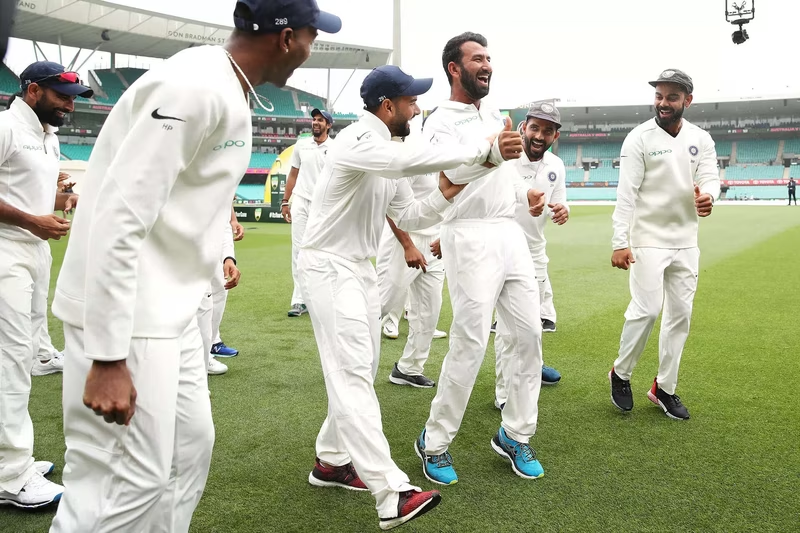
On this day seven years ago, Indian cricket didn’t just win a series—it rewrote history. The final whistle at the Sydney Cricket Ground on January 7, 2019, wasn’t just the end of a Test match; it was the closing chapter of a 71-year-long quest. For the first time ever, an Asian team had won a **Test series in Australia**—and it was Virat Kohli’s fearless Indian side that got the job done .
The **India Australia Test series win** wasn’t just a statistical milestone; it was a cultural earthquake. It shattered the myth that touring Down Under was a graveyard for subcontinental batsmen and spinners. It proved that with the right mix of resilience, strategy, and raw talent, even the most daunting cricketing fortress could fall. And fall it did—thanks to heroes like Cheteshwar Pujara, Jasprit Bumrah, and a captain whose hunger for victory was contagious.
In this deep-dive retrospective, we unpack the defining moments, tactical masterstrokes, and legacy of India’s historic 2018–19 Border-Gavaskar Trophy triumph—a series that didn’t just win matches, but changed the DNA of Indian overseas cricket.
Table of Contents
- The 71-Year Wait: Why Australia Was Cricket’s Final Frontier
- How the 2018–19 India Australia Test Series Unfolded
- The Unsung & Celebrated Heroes Behind the Victory
- Kohli & Shastri’s Tactical Masterstrokes
- The Lasting Legacy of India’s 2018 Australia Win
- How It Compares to India’s 2020–21 Gabba Miracle
- Conclusion: More Than a Series—A New Era
- Sources
The 71-Year Wait: Why Australia Was Cricket’s Final Frontier
India first toured Australia in 1947–48. For over seven decades, they came close—heartbreakingly so in 2003–04 under Sourav Ganguly—but never clinched the series. Australia’s pace-friendly pitches, relentless bounce, and hostile fast bowlers like McGrath, Warne, Johnson, and later Cummins made it the ultimate test for any visiting team .
Asian teams, in particular, struggled. Spin-friendly conditions at home didn’t prepare them for the sheer physicality of Australian summers. So when Kohli’s men landed in Adelaide in December 2018, few outside India gave them a real chance—especially after losing the opening ODI series. But this Indian team was different: fitter, mentally tougher, and built for overseas conquests.
How the 2018–19 India Australia Test Series Unfolded
The four-Test Border-Gavaskar Trophy was a rollercoaster of drama, discipline, and defiance:
- 1st Test, Adelaide: India won by 31 runs in a day-night Test. Bumrah (4/56) and Ashwin (4/51) dismantled Australia. Pujara scored 123, absorbing 371 balls—a masterclass in patience .
- 2nd Test, Perth: Australia bounced back with a 146-run win, exposing India’s top-order fragility.
- 3rd Test, Melbourne: India sealed the series with a 137-run victory. Pujara’s 106 and Bumrah’s 6/33 were pivotal. This win gave India an unassailable 2–1 lead .
- 4th Test, Sydney: A dead rubber ended in a draw, but the historic mission was already accomplished.
The final result: **India 2–1 Australia**. The first-ever series win by an Asian team on Australian soil .
The Unsung & Celebrated Heroes Behind the Victory
While Kohli was the face of the campaign, the win was a collective triumph:
- Cheteshwar Pujara: Scored 521 runs at an average of 74.42. His 123 in Adelaide and 106 in Melbourne were innings of extraordinary grit. He faced 1,258 deliveries—the most by any batter in the series .
- Jasprit Bumrah: In his maiden Australian tour, he took 21 wickets at 21.14. His slingy action and pinpoint yorkers troubled even David Warner and Usman Khawaja .
- Rishabh Pant: His fearless 73 in Adelaide shifted momentum. He played like a veteran, not a debutant.
- Mohammed Shami: Took 16 wickets, often breaking crucial partnerships with the new ball.
Notably, Kohli himself scored just 285 runs—but his captaincy was bold. He backed his bowlers, enforced the follow-on, and never let intensity drop.
Kohli & Shastri’s Tactical Masterstrokes
Ravi Shastri’s “no fear” mantra wasn’t just a slogan—it was a strategy. The team selection was aggressive: four frontline pacers (Bumrah, Shami, Ishant, Umesh) and just one spinner (Ashwin, later Kuldeep). They knew pace, not spin, would win in Australia.
Field placements were sharp, DRS usage was intelligent, and they exploited Australia’s post-ball-tampering fragility. Most importantly, they believed they could win—a mindset shift from previous Indian sides that came to “compete,” not “conquer.”
The Lasting Legacy of India’s 2018 Australia Win
This series did more than lift a trophy—it changed Indian cricket forever:
- It proved India could win abroad without relying on spin.
- It launched Bumrah as a global fast-bowling superstar.
- It set the template for future overseas wins, including the legendary 2020–21 Gabba victory with a second-string team .
- It ended the psychological inferiority complex against Australia.
As ESPNcricinfo noted, “India didn’t just win in Australia—they redefined how Asian teams approach Down Under tours” .
How It Compares to India’s 2020–21 Gabba Miracle
While the 2020–21 win at the Gabba (without Kohli, Bumrah, Shami, etc.) is often hailed as India’s greatest Test victory, the **2018–19 series win** laid the foundation. That first breakthrough gave the 2021 squad the belief that it was possible. One was historic; the other was heroic—but both trace their roots to the same fearless DNA forged in 2018.
Conclusion: More Than a Series—A New Era
The **India Australia Test series win** in 2018–19 wasn’t just about cricket. It was a statement of arrival—a declaration that India had become a complete, all-condition Test team. Seven years later, as young fans grow up watching India dominate overseas, they may not remember the agony of past tours. But they’ll always know that it all changed in that Australian summer, when Kohli’s warriors turned history into destiny.
Sources
- Times of India: OTD | 7 years ago! Kohli’s India became the first Asian team to win Test series Down Under
- ESPNcricinfo: Border-Gavaskar Trophy 2018–19 – Full Coverage
- ICC Cricket: Historical Test Series Records
- The Hindu: How India Conquered Australia