Introduction: A Life Lost, A Community on Edge
It started with an accusation—and ended with a drowning. In the Naogaon district of Bangladesh, 22-year-old Mithun Sarkar, a member of the country’s dwindling Hindu minority, was chased by a mob that alleged he had committed theft. In a desperate attempt to escape, he jumped into a canal—only to drown. His body was recovered hours later, leaving his family shattered and the nation grappling with yet another brutal episode in a growing wave of Hindu violence in Bangladesh.
This tragic death isn’t isolated. According to local human rights monitors, December 2025 alone saw over 50 reported incidents targeting Hindus—including murders, forced evictions, land grabs, and physical assaults. With authorities slow to respond and justice often elusive, Bangladesh’s Hindu community—once nearly 20% of the population, now under 8%—feels increasingly vulnerable, abandoned, and afraid.
Table of Contents
- The Tragic Death of Mithun Sarkar: What Happened?
- Hindu Violence in Bangladesh: A Disturbing December Surge
- Historical Context: Why Are Hindus Targeted?
- Government Response: Investigation or Inaction?
- International Reactions and Human Rights Concerns
- Voices from the Ground: Fear in Rural Bangladesh
- What Can Be Done to Protect Minorities?
- Conclusion: A Test for Bangladesh’s Secular Identity
- Sources
The Tragic Death of Mithun Sarkar: What Happened?
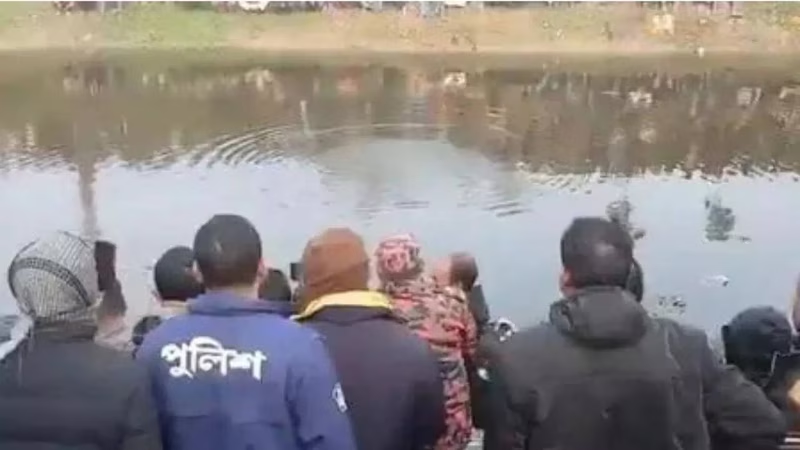
On the evening of December 28, 2025, in Naogaon’s Sapahar Upazila, local residents accused Mithun Sarkar of stealing from a nearby shop. Without evidence or police involvement, a crowd gathered and began pursuing him. Witnesses say Sarkar, fearing for his life, ran toward a nearby irrigation canal and jumped in to escape.
He never surfaced. Despite search efforts, his body was recovered the next morning. Local police have registered a case of “unnatural death” and claim an investigation is underway. However, community leaders argue the real crime—the mob violence that led to his death—has yet to be addressed. “He wasn’t given a chance to prove his innocence,” said a local Hindu community leader. “The mob became judge, jury, and executioner.”
Hindu Violence in Bangladesh: A Disturbing December Surge
Sarkar’s death is part of a terrifying pattern. Data compiled by the Bangladesh Hindu Buddhist Christian Unity Council (BHBCUC) reveals at least 52 violent incidents against religious minorities in December 2025 alone, with Hindus bearing the brunt:
- 7 murders linked to land disputes or false accusations
- 18 cases of temple vandalism or arson during religious festivals
- 14 forced evictions from ancestral properties
- 13 physical assaults following rumors on social media
Many attacks follow a similar script: a rumor spreads—often via WhatsApp or Facebook—alleging blasphemy, theft, or “love jihad.” Within hours, mobs form, and law enforcement is either absent or complicit. The result? A climate of fear that pushes more Hindus to migrate to India or urban centers.
Historical Context: Why Are Hindus Targeted?
The roots of this persecution go back decades. After Bangladesh’s 1971 independence, the constitution enshrined secularism—but political Islam has steadily eroded minority protections. Land is a key driver: Hindu families often hold valuable agricultural property governed by inheritance laws that make ownership complex. Opportunistic actors exploit this to seize land under the pretext of legal disputes or “moral transgressions.”
Moreover, extremist groups like Hefazat-e-Islam have normalized anti-minority rhetoric, framing Hindus as “Indian agents” or “un-Islamic.” In rural areas, where state presence is weak, these narratives go unchallenged.
Government Response: Investigation or Inaction?
The Awami League government, led by Prime Minister Sheikh Hasina, publicly champions secularism and minority rights. Yet, critics argue its actions don’t match its words. Police rarely intervene swiftly, and prosecutions for mob violence are rare. Of the 150+ attacks reported in 2025, fewer than 10 have led to convictions.
In Sarkar’s case, authorities have promised a “thorough probe,” but similar promises after the 2021 Durga Puja violence yielded little accountability. Human Rights Watch has repeatedly urged Bangladesh to strengthen protections for minorities—so far with limited results .
International Reactions and Human Rights Concerns
The U.S. Commission on International Religious Freedom (USCIRF) has placed Bangladesh on its watchlist for years due to systemic discrimination. Following Sarkar’s death, international NGOs renewed calls for action:
- Amnesty International: “Bangladesh must uphold its constitutional duty to protect all citizens, regardless of faith.”
- UN Human Rights Office: Urged “immediate measures to prevent mob violence and ensure justice for victims.”
India has also expressed concern, though it avoids direct condemnation to preserve diplomatic ties. For more on transnational minority rights, see our analysis on [INTERNAL_LINK:religious-minorities-in-south-asia].
Voices from the Ground: Fear in Rural Bangladesh
“We don’t celebrate festivals openly anymore,” said Rina Debnath, a schoolteacher in Rajshahi. “If we put up a lamp for Diwali, someone might report us for ‘causing unrest.’” Many Hindu families now keep a packed bag ready, fearing sudden eviction.
Youth are particularly vulnerable. False accusations of romantic involvement with Muslim girls—a common trope used to incite violence—have led to several recent lynching attempts. “We feel like second-class citizens in our own country,” one student told reporters anonymously.
What Can Be Done to Protect Minorities?
Experts recommend a multi-pronged approach:
- Fast-track courts for hate crimes and mob violence.
- Community policing units trained in minority sensitivity.
- Stricter regulation of social media to curb viral hate rumors.
- Land rights reform to protect Hindu inheritance claims.
Without systemic change, incidents like Mithun Sarkar’s death will continue to haunt Bangladesh’s conscience.
Conclusion: A Test for Bangladesh’s Secular Identity
The drowning of Mithun Sarkar is more than a tragedy—it’s a symptom of a deeper crisis. The surge in Hindu violence in Bangladesh threatens not only minority lives but the very foundation of the nation’s secular ideals. As 2026 begins, Bangladesh stands at a crossroads: will it protect its pluralistic heritage, or allow fear and intolerance to erase it? The world is watching—and so are its own citizens.
Sources
- Times of India: Another Hindu man dies in Bangladesh: Youth drowns in canal; was being chased by mob
- Human Rights Watch – Bangladesh Country Reports
- Bangladesh Hindu Buddhist Christian Unity Council (BHBCUC) – Incident Database
- U.S. Commission on International Religious Freedom (USCIRF) – 2025 Annual Report