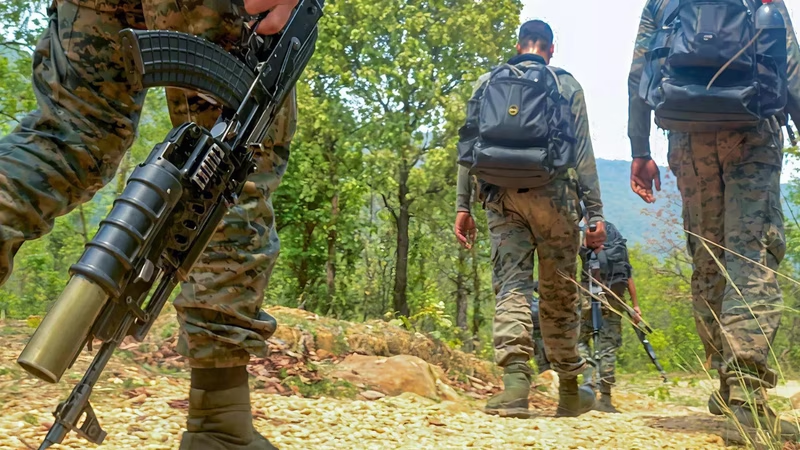
Kathua Encounter: Security Forces Lock Horns with Terrorists in Jammu
A tense and high-alert situation has gripped the Kathua district of Jammu and Kashmir after Indian security forces launched a major counter-terrorism operation targeting suspected militants. The Kathua encounter, which began in the early hours of the morning, marks a rare infiltration attempt in the Jammu plains—a region that has seen relative calm compared to the Kashmir Valley in recent years .
Initial reports confirm an exchange of heavy gunfire between security personnel and the terrorists, with the operation still ongoing as elite units from the Army and Jammu and Kashmir Police cordon off the area. While no casualties have been officially confirmed yet, the incident has sent shockwaves through local communities and raised urgent questions about evolving militant strategies in the region.
Table of Contents
- What We Know So Far: Timeline and Location
- Security Forces’ Strategy and Units Involved
- Why Kathua? Understanding the Strategic Shift in Militancy
- Historical Context: Militancy in the Jammu Region
- Impact on Local Civilians and Evacuation Efforts
- Broader Counter-Terrorism Challenges in J&K
- Conclusion: What This Encounter Signals for Regional Security
What We Know So Far: Timeline and Location
Based on official sources, the Kathua encounter began around 5:30 AM local time when a joint patrol team received intelligence about the presence of armed militants near a forested area on the outskirts of Kathua town .
Upon surrounding the suspected hideout, security forces were met with resistance, triggering a fierce gunfight. The area has since been sealed off, and aerial surveillance drones have been deployed to prevent any escape. As of midday, the operation remains active, with no official statement on the number of terrorists involved or their affiliations.
Security Forces’ Strategy and Units Involved
The operation is being spearheaded by a multi-agency task force, including:
- Rashtriya Rifles – The primary counter-insurgency unit of the Indian Army in J&K.
- Jammu and Kashmir Police’s Special Operations Group (SOG) – Known for urban counter-terrorism ops.
- Central Reserve Police Force (CRPF) – Providing perimeter security and crowd control.
Standard protocol in such encounters involves establishing a multi-layer cordon, cutting off communication lines, and using non-lethal means like tear gas before escalating to precision fire. Negotiation teams are also on standby if any of the suspects attempt surrender .
Why Kathua? Understanding the Strategic Shift in Militancy
For years, militancy in J&K has been concentrated in the Kashmir Valley—particularly in districts like Anantnag, Baramulla, and Pulwama. The Jammu region, including Kathua, has largely remained insulated due to its demographic composition and stronger community policing.
However, recent intelligence reports suggest a worrying trend: terrorist groups like The Resistance Front (TRF)—believed to be a front for Lashkar-e-Taiba—are attempting to expand their footprint into Jammu to:
- Disrupt national highways like NH-44, a critical logistics artery.
- Stoke communal tensions in a religiously diverse area.
- Create a perception of widespread instability beyond Kashmir.
This Kathua encounter could be an early sign of that strategy—and a major red flag for security planners.
Historical Context: Militancy in the Jammu Region
While less frequent, Jammu has not been immune to terrorism:
- 2002 Raghunath Temple Attack: Twin fidayeen attacks killed 13 worshippers in Jammu city.
- 2006 Kulgam Massacre: 10 civilians killed in Doda district.
- 2023 Reasi Terror Attack: 9 pilgrims killed in a bus ambush just 50 km from Kathua .
These incidents, though sporadic, have kept security agencies on high alert. The Jammu region’s proximity to the international border with Pakistan also makes infiltration attempts a persistent threat—though most are intercepted well before reaching populated zones.
Impact on Local Civilians and Evacuation Efforts
Local residents near the encounter site have been temporarily evacuated as a precaution. Schools and markets in the vicinity remain closed, and mobile internet services have been suspended—a standard measure to prevent real-time coordination by hostile elements .
Community leaders have appealed for calm, while local NGOs are assisting displaced families. “We trust our forces, but fear lingers,” said a Kathua resident who requested anonymity. The psychological toll on civilians, especially children, is a growing concern—[INTERNAL_LINK:psychological-impact-of-encounters-on-civilians] explores this in depth.
Broader Counter-Terrorism Challenges in J&K
This incident underscores three persistent challenges:
- Hybrid Warfare Tactics: Use of drones for surveillance and weapon drops along the border.
- Radicalization via Social Media: Local youth being recruited through encrypted apps.
- Geostrategic Pressure: Pakistan-based groups exploiting regional instability to keep India engaged.
Despite a significant decline in terror incidents since 2019, the threat remains dynamic and adaptive—requiring constant intelligence upgrades and community engagement.
Conclusion: What This Encounter Signals for Regional Security
The ongoing Kathua encounter is more than just another counter-terrorism operation. It’s a stark reminder that militancy in Jammu and Kashmir is evolving—and that no region can be considered permanently safe. For security forces, it’s a test of readiness. For policymakers, it’s a call to strengthen both hard security and soft developmental strategies in vulnerable districts.
As the situation develops, one thing is clear: India’s resolve to combat terrorism remains unwavering—but the battlefield is shifting, and vigilance must shift with it.