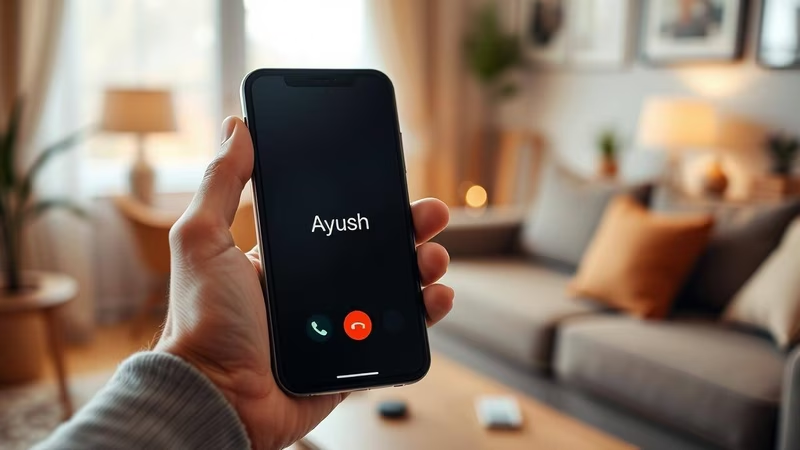
That call from an unknown number just flashed a name on your screen. Not a vague ‘Likely Spam’ tag from a third-party app, but a real, official-sounding business name. If you’ve been wondering what’s going on, you’re not alone. India is rolling out a powerful new telecom feature called Calling Name Presentation (CNAP), and it’s about to change how we all interact with our phones.
Forget relying solely on crowd-sourced apps like Truecaller. This new system is built directly into the 4G and 5G networks by your telecom provider, using verified data from the central government database. Its mission is clear: to arm every Indian citizen with the knowledge to identify who’s really calling, and in doing so, deliver a massive blow to the rampant problem of spam, phishing, and fraudulent calls that have plagued the country for years.
Table of Contents
- What is Calling Name Presentation (CNAP)?
- CNAP vs. Truecaller: The Key Differences You Must Know
- How Does CNAP Actually Work?
- The Nationwide Rollout: Timeline and What to Expect
- Privacy and Security: Is Your Data Safe?
- How to Stay Safe Even With CNAP
- Final Thoughts: A Safer, More Transparent Calling Future
- Sources
What is Calling Name Presentation (CNAP)?
Calling Name Presentation (CNAP) is a next-generation caller ID service mandated by India’s Department of Telecommunications (DoT) and the Telecom Regulatory Authority of India (TRAI) . Unlike traditional caller ID that only shows a number, CNAP will display the name officially registered against that phone number in the government’s Central Equipment Identity Register (CEIR) and other verified databases.
For example, if your bank, a government office, or even your local pharmacy calls you from their official business number, your phone will now display “ABC Bank Customer Care” or “City Municipal Corporation” instead of just a 10-digit number. This immediate identification is designed to build trust for legitimate callers and expose scammers who often spoof random numbers.
CNAP vs. Truecaller: The Key Differences You Must Know
Many people are confusing CNAP with popular apps like Truecaller. While they serve a similar purpose, their foundations are worlds apart. Here’s a quick breakdown:
| Feature | Calling Name Presentation (CNAP) | Truecaller |
|---|---|---|
| Source of Data | Government-verified databases (DoT, TRAI, CEIR) | Crowd-sourced from its user base |
| How it Works | Built into the telecom network infrastructure | Requires a third-party app on your phone |
| Accuracy | High, based on official registration | Variable; can be manipulated or inaccurate |
| Privacy Model | Opt-in for businesses; user data is not shared for ads | Free version relies on user data for its business model |
In essence, CNAP is the official, secure, and network-level solution, while Truecaller is a popular but user-dependent application. They can co-exist, but CNAP provides a far more reliable baseline of trust.
How Does CNAP Actually Work?
The process is seamless for the end-user but involves a sophisticated backend system:
- Business Registration: A legitimate business or organization registers its official phone number and its legal name with the government-approved CNAP database.
- Call Initiation: When that business makes a call, its telecom operator sends a query to the central CNAP repository.
- Name Lookup: The repository matches the calling number with its registered name.
- Name Delivery: This name is then pushed to the receiving telecom network and displayed on the recipient’s phone in real-time, before the call is even answered .
The Nationwide Rollout: Timeline and What to Expect
The DoT has mandated a nationwide rollout of CNAP for all 4G and 5G networks by March 31, 2026 . This means that in the coming months, you should start seeing this feature appear on your smartphone if you haven’t already. Major telecom operators like Airtel, Jio, and Vi are already in the process of integrating the necessary software into their networks.
For users, there’s nothing special you need to do to “turn it on.” It will be a native feature of your phone’s dialer app, much like how caller ID works today. You’ll simply start seeing more names associated with incoming calls from verified entities.
Privacy and Security: Is Your Data Safe?
One of the biggest concerns with any caller ID system is privacy. The government has assured that the CNAP system is designed with privacy as a core principle. Individual users are not required to register their personal names in a public directory. The system is primarily aimed at businesses and organizations that wish to be identified for their customer service or official communications.
Your personal mobile number and name will not be broadcast to the public. The system focuses on creating a verified channel for official communication, not on creating a public phone book. For more on India’s broader data protection framework, you can refer to the official resources on the Ministry of Electronics and Information Technology website .
How to Stay Safe Even With CNAP
While CNAP is a significant step forward, it’s not a magic bullet. Savvy scammers may still find ways to exploit the system. Here are some essential tips to stay safe:
- Be Skeptical of Urgency: Legitimate organizations will never demand immediate payment or personal information over a call.
- Verify Independently: If you get a call claiming to be from your bank, hang up and call the official customer care number from your bank’s website or your debit card.
- Don’t Share OTPs: Never, ever share a One-Time Password (OTP) with anyone, no matter who they claim to be.
- Report Suspicious Calls: Use the Chakshu facility on the Sanchar Saathi portal to report fraudulent communications .
For more on digital safety, check out our guide on [INTERNAL_LINK:how-to-avoid-online-scams-in-india].
Final thoughts: A safer, more transparent calling future
The rollout of Calling Name Presentation marks a pivotal moment in India’s fight against digital fraud. By leveraging the power of the telecom network and government-verified data, it provides a level of caller authentication that third-party apps simply cannot match. While it won’t eliminate all spam overnight, it will dramatically shift the balance of power back to the consumer, making it far harder for scammers to operate in the shadows. As this system goes live nationwide by March 2026, we can all look forward to a much less anxious relationship with our ringing phones.
Sources
The Calling Name Presentation (CNAP) feature is being rolled out by the Department of Telecommunications (DoT) and TRAI.
CNAP works by displaying the name registered against a phone number in a central, government-verified database.
The nationwide rollout for 4G and 5G networks is mandated to be completed by March 31, 2026.
The Ministry of Electronics and Information Technology (MeitY) oversees India’s digital infrastructure and data protection policies.
Original Reporting: Why are you seeing names flashing for calls from unknown numbers?