Table of Contents
- An Unlikely Bond: Kolkata Meets Caracas
- Chavez Largesse West Bengal School: The 2007 Grant That Changed Everything
- From Funding to Faith: Prayers for Venezuela
- The Political and Diplomatic Context of the Gift
- Why This Story Matters Today
- Global Solidarity in Local Classrooms
An Unlikely Bond: Kolkata Meets Caracas
More than 15,000 kilometers separate Kolkata and Caracas. Yet, in a quiet village on the outskirts of India’s cultural capital, the legacy of a charismatic South American leader lives on—not in politics, but in the laughter of schoolchildren and the sturdy walls of their classrooms. This is the story of the Chavez largesse West Bengal school phenomenon, a rare example of international goodwill trickling down to the grassroots level .
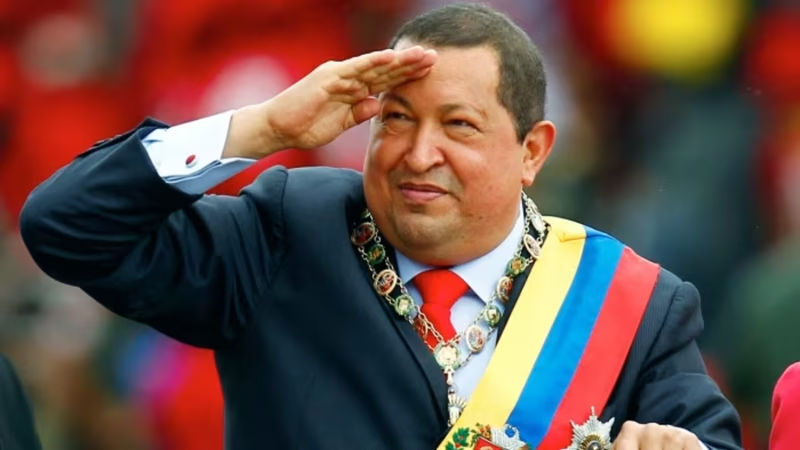
In 2007, when most of the world saw Venezuela through the lens of oil and political controversy, Hugo Chavez saw an opportunity for South-South cooperation. His administration, flush with oil revenue and driven by anti-imperialist ideals, extended financial support to developing educational institutions worldwide—including one in West Bengal.
Chavez Largesse West Bengal School: The 2007 Grant That Changed Everything
The beneficiary was the Bagu Junior Basic School in the North 24 Parganas district. At the time, the school struggled with crumbling infrastructure, overcrowded classrooms, and inadequate safety measures. Then came the unexpected lifeline: a grant of Rs 12 lakh (approximately $30,000 at the time) from the Venezuelan government .
This wasn’t just a donation—it was a transformation. The funds were used to:
- Construct two new, well-ventilated classrooms to reduce student density.
- Install proper windows, doors, and boundary walls for safety and security.
- Improve sanitation facilities, a critical need for rural schools in India.
- Procure basic teaching aids and furniture for better learning conditions.
For the teachers and students, this was more than money—it was dignity. The school, once overlooked, became a symbol of what international solidarity could achieve when it bypassed bureaucracy and reached those who needed it most.
From Funding to Faith: Prayers for Venezuela
Fast forward to 2025. Venezuela is embroiled in deep political and economic turmoil. In response, the staff and students of Bagu Junior Basic School recently held a special assembly—not for themselves, but for their distant benefactor’s homeland.
“We may be small, but our hearts are big,” said a teacher during the event. “Venezuela gave us hope when we had little. Now, we pray for peace in their land.” The prayer session included lighting candles, singing peace hymns, and a moment of silence for the people of Venezuela .
This act of empathy is remarkable not just for its sincerity, but for its rarity. In an age of transactional geopolitics, here is a community that remembers kindness—and reciprocates not with money, but with compassion.
The Political and Diplomatic Context of the Gift
The 2007 grant must be understood within the broader framework of Hugo Chavez’s foreign policy. As a vocal critic of U.S. hegemony, Chavez championed alliances with Global South nations, including India. Though not a major trading partner, India was seen as a strategic democratic ally in Asia .
Chavez’s visit to India in 2005 laid the groundwork for deeper ties. While most collaborations focused on energy (notably PDVSA’s stake in India’s Orissa Refinery), this educational grant was a softer, people-to-people initiative—reflecting Chavez’s belief that “another world is possible” through mutual aid .
Interestingly, the West Bengal government at the time, led by the Left Front, shared ideological sympathies with Chavez’s socialist platform, which may have facilitated the school’s selection. Today, even as political regimes have changed, the human connection endures.
Why This Story Matters Today
In a world increasingly defined by isolationism and digital detachment, the Bagu school’s gesture is a powerful reminder of three truths:
- Global solidarity isn’t abstract. It lives in classrooms, in rebuilt walls, and in children’s memories.
- Gratitude transcends borders. The school could have forgotten the source of its aid—but it chose to remember.
- Education is a universal language. Whether in Kolkata or Caracas, safe, dignified learning spaces are a shared human aspiration .
Moreover, this story challenges cynical narratives about foreign aid. Not all international assistance is strategic or self-serving. Sometimes, it’s simply human.
Global Solidarity in Local Classrooms
The legacy of the Chavez largesse West Bengal school extends beyond bricks and mortar. It’s embedded in the values being taught to a new generation. Students at Bagu Junior Basic School now learn not just mathematics and science, but also the importance of empathy, global citizenship, and paying kindness forward.
While Venezuela faces an uncertain future, and Hugo Chavez has been gone for over a decade, his gesture—however small in the grand scheme of geopolitics—continues to ripple outward. And in a quiet corner of West Bengal, children fold their hands not for themselves, but for strangers thousands of miles away.
Summary
The Bagu Junior Basic School’s recent prayer for Venezuela is more than a news item—it’s a testament to the enduring power of kindness. The Chavez largesse West Bengal school received in 2007 did more than build classrooms; it built a bridge of empathy between two nations. In today’s fractured world, this humble act of remembrance offers a beacon of hope that international solidarity can be personal, lasting, and profoundly human.
Sources
- Times of India: West Bengal school that received Chavez largesse prays for peace in Venezuela
- United Nations Educational, Scientific and Cultural Organization (UNESCO): Global Education Monitoring Reports
- [INTERNAL_LINK:india-venezuela-diplomatic-relations]
- [INTERNAL_LINK:grassroots-foreign-aid-success-stories]
- Al Jazeera: The Legacy of Hugo Chavez in Global South Diplomacy