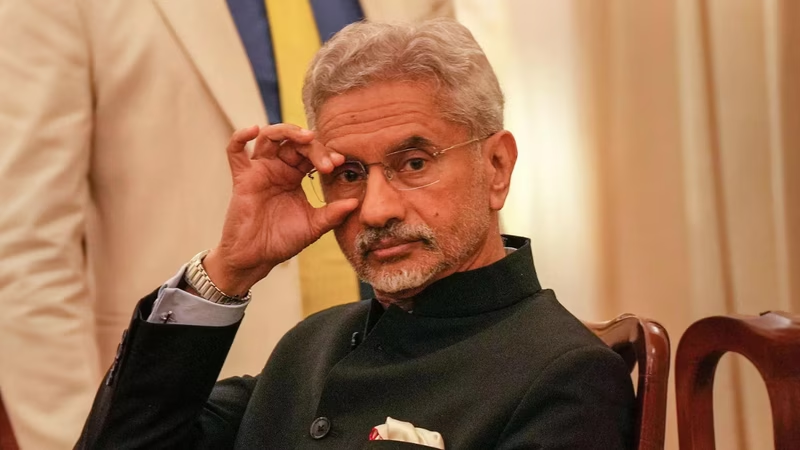
In a rapidly evolving geopolitical flashpoint, the United States has reportedly launched military strikes inside Venezuela—triggering swift diplomatic reactions from capitals around the world. Among the most notable responses came from New Delhi, where External Affairs Minister Dr. S. Jaishankar voiced India’s “deep concern” over the escalation and urged all parties to prioritize the safety of civilians and respect the principles of international law.
While full details of the US strikes in Venezuela remain under scrutiny—with the Pentagon yet to release an official operational breakdown—the mere confirmation of military action on Venezuelan soil has reignited debates about sovereignty, interventionism, and the fragile balance of power in the Western Hemisphere. India’s measured but firm stance reflects its long-standing foreign policy doctrine of non-interference, coupled with a growing emphasis on human security in conflict zones.
Table of Contents
- What Happened? Details of the US Strikes in Venezuela
- Jaishankar’s Statement: India’s Diplomatic Position
- Historical Context: US-Venezuela Relations and Past Interventions
- Global Reactions: From Russia to the UN
- India-Venezuela Relations: Trade, Oil, and Strategic Neutrality
- Implications for the Global Order and Non-Aligned Nations
- Conclusion: A Call for Restraint in a Fractured World
- Sources
What Happened? Details of the US Strikes in Venezuela
According to multiple international media reports on January 6, 2026, US forces conducted precision airstrikes targeting alleged drug trafficking hubs and illicit mining operations in southern Venezuela—areas long controlled by armed non-state groups with suspected ties to the Maduro regime. The US Department of Defense cited “imminent threats to regional security” and “violations of international counter-narcotics agreements” as justification.
While the White House framed the action as “limited, surgical, and intelligence-driven,” critics—including the Venezuelan government—denounced it as a “blatant violation of sovereignty.” President Nicolás Maduro called an emergency session of the National Defense Council and vowed to “defend every inch of Venezuelan territory,” raising fears of potential escalation.
Notably, the strikes occurred without prior UN Security Council authorization—a fact that has drawn sharp criticism from several Global South nations and amplified concerns about unilateral military action.
Jaishankar’s Statement: India’s Diplomatic Position
Speaking at a press briefing in New Delhi, External Affairs Minister S. Jaishankar addressed the unfolding crisis with characteristic diplomatic precision. “India is deeply concerned by the reports of military strikes inside Venezuela,” he stated. “We urge all nations to act in accordance with the UN Charter and prioritize the safety and well-being of civilians.”
Jaishankar stopped short of explicitly condemning the United States—a strategic partner in India’s Indo-Pacific framework—but emphasized that “sovereignty and territorial integrity are foundational principles of international relations.” His remarks align with India’s consistent stance against external military intervention, a position rooted in its post-colonial identity and leadership role in the Global South.
The minister also called for “dialogue and peaceful resolution of differences,” echoing New Delhi’s preference for diplomacy over force. This balanced approach allows India to uphold its principled foreign policy while maintaining its complex relationship with Washington.
Historical Context: US-Venezuela Relations and Past Interventions
Tensions between the US and Venezuela have simmered for decades, but they intensified dramatically after 2019, when the US recognized opposition leader Juan Guaidó as Venezuela’s legitimate president—a move rejected by Maduro and most of the Global South.
Key flashpoints include:
- 2020: US indictments against Maduro for narco-terrorism; deployment of naval assets off Venezuela’s coast.
- 2022: Partial easing of sanctions after talks between Maduro’s government and the opposition.
- 2025: Renewed US accusations of electoral manipulation and human rights abuses following Venezuela’s disputed elections.
While direct US military action on Venezuelan soil has been rare, the January 2026 strikes mark a significant escalation—potentially signaling a shift toward more assertive US policy in Latin America under growing domestic pressure to combat fentanyl precursors allegedly sourced from the region.
Global Reactions: From Russia to the UN
The international response has been deeply polarized:
- Russia and China: Condemned the strikes as “imperialist aggression” and called for an emergency UN Security Council session.
- European Union: Expressed “serious concern” but stopped short of condemnation, urging “de-escalation and adherence to international law.”
- Organization of American States (OAS): Remained divided, with Colombia and Brazil calling for dialogue, while Argentina backed Venezuela’s sovereignty.
- United Nations: Secretary-General António Guterres appealed for “maximum restraint” and reaffirmed that “military solutions only deepen human suffering.”
India’s position—alongside South Africa, Indonesia, and Egypt—reflects a broader Global South unease with unilateralism, especially from permanent members of the Security Council.
India-Venezuela Relations: Trade, Oil, and Strategic Neutrality
India and Venezuela maintain modest but historically warm ties. In the early 2000s, Venezuela was a key oil supplier under favorable payment terms, though Indian imports have dwindled to near zero in recent years due to payment sanctions and logistical hurdles.
Currently, bilateral trade stands at less than $200 million annually, focused on pharmaceuticals, machinery, and agricultural products. Despite limited economic stakes, India values Venezuela as a partner in forums like the Non-Aligned Movement (NAM) and has consistently supported its admission to BRICS-led initiatives.
Critically, India has never recognized Guaidó and continues to engage with the Maduro government through diplomatic channels—a stance that reinforces its commitment to non-interference. This neutrality strengthens India’s credibility when advocating for peaceful conflict resolution on global stages.
For more on India’s Latin America strategy, explore our analysis on [INTERNAL_LINK:india-latin-america-diplomacy-2026].
Implications for the Global Order and Non-Aligned Nations
The US strikes in Venezuela represent more than a regional incident—they are a stress test for the rules-based international order. For non-aligned and developing nations, the precedent of unilateral military action undermines the UN Charter’s core principles and erodes trust in multilateral institutions.
India’s response, therefore, carries symbolic weight. As a voice for the Global South and a rising power with strategic autonomy, New Delhi’s call for restraint and civilian protection sets a template for how middle powers can navigate great-power rivalries without compromising their values. In an era of fragmentation, such principled neutrality may be one of the few remaining anchors of global stability.
Conclusion: A Call for Restraint in a Fractured World
As the dust settles on the US strikes in Venezuela, the world watches to see whether this episode sparks wider conflict or leads to renewed diplomacy. India’s position—articulated clearly by Jaishankar—offers a crucial reminder: even in complex geopolitical storms, the safety of ordinary people must remain the highest priority. In a multipolar world where might often trumps right, India’s consistent advocacy for sovereignty, dialogue, and human security stands as a quiet but powerful counterpoint to the drums of war.
Sources
- Jaishankar’s official statement: Times of India
- Background on US-Venezuela relations: U.S. Department of State
- UN Charter and sovereignty principles: United Nations
- India-Venezuela bilateral trade data: Ministry of Commerce and Industry, India