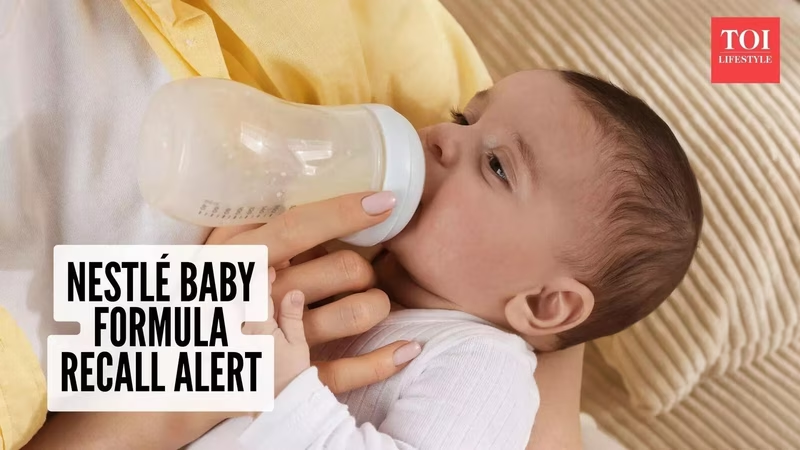
If you’re a parent relying on infant formula to feed your baby, your heart might skip a beat at the words: **baby formula recall**. And that’s exactly what’s happening right now. Global food giant Nestlé has initiated a precautionary recall of select batches of its infant formula across multiple countries after detecting a potential contaminant: **cereulide**, a heat-stable toxin produced by *Bacillus cereus* bacteria.
While the company and health regulators stress that **no illnesses have been reported** linked to this issue, the mere possibility of a toxin in a product designed for the most vulnerable among us—newborns and infants—has sent shockwaves through parenting communities worldwide.
So, what’s really going on? Should you panic? And most importantly—how do you know if your formula is affected? Let’s break it down with clarity, care, and evidence-based facts.
Table of Contents
- What Is the Baby Formula Recall About?
- Which Nestlé Products Are Affected?
- What Is Cereulide—and Why Is It Dangerous?
- Symptoms to Watch For in Infants
- The Role of Arachidonic Acid Oil in the Recall
- Global Regulatory Response
- What Parents Should Do Right Now
- How to Check If Your Formula Is Recalled
- Conclusion: Vigilance Over Panic
- Sources
What Is the Baby Formula Recall About?
Nestlé has voluntarily recalled certain batches of infant formula after internal quality testing revealed the **rare presence of cereulide** in an ingredient used in production: **arachidonic acid (ARA) oil**. This oil is commonly added to infant formulas to mimic the fatty acid profile of breast milk, supporting brain and eye development.
Importantly, the contamination appears to be limited to specific lots of the ARA oil supplied by a third-party vendor—not a systemic failure across all Nestlé production lines. The recall is being described as a **precautionary measure**, reflecting Nestlé’s “responsible action” to ensure infant safety, even in the absence of confirmed health incidents.
Which Nestlé Products Are Affected?
While the exact product names and batch numbers vary by country, the recall primarily impacts:
- Nestlé NAN OPTIPRO HA 1 and HA 2
- Certain variants of Nestlé LACTOGEN
- Select private-label formulas manufactured by Nestlé under contract
The recall has been confirmed in at least **12 countries**, including parts of Europe, Asia, and Latin America. Notably, as of January 2026, **no impacted batches have been distributed in the United States**, according to the FDA. However, parents who purchase formula online or through international retailers should remain cautious.
What Is Cereulide—and Why Is It Dangerous?
Cereulide is a potent **emetic toxin** (meaning it causes vomiting) produced by certain strains of *Bacillus cereus*, a common soil bacterium. Unlike many bacteria, cereulide is **heat-stable**—it doesn’t break down during pasteurization or cooking, making it particularly concerning in processed foods.
In adults, cereulide poisoning typically causes nausea and vomiting within 1–6 hours of ingestion and resolves within 24 hours. But in **infants**, whose immune and digestive systems are immature, the effects can be more severe, potentially leading to dehydration, electrolyte imbalance, or even liver stress in extreme cases.
According to the European Food Safety Authority (EFSA), cereulide is “rarely detected in food but poses a high acute risk to infants” .
Symptoms to Watch For in Infants
If your baby has consumed a recalled formula, monitor for these signs within 1–12 hours:
- Repeated vomiting (not just spit-up)
- Lethargy or unusual drowsiness
- Refusal to feed
- Dehydration signs: dry mouth, fewer wet diapers, sunken soft spot (fontanelle)
- Fever or irritability without other obvious cause
If any of these symptoms appear, **contact your pediatrician or seek emergency care immediately**. Do not wait.
The Role of Arachidonic Acid Oil in the Recall
Arachidonic acid (ARA) is a fatty acid naturally found in breast milk. It’s added to most infant formulas alongside DHA (docosahexaenoic acid) to support neurodevelopment. The ARA oil used in formula production is typically derived from fungal fermentation.
In this case, the contamination likely occurred during the fermentation or purification process of the ARA oil by a supplier. Nestlé has since suspended use of that supplier’s batches and is conducting a full audit. This highlights how **even trace ingredients in complex supply chains can pose unforeseen risks**—especially in products for infants.
Global Regulatory Response
Health authorities have responded swiftly:
- European Commission: Issued an alert via the Rapid Alert System for Food and Feed (RASFF).
- India’s FSSAI: Directed states to pull affected batches from shelves.
- WHO: Monitoring the situation but has not issued a global advisory.
Regulators emphasize this is **not a product defect** but a raw material contamination—a subtle but important distinction for food safety professionals [[INTERNAL_LINK:infant-formula-safety-standards-india]].
What Parents Should Do Right Now
- Check your formula’s batch number against official recall lists (see next section).
- Do not use** any recalled product—even if your baby seems fine.
- Discard or return** the product to the retailer for a refund.
- Consult your pediatrician** before switching formulas abruptly.
- Report any adverse effects to your national health authority.
How to Check If Your Formula Is Recalled
1. **Locate the batch/lot number** (usually printed on the bottom or side of the can).
2. **Visit Nestlé’s official recall portal**: https://www.nestle.com/recall2026 (country-specific links available).
3. **Check your national health authority’s website**—e.g., FSSAI (India), EFSA (Europe), or Health Canada.
4. **Call Nestlé’s consumer helpline** in your country for verification.
Conclusion: Vigilance Over Panic
While the **baby formula recall** is undoubtedly alarming, it’s also a sign that food safety systems are working—detecting potential risks before harm occurs. Nestlé’s proactive stance, though late for some anxious parents, aligns with global best practices for infant nutrition safety.
Stay informed, stay calm, and always prioritize your child’s health. In a world where trust in packaged foods is fragile, transparency and swift action are the first lines of defense.
Sources
- Times of India. “Baby formula recall across multiple countries: Safety concerns and symptoms to watch.” https://timesofindia.indiatimes.com/…
- European Food Safety Authority (EFSA). “Scientific Opinion on Bacillus cereus and Cereulide.” https://www.efsa.europa.eu/
- Nestlé Global. “Product Safety Notice – January 2026.” https://www.nestle.com/