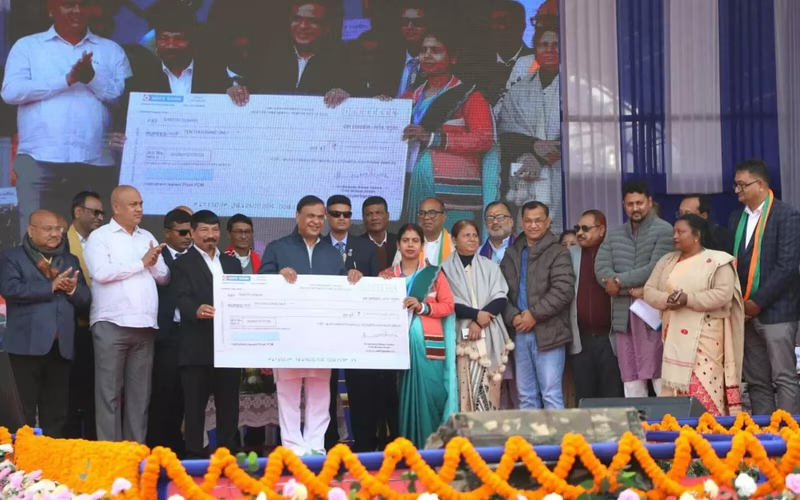
From Seed Capital to Political Storm: The Rise of Assam’s ‘Lakhpati Baideo’ Scheme
In villages across Assam, something unprecedented is happening. Women who once relied on daily wages or farm labor are now opening small shops, poultry units, tailoring centers, and handicraft businesses—thanks to a simple envelope containing Rs 10,000 in seed capital from the state government. Dubbed the Lakhpati Baideo scheme (“Millionaire Sister” initiative), this program has already reached 1.5 million women and aims to empower 4 million by 2026.
But with assembly elections on the horizon, the scheme has ignited debate: Is this a genuine leap toward gender equity and rural economic revival—or a meticulously timed pre-poll gift from Chief Minister Himanta Biswa Sarma’s government?
Table of Contents
- What Is the Lakhpati Baideo Scheme?
- How the MMU-A Initiative Works
- Lakhpati Baideo Scheme: Impact on Rural Economy
- Political Timing and Public Perception
- Challenges and Criticism
- How It Compares to Other Women Schemes
- Conclusion: Empowerment with an Expiry Date?
- Sources
What Is the Lakhpati Baideo Scheme?
Launched under the broader Mahila Samarthya Mission (now rebranded as MMU-A—Mission for Marginalized and Underprivileged in Assam), the Lakhpati Baideo scheme is one of the most aggressive female entrepreneurship drives in India.
Each enrolled woman receives:
- Rs 10,000 as non-refundable seed capital
- Training in business planning, financial literacy, and digital payments
- Access to government procurement channels for products like soaps, pickles, and masks
The goal? To help each woman generate at least ₹1 lakh in annual income—hence the aspirational title “Lakhpati Baideo.”
How the MMU-A Initiative Works
The MMU-A acts as the backbone of this transformation. It’s a mission-mode program that coordinates with district administrations, self-help groups (SHGs), and NGOs to identify beneficiaries, especially from SC/ST, tea tribes, and Bodo communities.
Unlike traditional welfare schemes that disburse cash with little follow-up, MMU-A includes:
- Monthly mentorship by local entrepreneurs
- Digital dashboards to track business progress
- Cluster-based production units to reduce costs and scale output
So far, 15 lakh women out of a targeted 40 lakh have been covered—a 37.5% rollout in under two years .
Lakhpati Baideo Scheme: Impact on Rural Economy
Early data suggests real economic ripple effects:
- In Nagaon district, 62% of beneficiaries reported monthly earnings above ₹8,000 within six months.
- Poultry and organic farming clusters in Darrang have reduced dependency on middlemen.
- Digital literacy has surged, with over 90% of enrolled women now using UPI for transactions .
“Before, I cooked for my family. Now, I supply 50 meals a day to a local school,” says Rekha Devi, 34, from Barpeta. “This Rs 10,000 changed everything.”
Political Timing and Public Perception
Yet, the scheme’s rollout aligns tightly with Assam’s electoral calendar. With state elections expected in early 2026, the BJP-led government is under pressure to consolidate its base—especially among women, who make up 49% of the electorate.
Critics argue the branding—“Lakhpati Baideo”—is a direct echo of Prime Minister Modi’s “Lakhpati Kisan” narrative, repackaged for regional appeal. “It’s welfare with a WhatsApp-forward aesthetic,” says political analyst Dr. Arunabh Saikia. “Effective? Yes. Purely developmental? Unlikely.”
Still, public sentiment leans positive. A recent CSDS survey found 68% of rural women in Assam view the scheme favorably—regardless of political affiliation .
Challenges and Criticism
Despite its promise, the Lakhpati Baideo scheme faces hurdles:
- Scalability: Can 4 million micro-businesses thrive without market saturation?
- Sustainability: Rs 10,000 is often insufficient for equipment or licenses.
- Exclusion Errors: Many eligible women in remote areas remain unregistered due to poor internet or literacy.
Opposition parties also allege favoritism in fund distribution, though no concrete evidence has emerged.
How It Compares to Other Women Schemes
Nationally, Assam’s approach stands out for its direct cash + mentorship model:
| Scheme | State | Support Provided |
|---|---|---|
| Lakhpati Baideo | Assam | ₹10,000 + training + market linkage |
| Indira Gandhi Mahila Shakti Yojana | Rajasthan | ₹5,000 grant + SHG linkage |
| Kudumbashree | Kerala | Interest-free loans + collective enterprises |
Unlike Kerala’s collective model or Rajasthan’s smaller grants, Assam’s strategy is bold, individual-focused, and highly visible—perfect for electoral optics, but harder to sustain long-term.
For more on how states are reimagining women’s welfare, see our feature on [INTERNAL_LINK:innovative-women-empowerment-schemes-in-india].
Conclusion: Empowerment with an Expiry Date?
The Lakhpati Baideo scheme is undeniably transformative for thousands of Assamese women. It provides dignity, agency, and a foothold in the formal economy. But its proximity to elections invites skepticism. True empowerment won’t be measured in enrollment numbers—but in whether these businesses survive, scale, and thrive long after the votes are counted. If Assam can turn this political moment into lasting economic momentum, it may set a blueprint for the nation.
Sources
- Times of India. “Poll-bound Assam intensifies self-employment initiative for women: 15L out of 40L covered.” https://timesofindia.indiatimes.com/…
- Assam State Rural Livelihoods Mission (ASRLM). MMU-A Progress Report, Q3 2025. https://asrlm.assam.gov.in
- Centre for the Study of Developing Societies (CSDS). “Women’s Welfare Schemes and Electoral Trust in Northeast India,” December 2025. https://csds.in
- Ministry of Rural Development, Government of India. National Guidelines on Women Entrepreneurship. https://rural.nic.in