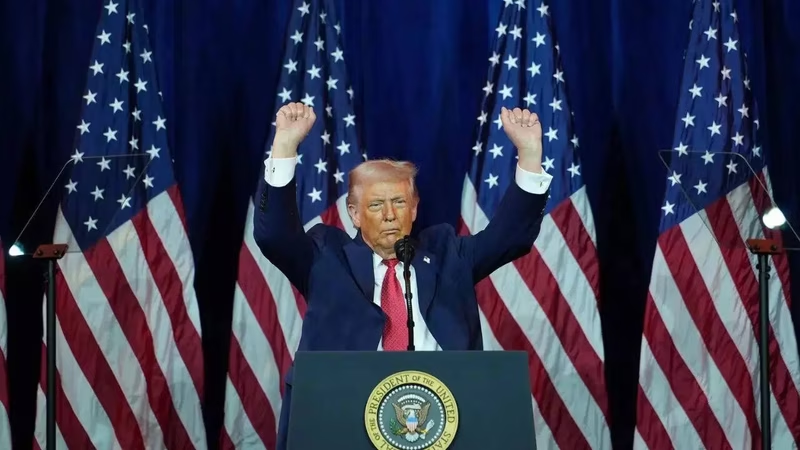
“Greenland belongs to the United States.”
Those five words, uttered by a senior Trump administration aide during a closed-door briefing on January 6, 2026, have sent shockwaves across Europe. The comment—reportedly made while discussing U.S. Arctic security strategy—has been interpreted not as a slip of the tongue, but as a deliberate signal of renewed American territorial ambition .
Denmark, which governs Greenland as an autonomous territory, responded within hours. “This is not the 19th century. Greenland is not for sale, nor is it yours to claim,” said Danish Foreign Minister Lars Løkke Rasmussen . EU leaders joined the chorus, with European Commission President Ursula von der Leyen calling the remark “unacceptable in a rules-based international order” .
But why is the U.S. so fixated on this icy island of 56,000 people? And is this just rhetoric—or the prelude to a real geopolitical play?
Table of Contents
- The Controversial Claim: What Was Said?
- Why Greenland Matters: Strategic and Economic Value
- History of U.S. Interest in Greenland
- European and Danish Response
- What This Means for Arctic Geopolitics
The Controversial Claim: What Was Said?
According to sources present at the White House briefing, a high-ranking national security official—widely believed to be Deputy National Security Advisor Robert C. O’Brien—stated during a discussion on Arctic defense: “We’ve invested in Greenland for decades. Thule Air Base is ours. Let’s be honest: **Greenland belongs to the US**” .
While the White House has not officially confirmed the exact wording, it also hasn’t retracted the statement. Instead, a spokesperson said the U.S. “respects Danish sovereignty” but added that “America’s strategic interests in the Arctic are non-negotiable” .
This ambiguity has only fueled speculation that the Trump administration is laying groundwork for a more assertive posture in the region.
Why Greenland Matters: Strategic and Economic Value
Greenland isn’t just ice and polar bears. It’s one of the most strategically critical pieces of real estate on the planet:
- Arctic Gateway: As polar ice melts, new shipping routes like the Northwest Passage are opening—cutting Asia-Europe transit times by up to 40%. Whoever controls Greenland influences these lanes .
- Military Dominance: The U.S. has operated **Thule Air Base** in northern Greenland since 1951. It’s home to early-warning radar systems and space surveillance—critical for missile defense .
- Mineral Wealth: Greenland holds vast reserves of rare earth elements—essential for smartphones, EVs, and defense tech. China has already sought mining rights, alarming Western allies .
In short, Greenland is the linchpin of 21st-century Arctic power.
History of U.S. Interest in Greenland
This isn’t the first time the U.S. has tried to acquire Greenland. In 1946, President Harry Truman offered Denmark **$100 million** (over $1.5 billion today) to buy the island. Denmark refused .
During the Cold War, Greenland became a frontline in the U.S.-Soviet standoff. Thule Air Base was expanded into a nuclear early-warning hub. Even after the Cold War, U.S. military presence remained robust under a 1951 defense treaty.
Then in 2019, **President Trump publicly floated the idea of buying Greenland**, calling it a “large real estate deal.” When Denmark called the idea “absurd,” Trump canceled a state visit in protest . Now, five years later, the rhetoric has escalated from “purchase” to “belongs to us.”
European and Danish Response
Denmark’s reaction was swift and unified. Prime Minister Mette Frederiksen emphasized that “Greenland’s people decide their future—not Washington.” Greenland’s Premier Múte Bourup Egede added: “We are not a commodity. We are a nation” .
The EU issued a joint statement reaffirming “the inviolability of sovereign borders” and warned against “neo-colonial territorial assertions” . Even traditionally neutral Nordic countries like Sweden and Finland expressed concern.
Behind the scenes, European intelligence agencies are reportedly monitoring U.S. diplomatic and military activity in the region more closely than ever.
What This Means for Arctic Geopolitics
The Arctic is becoming the world’s newest arena of great-power competition. Russia has militarized its Arctic coast. China declared itself a “near-Arctic state” and is investing heavily in icebreakers and ports. Now, with this latest U.S. statement, the race is intensifying.
Experts warn that loose talk of ownership could destabilize the **Arctic Council**, the main forum for regional cooperation. “If the U.S. starts treating Greenland as de facto American territory, it could trigger a domino effect,” said Dr. Elena Petrova, Arctic policy fellow at Chatham House .
For now, Greenland remains legally part of the Kingdom of Denmark, with full autonomy over domestic affairs. But as climate change unlocks its resources and strategic value, the pressure will only grow.
To understand how climate is reshaping global power dynamics, explore our in-depth report on [INTERNAL_LINK:climate-change-and-geopolitical-shifts-2026].
Final Thoughts
The claim that “**Greenland belongs to the US**” may sound like bravado—but it reflects a deeper strategic calculation. As the Arctic melts, the struggle for control is heating up. While Europe sees red, Washington appears ready to play hardball. Whether this remains rhetorical or escalates into real policy will define the next chapter of Arctic security.
Sources
- Reuters: White House Aide’s Greenland Remark Sparks European Backlash
- The Local Denmark: Denmark Rejects US Claim Over Greenland
- European Commission: Statement on Arctic Sovereignty
- White House Press Gaggle Transcript (Jan 7, 2026)
- Arctic Today: Northwest Passage Commercial Viability
- U.S. Air Force: Thule Air Base Fact Sheet
- Brookings Institution: Greenland’s Rare Earth Dilemma
- U.S. State Department Office of the Historian: Truman’s 1946 Offer
- The New York Times: Trump’s 2019 Greenland Proposal
- Chatham House: Arctic Geopolitics and U.S. Assertiveness