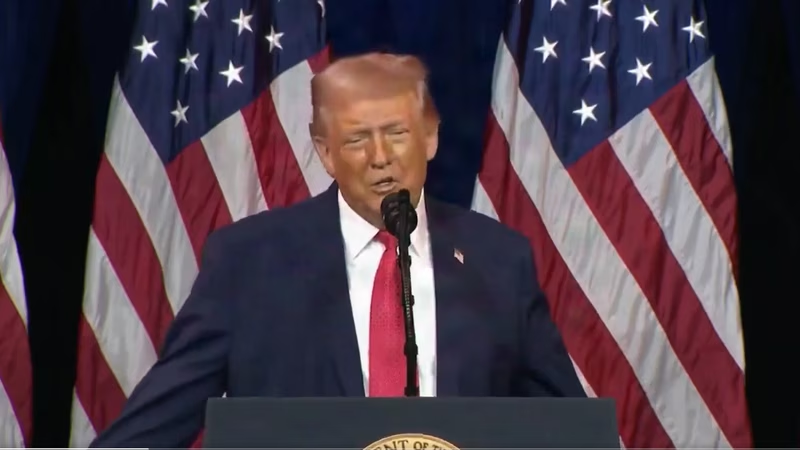
“Nobody could’ve done that.”
Those were the words of President Donald Trump as he stood before a room full of House Republicans at the Kennedy Center on January 6, 2026 . He was, of course, referring to a stunning and controversial US military operation in Venezuela that he claims successfully captured the nation’s long-standing leader, Nicolás Maduro .
But Trump didn’t stop there. He went on to accuse Maduro of being responsible for the deaths and torture of “millions,” painting a picture of a regime built on terror . While his base cheered, international observers and fact-checkers were left scrambling. So, what exactly happened in Venezuela, and how accurate are the President’s dramatic claims?
Table of Contents
- What Did Trump Say in His GOP Address?
- The Trump-Maduro Capture Operation: What We Know
- Fact-Checking the ‘Torture’ and ‘Millions Killed’ Claims
- Political Fallout and Legal Questions
- What Happens Next in Venezuela?
What Did Trump Say in His GOP Address?
During his meeting with House Republicans, President Trump used the Venezuela operation as a centerpiece to showcase his administration’s strength . He framed it as a decisive act that the previous administration—and the current Democratic leadership—would have been too weak to execute .
He directly criticized Democrats for their lack of public support for the mission, calling them out for not acknowledging its success . He also claimed that the “radical left” in the US was financially backing protesters who support the Maduro regime, further deepening the domestic political divide .
The Trump Maduro capture Operation: What We Know
According to official statements from the White House, US forces launched a series of strikes on key infrastructure in northern Venezuela, followed by a direct assault on Maduro’s residence in Caracas . The President confirmed that both Maduro and his wife were apprehended and have been flown out of the country .
This operation, which appears to have been in the works for some time, represents a massive escalation in US foreign policy. Trump had been publicly threatening Maduro for months, even suggesting in late December 2025 that it would be “smart” for the Venezuelan leader to step down voluntarily .
The speed and secrecy of the operation have left many lawmakers stunned. Several Democratic members of Congress have already voiced strong criticism, arguing that the President acted without seeking the necessary congressional authorization for such a military action, which they believe blatantly oversteps his constitutional authority .
Fact-Checking the ‘Torture’ and ‘Millions Killed’ Claims
While the Maduro regime has a well-documented and brutal human rights record, Trump’s specific claim that Maduro has “killed and tortured millions” is a significant exaggeration.
Human rights organizations have indeed reported on widespread abuses. A 2019 UN report, for instance, cited “repression of political opponents, arbitrary detentions and cases of torture and cruel treatment including electric shocks and suffocation” under Maduro’s rule . More recent reports from Human Rights Watch have detailed systemic torture in detention facilities .
However, credible estimates of deaths directly attributable to the regime’s political violence are in the thousands, not millions. For example, one analysis cited 5,287 people killed during Venezuelan security operations over a specific period . While this is a horrifying number, it is orders of magnitude lower than the figure Trump cited. In fact, US intelligence agencies have previously contradicted such inflated claims .
Political Fallout and Legal Questions
The unilateral nature of this military strike has ignited a firestorm in Washington. The core legal question is whether the President had the authority to launch such an operation without a formal declaration of war or an Authorisation for Use of Military Force (AUMF) from Congress.
Historically, such actions have been a source of major constitutional conflict. Critics argue that bypassing Congress sets a dangerous precedent for executive power . Supporters, however, will likely point to the humanitarian justification and the removal of a brutal dictator as a valid reason for swift action.
This event is sure to become a central talking point in the upcoming election cycle, with both parties using it to galvanize their bases. For more on how foreign policy is shaping the 2026 elections, see our analysis on [INTERNAL_LINK:us-foreign-policy-2026-election-impact].
What Happens Next in Venezuela?
With Maduro allegedly captured, a massive power vacuum now exists in Caracas. The question is no longer about his rule, but about who—or what—will fill the void. Will the US support a transitional government? Will rival factions within Venezuela’s military or political landscape vie for control?
The international community, including the United Nations and regional powers like Brazil and Colombia, will be watching closely. The stability of the entire region could hinge on the next few weeks of political maneuvering.
Final Thoughts
President Trump’s announcement of the Trump Maduro capture is a geopolitical earthquake. While the removal of a dictator with a known record of human rights abuses is a significant event, the means, the justification, and the veracity of the accompanying claims are all under intense scrutiny. The world is now waiting to see the full consequences of this bold and controversial move.
Sources
- White House Briefing: President Trump Announces Capture of Nicolás Maduro
- Reuters: US carries out strikes in Venezuela targeting Maduro government
- Associated Press: Trump confirms capture of Venezuelan leader Maduro
- Human Rights Watch: Venezuela
- UN Report on Human Rights Violations in Venezuela (2019)