In a move that could reshape India’s electoral landscape, the Election Commission (EC) has boldly asserted its constitutional authority to conduct a Special Intensive Revision (SIR) of electoral rolls—specifically to identify and remove non-citizens from voter lists. Appearing before the Supreme Court, senior advocate Rakesh Dwivedi, representing the EC, declared: “Citizenship is the bedrock of democratic representation. Only citizens can vote. Only citizens can hold public office.”
This statement, made in response to petitions linking voter rolls with the National Register of Citizens (NRC), has ignited a fierce national conversation. Is the EC overstepping? Or is it simply upholding a foundational principle of democracy? As the legal battle unfolds, one thing is clear: the outcome of this Special Intensive Revision dispute could redefine electoral integrity in India for decades to come.
Table of Contents
- What Is the Special Intensive Revision (SIR)?
- Why the EC Is Fighting This Battle in the Supreme Court
- The Constitutional Argument: Citizenship and Voting Rights
- NRC Fears and Political Fallout
- How SIR Differs from Regular Revision
- Global Comparisons: What Other Democracies Do
- What Happens Next: The Road Ahead
- Conclusion: Democracy Needs Clean Rolls—but at What Cost?
- Sources
What Is the Special Intensive Revision (SIR)?
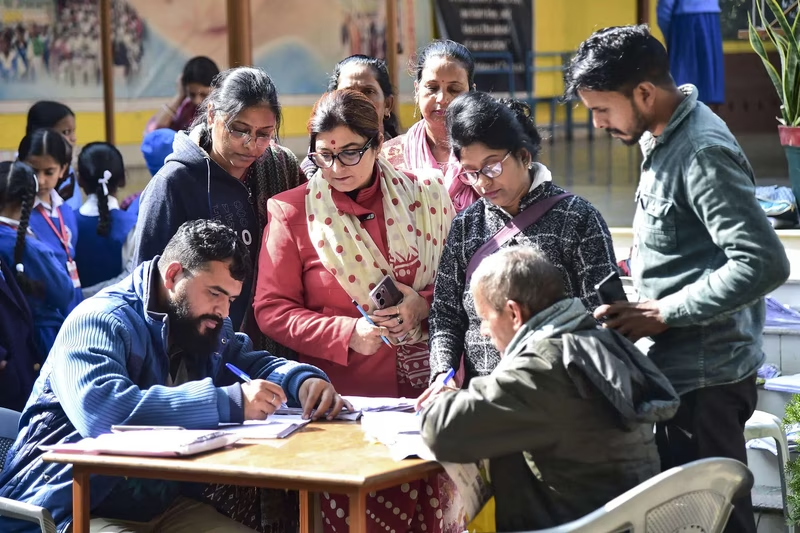
The Special Intensive Revision is not a routine update. It’s a targeted, high-stakes exercise undertaken by the Election Commission to thoroughly verify voter eligibility, especially in areas suspected of large-scale inclusion of ineligible persons—including foreigners.
Unlike the annual revision cycle, SIR involves door-to-door verification, physical hearings, documentary scrutiny, and public display of draft rolls for objections. It’s labor-intensive, legally sensitive, and politically volatile. The EC has conducted SIRs in states like Assam and West Bengal in the past, often amid controversy.
Why the EC Is Fighting This Battle in the Supreme Court
The current legal tussle stems from petitions demanding that the EC link its voter lists with the NRC—a citizenship register last updated in Assam in 2019. Critics fear this could disenfranchise legitimate voters, especially from marginalized communities.
But the EC’s stance is clear: it doesn’t need external mandates to act. Article 324 of the Indian Constitution grants it “superintendence, direction, and control” of elections—including the power to prepare and revise electoral rolls. As Dwivedi argued, “The Commission is not a passive data-collector. It is the final authority on who qualifies as a voter.”
The Constitutional Argument: Citizenship and Voting Rights
The core of the EC’s case rests on two pillars:
- Article 326: Guarantees adult suffrage—but only to “citizens of India.”
- Representation of the People Act, 1950: Explicitly bars non-citizens from voter registration (Section 16).
“You cannot separate voting from citizenship,” Dwivedi emphasized. “To allow non-citizens on electoral rolls is not just an administrative error—it’s a constitutional wrong.”
NRC Fears and Political Fallout
Opposition parties have warned that equating voter lists with NRC could lead to mass exclusion, echoing concerns from Assam where 1.9 million people were left off the 2019 NRC list. Many fear documentation gaps—not lack of citizenship—could disqualify voters.
However, the EC insists its process is fair. “We don’t use NRC as a filter,” an EC official clarified off-record. “We verify nationality through passports, birth certificates, or legacy documents. Due process is guaranteed.”
Still, the political temperature is high. [INTERNAL_LINK:nrc-and-electoral-reforms-in-india]
How SIR Differs from Regular Revision
Here’s a quick comparison:
| Feature | Regular Revision | Special Intensive Revision (SIR) |
|---|---|---|
| Frequency | Annual | Ad-hoc, based on intelligence or court orders |
| Verification | Self-declaration + random checks | Door-to-door, document-based, physical hearings |
| Scope | Nationwide, general update | Targeted (e.g., border districts, urban slums) |
| Legal Scrutiny | Minimal | High—objections can go to Electoral Registration Officers |
Global Comparisons: What Other Democracies Do
India isn’t alone in guarding voter rolls. In the U.S., non-citizens are barred from voting in federal elections, and states like Arizona require proof of citizenship to register. The UK’s Electoral Commission cross-checks voter data with Home Office immigration records.
According to the ACE Electoral Knowledge Network, over 140 democracies explicitly restrict voting to citizens only . The real challenge, as India now faces, is balancing accuracy with inclusion.
What Happens Next: The Road Ahead
The Supreme Court is expected to issue guidelines on how SIR should be conducted without violating due process. Key questions remain:
- Can states demand a stay on SIR pending NRC clarity?
- Who bears the burden of proof—voter or EC?
- Will Aadhaar or NPR data be used as supporting evidence?
One thing is certain: the EC is determined to assert its autonomy. “We will not outsource our constitutional duty,” a senior official told reporters.
Conclusion: Democracy Needs Clean Rolls—but at What Cost?
The Special Intensive Revision debate is about more than procedure—it’s about the soul of Indian democracy. Clean electoral rolls are non-negotiable for fair representation. But so is protecting the right of every eligible citizen to vote without intimidation or bureaucratic hurdles.
As the Supreme Court weighs this delicate balance, the Election Commission’s stand serves as both a warning and a promise: democracy must be pure, but it must also be just. The path forward demands not just legal clarity, but national consensus.
Sources
- Times of India: “SIR row: EC tells SC it has power to undertake electoral roll revision”
- Constitution of India: Articles 324, 326
- Representation of the People Act, 1950 (Section 16)
- ACE Electoral Knowledge Network: “Voter Eligibility Worldwide”
- Supreme Court of India: Writ Petition (Civil) No. ___ of 2026 (SIR Case)