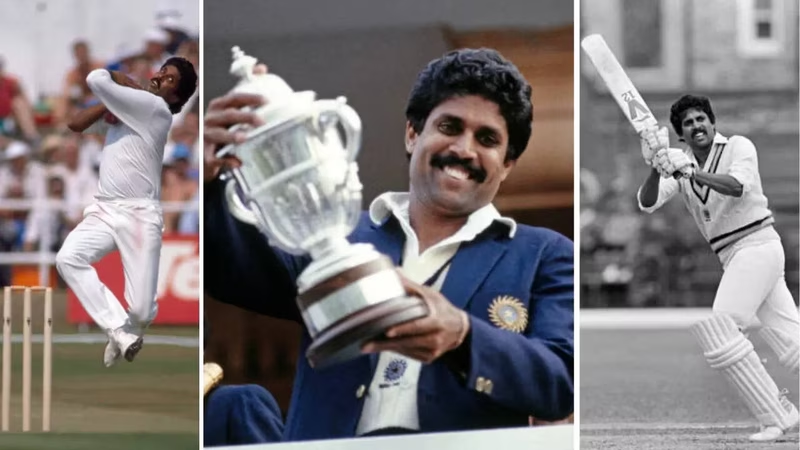
At a time when cricket is dominated by stats, speed guns, and hyper-specialization, it’s worth pausing to reflect on a player who defied easy categorization. Today, as Kapil Dev celebrates his 67th birthday, the question isn’t just about nostalgia—it’s a stark reality: Indian cricket has never truly replaced him.
He wasn’t the fastest bowler of his era. He didn’t boast the most lethal yorker or the unplayable bouncer. Yet, in an age shared with giants like Imran Khan, Ian Botham, and Richard Hadlee, Kapil carved a legacy that remains singular in Indian cricket history. His magic wasn’t in raw pace—it was in relentless accuracy, tireless stamina, and that uncanny ability to swing the ball away from right-handers just when it mattered most.
More than his 434 Test wickets or his swashbuckling 175* at Tunbridge Wells, it was his presence—calm under fire, leading from the front—that elevated him from star to icon. And decades later, despite a conveyor belt of talent, India is still searching for a true successor to this all-round colossus.
Table of Contents
- The Kapil Dev Paradox: Why Stats Don’t Tell the Full Story
- Kapil Dev and the 1983 World Cup: A Leadership Masterclass
- The Four Horsemen of All-Round Greatness
- Why Has India Failed to Produce Another Kapil Dev?
- Honourable Mentions: Who Came Close?
- What Modern Cricket Can Learn from Kapil Dev’s Playbook
- Celebrating Kapil Dev at 67: A Lasting Legacy
- Sources
The Kapil Dev Paradox: Why Stats Don’t Tell the Full Story
Let’s address the elephant in the room: Kapil Dev’s Test bowling strike rate—just under 64 balls per wicket—doesn’t scream “dominance” by today’s T20-influenced standards. He averaged fewer than four wickets per Test, a figure that pales next to modern strike bowlers. But reducing Kapil to numbers is like judging the Mona Lisa by its frame.
His genius lay in context. In an era of uncovered pitches, basic protective gear, and limited support from fellow bowlers, Kapil bowled marathon spells. He once bowled 48 consecutive overs in a Test against Pakistan—a feat almost unthinkable today. His ability to swing the ball with an old cherry, maintain line and length for hours, and still attack with the bat made him India’s one-man engine.
Kapil Dev and the 1983 World Cup: A Leadership Masterclass
No discussion of Kapil Dev is complete without the 1983 World Cup. At just 24, he became the youngest captain to lift the trophy—a record that stood for decades. But it wasn’t just the win; it was *how* he led.
His legendary 175* against Zimbabwe—scored with no official scorer, no backup bat, and with India reeling at 17/5—wasn’t just an innings. It was an act of willpower that saved India’s campaign. And in the final, his iconic running catch to dismiss Viv Richards shifted the momentum irreversibly. As former teammate Sunil Gavaskar once said, “Kapil didn’t just play cricket—he *believed* in the impossible.”
The Four Horsemen of All-Round Greatness
Kapil wasn’t alone in his era. He was part of cricket’s legendary quartet of all-rounders:
- Imran Khan (Pakistan): The strategist with lethal reverse swing.
- Ian Botham (England): The explosive, maverick match-winner.
- Richard Hadlee (New Zealand): The metronomic swing bowler and gritty batsman.
- Kapil Dev (India): The tireless workhorse with heart and swing.
While the others had more polished skills, Kapil’s uniqueness was his completeness. He batted in the top six, opened the bowling, and captained with fearless optimism. In a team often short on confidence, he was the emotional and tactical fulcrum.
Why Has India Failed to Produce Another Kapil Dev?
Since Kapil retired in 1994, India has seen gifted all-rounders—but none who replicated his dual dominance:
- Manoj Prabhakar: A handy bowler but limited with the bat.
- Ajit Agarkar: A strike bowler who occasionally scored quick runs, but not consistently.
- Ravindra Jadeja: Arguably the closest, with over 200 wickets and 2,500+ Test runs, yet his batting remains secondary to his bowling and fielding.
- Hardik Pandya: Explosive in white-ball cricket, but his red-ball fragility and injury concerns limit his all-round impact.
The modern game’s specialization is partly to blame. Today’s players are groomed as batters *or* bowlers early on. The physical and mental demands of excelling in both disciplines at the highest level have never been higher. [INTERNAL_LINK:indian-cricket-all-rounders-through-the-decades]
Honourable Mentions: Who Came Close?
While no one has fully filled Kapil’s shoes, a few have flashed glimpses of that duality:
- Ravindra Jadeja: His fielding and left-arm spin are world-class, and he’s developed into a dependable No. 7. In home conditions, he’s often India’s MVP.
- Irfan Pathan: His 2003–06 peak—swinging the new ball and batting aggressively—hinted at Kapil-esque potential, but injuries and loss of form derailed his career.
What Modern Cricket Can Learn from Kapil Dev’s Playbook
Kapil’s legacy isn’t just about runs and wickets—it’s about attitude. Three lessons stand out:
- Lead by Example: He never asked teammates to do what he wouldn’t do himself.
- Embrace Pressure: From Tunbridge Wells to Lord’s, he thrived when stakes were highest.
- Stay Adaptable: He evolved his game across formats and conditions without losing his core identity.
In an age of data-driven coaching, Kapil reminds us that cricket is still played between the ears. His mental fortitude was his greatest weapon.
Celebrating Kapil Dev at 67: A Lasting Legacy
As Kapil Dev turns 67, his influence echoes far beyond scorecards. He redefined what an Indian cricketer could be—bold, versatile, and unafraid. He inspired a generation that believed India could beat anyone, anywhere.
While the search for his true successor continues, perhaps the answer isn’t in finding another Kapil—but in nurturing players who embody his spirit: relentless, selfless, and fearless. On his birthday, we don’t just celebrate a legend. We honor the blueprint he left behind.
Sources
- Times of India: “Kapil Dev turns 67: The all-rounder Indian cricket never replaced”
- ESPNcricinfo archives on Kapil Dev’s career statistics and 1983 World Cup match reports
- Interviews with Sunil Gavaskar and other 1983 World Cup teammates (as cited in various documentaries)
- International Cricket Council (ICC) historical records