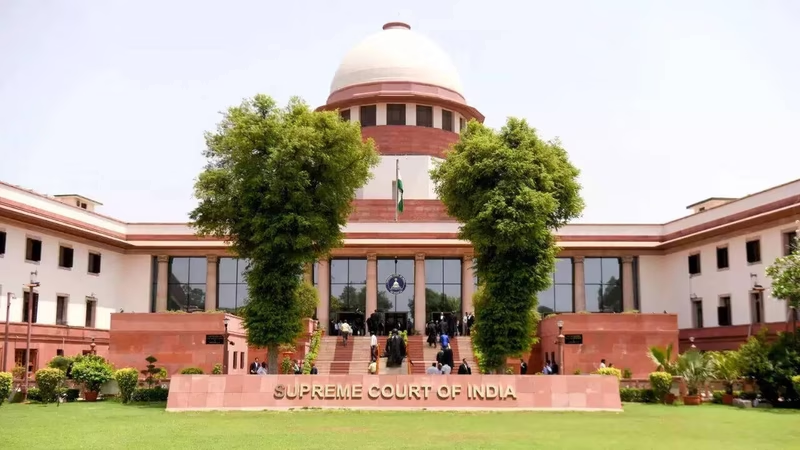
In a powerful affirmation of judicial independence, the Supreme Court of India has delivered a landmark ruling that shields judges from being penalized for honest mistakes. The apex court declared that a fearless judiciary is non-negotiable for the survival of the rule of law and a vibrant democracy. The judgment, which also led to the reinstatement of a lower court judge who was terminated for an error in judgment, sends a clear message: judges must be free to make decisions without the paralyzing fear of personal consequences, especially from frivolous complaints .
Table of Contents
- The Core of the SC’s Landmark Ruling
- Case Background: The Judge Who Was Terminated for an ‘Error’
- Why a Fearless Judiciary is the Bedrock of Democracy
- The Chilling Effect: How Frivolous Complaints Paralyze Justice
- Drawing the Line: Error of Judgment vs. Misconduct
- Implications for India’s Judicial System
- Conclusion: Protecting the Guardians of Justice
- Sources
The Core of the SC’s Landmark Ruling
The Supreme Court’s central and most crucial pronouncement is simple yet profound: judges performing their official duties in good faith cannot be subjected to disciplinary proceedings merely because their decision is later found to be an error in judgment. The bench, recognizing the immense pressure judges face, emphasized that the possibility of making a mistake is an inherent part of the complex judicial process. To punish them for such honest errors would be to invite a culture of timidity and hesitation, directly undermining the very concept of a fearless judiciary . This distinction between a judicial error and an act of misconduct or mala fide intent is critical to the healthy functioning of the justice system.
Case Background: The Judge Who Was Terminated for an ‘Error’
The ruling came in response to a specific and troubling case. A judicial officer had been summarily terminated from service following a decision that was later deemed incorrect by a higher court. The termination was based solely on the outcome of that single judgment, without any investigation into whether the judge had acted in bad faith, with negligence, or with corrupt intent. The Supreme Court found this action to be grossly unjust and disproportionate. By reinstating the judge, the SC sent a strong signal to high courts and judicial service commissions across the country that career-ending punishments for honest judicial errors are unacceptable and illegal .
Why a Fearless Judiciary is the Bedrock of Democracy
The court’s language was unambiguous on this point. It described the judiciary as the “bedrock” of the constitutional scheme. For the judiciary to effectively act as a check on the executive and the legislature, and to protect the fundamental rights of citizens, its members must be insulated from external pressures and threats. A judge who is constantly looking over their shoulder, worried that a bold or unconventional decision might cost them their career, is a judge who will play it safe. This safety-first approach is anathema to justice, which often requires courageous and unpopular rulings to uphold the Constitution. The independence of the judiciary isn’t a privilege for judges; it’s a fundamental right for every citizen who seeks fair and impartial justice .
The Chilling Effect: How Frivolous Complaints Paralyze Justice
One of the most insightful observations from the bench was about the “chilling effect” of frivolous complaints. The court expressed deep concern that a flood of baseless grievances against judges, often filed by disgruntled litigants, is creating an atmosphere of fear, particularly in trial courts. This fear is having a direct and damaging impact on the administration of justice. As the SC noted, trial judges are now becoming overly cautious and hesitating to grant bail, even in deserving cases, simply because they fear that their decision might be challenged and used as a weapon against them . This not only clogs the prison system with undertrials but also violates the basic principle of “bail, not jail” that is central to a fair legal system.
Drawing the Line: Error of Judgment vs. Misconduct
The SC was careful to clarify that its protection is not absolute. The ruling explicitly states that judges can and should be held accountable for:
- Mala fide actions: Decisions made with corrupt or dishonest intentions.
- Gross negligence: A complete and reckless disregard for the law and procedure.
- Proven misconduct: Behavior that is unbecoming of a judicial officer, such as taking bribes or showing bias.
The key distinction lies in the judge’s intent and conduct, not just the final outcome of a case. An honest, well-reasoned decision that is later overturned on appeal is an error of judgment. A decision made for personal gain or out of sheer laziness is misconduct.
Implications for India’s Judicial System
This judgment has far-reaching consequences. It should lead to a more robust framework for handling complaints against judges, one that filters out frivolous cases at an early stage. It also places a responsibility on High Courts to defend their subordinate judges from unwarranted attacks and to foster a work environment that encourages reasoned risk-taking. For the public, it’s a reminder that the judiciary is a human institution, and expecting perfection is unrealistic. The goal is not infallibility but a system where judges can operate with integrity and courage. The Commonwealth Secretariat, in its guidelines on judicial conduct, similarly stresses the need to protect judges from unfounded allegations to preserve public confidence in the justice system .
Conclusion: Protecting the Guardians of Justice
The Supreme Court’s ruling is a timely and necessary shield for the Indian judiciary. By firmly establishing that a fearless judiciary cannot be held hostage to the fear of punishment for honest errors, the court has taken a giant step towards ensuring that justice can be delivered boldly and without fear or favor. This judgment is not just about protecting judges; it’s about protecting the very soul of our democracy. The guardians of our Constitution must themselves be guarded from the toxic culture of retribution for making difficult calls. For more on judicial reforms in India, see our [INTERNAL_LINK:india-judicial-reform-challenges].
Sources
1. The Times of India. “SC: Fearless judges bedrock of judiciary, can’t be penalised for error of judgment.” https://timesofindia.indiatimes.com/india/fearless-judges-bedrock-of-judiciary-cant-be-penalised-for-error-of-judgment-supreme-court/articleshow/126363824.cms .
2. Supreme Court of India. “Report of the National Judicial Commission.” https://main.sci.gov.in .
3. Commonwealth Secretariat. “Commonwealth (Latimer House) Principles on the Accountability of and Relationship between the Three Branches of Government.” https://thecommonwealth.org .