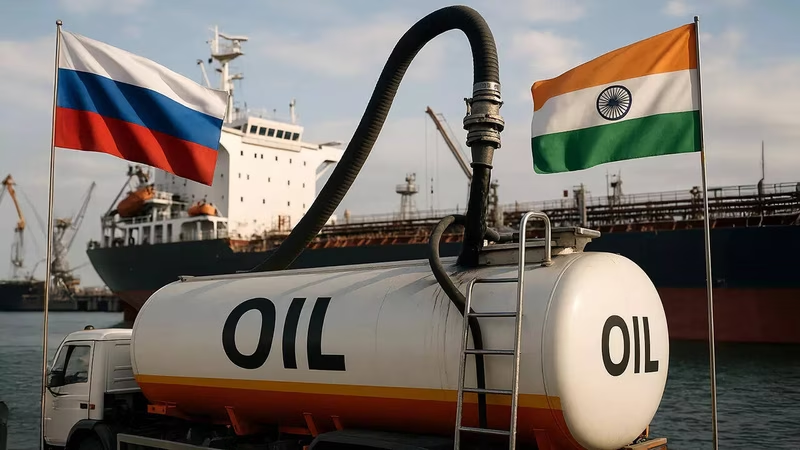
In a move that has rewritten the rules of global energy geopolitics, India has emerged as a colossal buyer of Russian oil, importing an eye-watering **€144 billion** worth of crude since Russia’s full-scale invasion of Ukraine in February 2022. This massive influx of discounted oil transformed India from a marginal player in Russia’s energy export market to its second-largest customer, right behind China. This strategic pivot wasn’t just a smart economic play for New Delhi—it was a masterclass in geopolitical opportunism that simultaneously filled Moscow’s war chest at a time when Western buyers were fleeing. Now, however, this lucrative **India Russia oil trade** is showing signs of strain under the weight of new, more aggressive international sanctions .
Table of Contents
- The €144 Billion Opportunity: How India Seized the Moment
- India’s Rise as Russia’s Energy Lifeline
- The Mechanics of the Deal: How the Trade Actually Worked
- New Sanctions, New Challenges: Why the Trade is Cooling
- The Global Ripple Effect: Reshaping Energy Markets
- Conclusion: A High-Stakes Balancing Act for India
- Sources
The €144 Billion Opportunity: How India Seized the Moment
When the West imposed sweeping sanctions on Russian energy, it created a massive vacuum in the global oil market. Russian Urals crude, once a staple for European refiners, was suddenly available at steep discounts of $20-$30 per barrel. While Europe scrambled to find alternatives, India, with its massive and growing energy demand, saw a golden opportunity. State-owned refiners like Indian Oil Corporation (IOC) and Reliance Industries, one of the world’s largest private refiners, moved swiftly. They began buying massive cargoes of discounted Russian oil, processing it into fuels, and either selling it domestically or even re-exporting some to Europe. This single strategic decision has saved India billions of dollars in its import bill and supercharged its refining sector’s profits .
India’s Rise as Russia’s Energy Lifeline
The scale of this shift is staggering. Before the war, Russia accounted for a mere 2% of India’s oil imports. By 2023, that figure had skyrocketed to over **40%**, making Russia India’s top supplier for several months running . This surge directly filled the gap left by Western nations and proved to be a critical economic lifeline for the Kremlin. At a time when its primary market was collapsing, India (alongside China) provided a ready, willing, and massive buyer. This transformation cemented India’s position as Russia’s second-largest crude oil customer, a title it has held with significant economic and strategic weight .
The Mechanics of the Deal: How the Trade Actually Worked
This wasn’t a simple transaction. The **India Russia oil trade** operated through a complex financial and logistical web designed to circumvent Western sanctions.
- Payment Mechanisms: To avoid the SWIFT banking system, the two nations heavily relied on alternative currencies, primarily the UAE Dirham and a mix of the Russian Ruble and Indian Rupee. This created its own set of complications around exchange rates and settlement liquidity.
- Shadow Fleet: A significant portion of the oil was transported by a so-called “shadow fleet” of tankers—older vessels often with obscured ownership—to avoid price cap mechanisms imposed by the G7.
- The Price Cap Loophole: The EU’s price cap, set at $60 per barrel, was often difficult to enforce on sales to countries like India, allowing Moscow to sell above the cap and still find eager buyers .
This intricate system allowed the trade to flourish for nearly two years.
New Sanctions, New Challenges: Why the Trade is Cooling
However, this lucrative arrangement is now facing its biggest test. Recent, more aggressive sanctions from the US and UK have specifically targeted the “shadow fleet” and the financial networks facilitating the trade. These measures have made shipping and insuring Russian oil far more expensive and risky. As a result, data from market analysts shows that India’s purchases of Russian crude have **dipped significantly in recent months** . The era of easy, super-discounted oil may be coming to an end, forcing Indian refiners to recalibrate their sourcing strategies and potentially pay more for their crude.
The Global Ripple Effect: Reshaping Energy Markets
The impact of this trade has been felt worldwide. It’s a prime example of how sanctions can be blunted by the laws of supply and demand. While Europe successfully reduced its direct dependence on Russian energy, the global oil price was stabilized by the massive absorption of that oil by Asia. For India, the benefits were clear: lower energy costs for its economy. For Russia, it meant survival. The International Energy Agency (IEA) in its 2025 report highlighted this Eastward shift as a defining feature of the post-invasion energy landscape, noting that it has created a more fragmented and complex global market .
Conclusion: A High-Stakes Balancing Act for India
India’s €144 billion bet on Russian oil has been a resounding short-term success, boosting its economy and refining industry. However, it has also placed New Delhi in a delicate geopolitical position, walking a tightrope between its strategic partnership with the US and its pragmatic energy needs. As Western sanctions tighten their grip, the sustainability of the **India Russia oil trade** is increasingly in question. The next phase will test India’s ability to navigate this complex landscape, balancing its economic interests with the growing pressure from its Western allies. The era of easy oil may be over, but the strategic lessons from this energy gamble will shape India’s foreign policy for years to come. For more on India’s energy strategy, see our [INTERNAL_LINK:india-energy-security-2026].
Sources
1. The Times of India. “Russia oil trade: India imported €144bn worth of crude since start of Ukraine war.” https://timesofindia.indiatimes.com/business/india-business/russia-oil trade-india-imported-144-billion-worth-of-crude-since-start-of-ukraine-war-second-largest-buyer-after-china/articleshow/126376325.cms .
2. Reuters. “India’s share of Russian oil imports soars to record high.” https://www.reuters.com, 2023 .
3. Financial Times. “How India and China are keeping Russian oil flowing.” https://www.ft.com, 2024 .
4. International Energy Agency (IEA). “Oil 2025: Analysis and forecast to 2030.” https://www.iea.org/reports/oil-2025 .