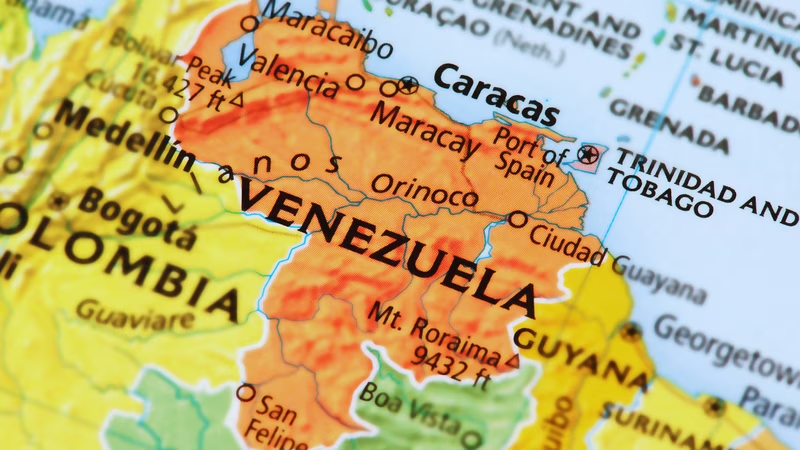
In a decisive move to protect its citizens, the Ministry of External Affairs (MEA) has issued a formal and urgent India travel advisory Venezuela, effectively telling all Indians to stay away unless absolutely necessary. This stark warning, released on January 6, 2026, comes amid a rapid deterioration of the security and humanitarian situation in the South American nation. With crime rates soaring, political instability deepening, and essential supplies like food, water, and medicine becoming scarce, Venezuela has become a high-risk destination. For the estimated few hundred Indian nationals who may still be there—often working in sectors like oil and gas or part of the small Indian diaspora—the MEA has also published a dedicated emergency helpline to seek immediate assistance .
Table of Contents
- Why India Issued This Travel Advisory Now
- Inside Venezuela’s Crisis: The Perfect Storm of Instability
- Global Consensus: The US, Canada, and Australia Join the Warning
- What the Advisory Means for Indian Citizens
- Emergency Contacts and Safety Protocols for Those in Venezuela
- How to Stay Informed and Plan Future Travel
- Conclusion: Safety First in an Unpredictable Environment
- Sources
Why India Issued This Travel Advisory Now
The timing of the India travel advisory Venezuela is not coincidental. It’s a direct response to a significant spike in volatility. Recent weeks have seen a surge in civil unrest, with anti-government protests met with a heavy-handed response. Simultaneously, the country’s economic freefall has accelerated, leading to hyperinflation and a complete breakdown in public services. This has created a fertile ground for violent crime, including armed robbery and kidnapping, which now pose a severe and immediate threat to foreigners and locals alike. The MEA’s advisory is a classic example of a government acting on real-time intelligence to fulfill its primary duty: the welfare of its citizens abroad .
Inside Venezuela’s Crisis: The Perfect Storm of Instability
To understand the gravity of the MEA’s warning, one must grasp the multi-layered crisis gripping Venezuela:
- Political Turmoil: The country remains deeply polarized between supporters of President Nicolás Maduro and a fractured but determined opposition. The political deadlock has paralyzed governance and fueled social unrest.
- <Humanitarian Emergency: According to the United Nations, over 7 million Venezuelans have fled the country since 2015. For those who remain, access to basic necessities is a daily struggle. Hospitals lack supplies, clean water is unreliable, and power outages are frequent .
- Crime Epidemic: Caracas, the capital, has consistently ranked among the most violent cities in the world. The collapse of law and order has empowered criminal gangs and traffickers, making the country extremely dangerous for visitors .
This toxic combination makes any non-essential travel not just unwise, but potentially life-threatening.
Global Consensus: The US, Canada, and Australia Join the Warning
India is far from alone in its assessment. This advisory places India firmly within a global consensus that views Venezuela as a high-risk zone. The United States State Department has maintained its highest-level “Do Not Travel” warning for Venezuela for years, citing crime, civil unrest, and the risk of wrongful detention . Similarly, Canada’s official travel advice strongly recommends avoiding all travel to Venezuela, while Australia’s Smartraveller service has issued a “Reconsider your need to travel” alert, its second-highest level of warning . This international alignment underscores that the risks are not a matter of perception but are grounded in verifiable, on-the-ground realities.
What the Advisory Means for Indian Citizens
The MEA’s message is clear and direct:
- Avoid All Non-Essential Travel: If your trip to Venezuela is for tourism, visiting friends, or any purpose that is not critically urgent, it should be postponed indefinitely.
- Reconsider Essential Travel: Even for essential purposes like official business, extreme caution is advised. A thorough risk assessment and robust security protocols are a must.
- Register Your Travel: Any Indian citizen who must travel to Venezuela is strongly urged to register their travel details with the Indian Embassy in Caracas through the MADAD portal .
Emergency Contacts and Safety Protocols for Those in Venezuela
For the small number of Indian nationals currently in Venezuela, the MEA has provided a lifeline. The emergency helpline number is **+58-212-9763366**. This line is operational for immediate consular assistance. Beyond this, the Indian Embassy in Caracas advises its citizens to:
- Limit their movement and avoid all demonstrations and large gatherings.
- Maintain a low profile and avoid displaying signs of wealth.
- Keep a close watch on local news and official MEA updates via their social media channels.
- Have a contingency plan for evacuation if the situation deteriorates further.
How to Stay Informed and Plan Future Travel
Travel advisories are dynamic. The situation in Venezuela could evolve rapidly. Before making any future travel plans, it is crucial to check the official MEA website for the latest advisory status. You can find all country-specific travel information on the Ministry’s portal under the ‘Travel Advisory’ section. For a comprehensive guide on international travel safety, see our [INTERNAL_LINK:global-travel-safety-tips-2026].
Conclusion: Safety First in an Unpredictable Environment
The India travel advisory Venezuela is a clear, necessary, and responsible action by the government. It reflects the harsh reality on the ground in a nation besieged by political, economic, and social collapse. For Indian citizens, the message is unambiguous: your safety is paramount. Heed this warning, stay informed through official channels, and avoid this volatile region until a more stable and secure environment is established. In matters of international travel, caution is never an overreaction—it’s the smartest strategy.
Sources
1. The Times of India. “India issues travel advisory for Venezuela; shares emergency helpline details.” https://timesofindia.indiatimes.com/life-style/travel/news/india-issues-travel-advisory-for-venezuela-after-recent-developments-shares-emergency-helpline-details/articleshow/126374312.cms .
2. United Nations Office for the Coordination of Humanitarian Affairs (OCHA). “Venezuela Humanitarian Response Plan 2025.” https://www.unocha.org .
3. Council on Foreign Relations. “Venezuela: The Crisis Explained.” https://www.cfr.org .
4. U.S. Department of State. “Venezuela Travel Advisory.” https://travel.state.gov .
5. Government of Canada. “Travel Advice and Advisories for Venezuela.” https://travel.gc.ca .
6. Ministry of External Affairs, Government of India. “MADAD Portal for Indian Citizens Abroad.” https://madad.gov.in .