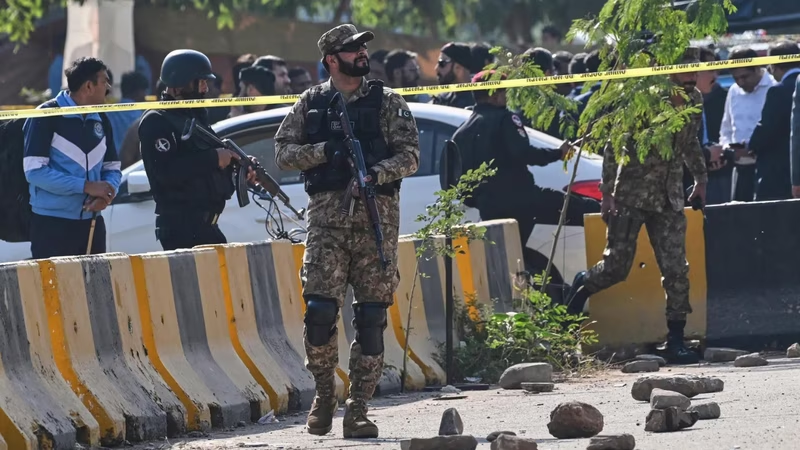
In a move that can only be described as a stunning act of self-incrimination, Pakistan’s powerful military establishment has publicly admitted to a festering wound at the heart of its national security: a deeply entrenched political-criminal-terror nexus. This isn’t a claim from a foreign intelligence agency or a political opponent; it’s an official, on-the-record acknowledgment from the very institution tasked with the country’s defense. The admission comes amid a terrifying spike in violence that has left hundreds dead and the nation on edge, forcing a long-overdue, yet deeply concerning, confrontation with a complex and deadly reality .
Table of Contents
- Pakistan’s Own Goal: The Military’s Rare Admission
- The Alarming Numbers: A Surge in Violence
- Ground Zero: Why Khyber Pakhtunkhwa is the Epicenter
- How the Nexus Works: A Symbiotic Relationship
- What This Means for Regional Security
- Conclusion: A Dangerous Crossroads for Pakistan
- Sources
Pakistan’s Own Goal: The Military’s Rare Admission
On January 6, 2026, the Director General of Inter-Services Public Relations (DG ISPR), Lieutenant General Ahmed Sharif Chaudhry, made a statement that sent shockwaves through diplomatic and security circles. He explicitly confirmed the existence of a political-criminal-terror nexus, a term that encapsulates a dangerous alliance between local political powerbrokers, organized criminal gangs, and militant terrorist outfits . This is a significant departure from the usual state narrative, which often downplays or denies such systemic collusion. The military’s admission, in this case, is a tacit acknowledgment that the enemy is not just external but is deeply woven into the country’s own political and social fabric .
The Alarming Numbers: A Surge in Violence
The admission is not made in a vacuum. It is a direct response to a terrifying escalation in violence across Pakistan. The latest data paints a grim picture:
- A staggering 46% surge in violence was recorded in the third quarter of 2025 alone .
- The country witnessed at least 329 separate violent incidents, including terrorist attacks and major security operations .
- These incidents resulted in a horrifying toll of 901 fatalities and 599 injuries .
Lt. Gen. Chaudhry further revealed that a shocking **71% of all terrorist incidents reported in 2025** can be directly attributed to this very nexus . This data transforms the military’s statement from a theoretical observation into a data-backed crisis of national proportions.
Ground Zero: Why Khyber Pakhtunkhwa is the Epicenter
While the problem is national, the province of Khyber Pakhtunkhwa (KP) has been identified as the primary battleground and the worst-hit region . The mountainous, tribal territories of KP have long served as a sanctuary for various militant groups. The new element, however, is the formalized alliance with local political actors who provide logistical support, intelligence, and a degree of political cover, while criminal networks supply the funding, weapons, and smuggling routes. This toxic cocktail has turned the province into a primary launchpad for violence that threatens the entire country’s stability.
How the Nexus Works: A Symbiotic Relationship
Understanding the political-criminal-terror nexus requires seeing it as a self-sustaining ecosystem. It’s not a one-off event but a symbiotic relationship where each player benefits from the chaos.
- The Political Element: Local politicians, often from powerful families, use militant groups as private militias to eliminate rivals, control votes, and maintain their fiefdoms. In return, they shield these groups from law enforcement.
- The Criminal Element: Organized crime syndicates provide the essential infrastructure: arms trafficking, drug smuggling for funding, and the logistics network needed to move fighters and supplies across porous borders.
- The Terrorist Element: Militant groups gain safe havens, a steady stream of recruits from disenfranchised communities, and the political and criminal support needed to regroup, train, and launch attacks with alarming efficiency .
This intricate web makes traditional counter-terrorism strategies, which often target one element in isolation, largely ineffective.
What This Means for Regional Security
Pakistan’s internal crisis is a direct threat to its neighbors and the wider region. A state that admits its own soil is a breeding ground for a complex terror network cannot be a reliable partner for regional peace. For India, this admission validates long-standing concerns about cross-border terrorism originating from Pakistani soil . It also raises serious questions for international partners, including the United States and China, who have significant strategic and economic interests in the region. The stability of an entire region now hinges on whether Pakistan can dismantle a network it has, for years, been accused of nurturing. The Brookings Institution, a leading global think tank, has long documented the complex interplay between state policy and non-state militant actors in South Asia, highlighting the regional security implications of such internal failures .
Conclusion: A Dangerous Crossroads for Pakistan
Pakistan’s admission of the political-criminal-terror nexus is a moment of profound reckoning. It is both a sign of a new, perhaps forced, honesty and a stark warning of the monumental challenge ahead. Merely acknowledging the problem is the first, and easiest, step. The real test lies in taking concrete, sustained, and politically costly action against powerful domestic actors who are part of the problem. The surge in violence in 2025 is not a statistic; it’s a symptom of a deep, systemic rot. The world will be watching closely in 2026 to see if Pakistan’s moment of truth translates into a genuine war on this internal enemy, or if this admission becomes just another footnote in a long history of strategic ambiguity. For more on the implications for South Asian geopolitics, see our [INTERNAL_LINK:pakistan-india-relations-2026] analysis.
Sources
1. The Times of India. “Own goal? Pakistan admits political-criminal-terror nexus on its soil; report flags rising violence.” https://timesofindia.indiatimes.com/world/pakistan/own-goal-pakistan-admits-political-criminal-terror-nexus-on-its-soil-report-flags-rising-violence/articleshow/126374963.cms .
2. Data on violence surge from a report cited in multiple news sources, January 2026 .
3. “KP worst-hit by terrorism due to political-criminal-terror nexus: ISPR DG.” National News, January 6, 2026 .
4. “Terror Nexus in Khyber Pakhtunkhwa | DG ISPR Exposes Political–Criminal Alliance Behind Violence.” Official ISPR statement .
5. Brookings Institution. “The Crime-Terror Nexus in Pakistan: A Persistent Challenge.” https://www.brookings.edu .