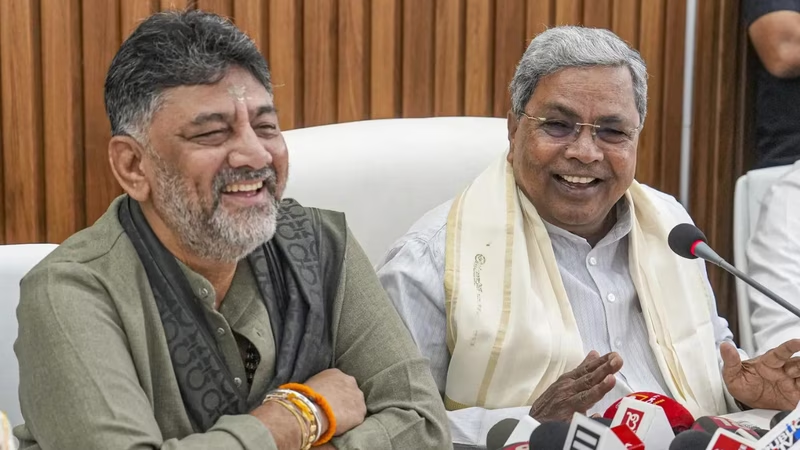
“I will complete my full five-year term,” declared Karnataka Chief Minister Siddaramaiah with unmistakable confidence—and a hint of defiance. His statement comes amid swirling rumors of power struggles within the ruling Congress party, particularly around his working relationship with Deputy CM D.K. Shivakumar. But in a move that surprised many, Shivakumar himself responded not with a challenge, but with a public message: “Good luck.”
On the surface, it’s a moment of unity. But beneath the pleasantries lies a high-stakes political balancing act that could shape Karnataka’s governance for years to come. Can Siddaramaiah—now in his second innings as CM at 76—truly deliver a stable, full-term government? And what does Shivakumar’s “good luck” really mean in the cutthroat world of Karnataka politics?
Table of Contents
- Siddaramaiah’s Full-Term Pledge: Confidence or Campaign Strategy?
- The “Good Luck” Message: Unity or Calculated Courtesy?
- A Complicated History: From Rivals to Ruling Duo
- Key Challenges Threatening Siddaramaiah’s Full Term
- Public Opinion and Governance: Can Delivery Secure Stability?
- The 2028 Elections Already Looming Large
- Conclusion: Unity Today, Uncertainty Tomorrow?
- Sources
Siddaramaiah’s Full-Term Pledge: Confidence or Campaign Strategy?
When Siddaramaiah says he’s “confident” of completing his Siddaramaiah full term, he’s sending multiple signals at once. To voters, it’s a promise of stability. To rivals like the BJP and JD(S), it’s a show of strength. And to his own party, it’s a reminder of who’s in charge—for now.
Having led Karnataka from 2013 to 2018 before losing power, Siddaramaiah returned in 2023 with a decisive mandate. But his second term is more complex: he shares power with Shivakumar, a powerful Vokkaliga leader whose grassroots clout was instrumental in the Congress victory. This delicate power-sharing arrangement has fueled speculation that Shivakumar might push for greater influence—or even a mid-term succession plan.
The “Good Luck” Message: Unity or Calculated Courtesy?
Shivakumar’s public response—“Good luck”—was brief but loaded. In Indian political culture, such phrases can be both supportive and subtly distancing. Was it genuine goodwill? Or a polite way of saying, “I’ll let you lead—for now”?
Notably, Shivakumar did not echo Siddaramaiah’s claim about a full term. He offered wishes, not pledges. This nuance hasn’t gone unnoticed by political analysts. “It’s classic Karnataka politics,” says Dr. Anand Kumar, a political scientist at JNU. “Public harmony masks private calculations.”
A Complicated History: From Rivals to Ruling Duo
Siddaramaiah and Shivakumar were once bitter rivals within the Congress. Siddaramaiah, a Kuruba leader, and Shivakumar, a Vokkaliga heavyweight, represented competing caste-based support bases—a dynamic that often split the party.
It was only after Siddaramaiah left the JD(S) and joined Congress in 2006 that a fragile truce began. But tensions resurfaced repeatedly, especially during ticket distribution and leadership debates. Their current alliance is less about friendship and more about electoral necessity: together, they command both dominant non-Brahmin communities in southern Karnataka, which is crucial to keeping the BJP at bay.
Key Challenges Threatening Siddaramaiah’s Full Term
Despite his confidence, several risks loom large:
- Internal dissent: Younger Congress leaders feel sidelined in decision-making.
- Economic pressures: Rising inflation and drought conditions in north Karnataka threaten rural support.
- BJP’s aggressive opposition: The BJP is actively campaigning on issues like law and order and alleged corruption.
- Succession planning: With Siddaramaiah at 76, the party lacks a clear next-gen face, creating vacuum anxieties.
Any major governance failure—or a high-profile defection—could destabilize the coalition faster than expected.
Public Opinion and Governance: Can Delivery Secure Stability?
So far, the Siddaramaiah-Shivakumar government has rolled out popular schemes like Gruha Lakshmi (₹2,000 monthly aid for women heads of households) and Anna Bhagya (free rice). These have boosted their approval ratings, especially among women and low-income groups.
According to a CSDS-Lokniti survey from late 2025, 58% of Karnataka residents approve of the state government’s performance—up from 49% in 2024 . If this trend continues, completing a Siddaramaiah full term becomes not just possible, but probable.
The 2028 Elections Already Looming Large
Even as Siddaramaiah focuses on governance, 2028 is already on everyone’s mind. The Congress knows that winning back-to-back terms would be historic in Karnataka, where no party has done so since 1989.
But who will lead the ticket in 2028? Siddaramaiah is unlikely to run again at 80. That makes the next five years a critical transition phase. Shivakumar is the obvious heir—but only if he can broaden his appeal beyond the Vokkaliga belt. The “good luck” exchange may be the opening salvo in a quiet succession drama playing out behind closed doors.
Conclusion: Unity Today, Uncertainty Tomorrow?
Siddaramaiah’s vow to serve a full term is both a declaration of strength and a strategic necessity. With Shivakumar’s public backing—even if lukewarm—it buys the government crucial breathing room. But in Karnataka’s volatile political landscape, today’s unity can quickly unravel tomorrow. For now, the Congress’s best hope lies in delivering on promises, managing internal rivalries, and keeping the BJP at bay. If they succeed, Siddaramaiah might just go down in history not just as a two-time CM, but as the first in decades to complete a full second term.
Sources
[INTERNAL_LINK:karnataka-politics-history]
[INTERNAL_LINK:congress-karnataka-alliance-analysis]
Times of India: ‘Good luck’: Siddaramaiah confident of full 5-year term; Shivakumar extends wishes
Centre for the Study of Developing Societies (CSDS) – Karnataka Governance Survey 2025
Election Commission of India