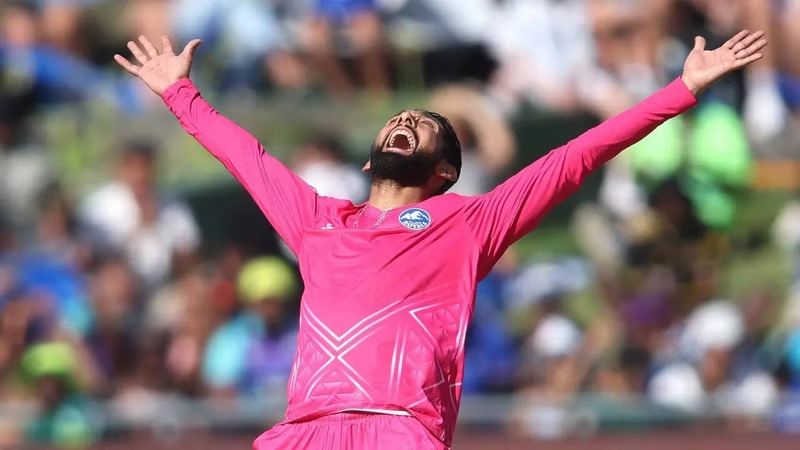
Let’s be honest: in today’s hyper-competitive, youth-obsessed T20 world, a 39-year-old cricketer is often seen as past his prime—maybe a mentor in the dressing room, but rarely a match-winner on the field. Yet **Sikandar Raza** isn’t just playing. He’s leading, performing, and making history in the SA20, South Africa’s marquee T20 league. And in doing so, he’s sending a powerful message: greatness doesn’t retire on a birthday.
Raza’s journey—from Sialkot, Pakistan, to becoming Zimbabwe’s most consistent all-rounder—is paved with heartbreak, resilience, and reinvention. And now, at an age when most cricketers are analyzing games from commentary boxes, he’s out there swinging for sixes and spinning batsmen into submission. His story is more than inspirational; it’s a blueprint for athletes from underdog nations seeking a global stage.
Table of Contents
- Sikandar Raza’s SA20 Impact: Age Is Just a Number
- The Road from Sialkot to Harare: An Unlikely Cricketing Odyssey
- Battling Cancer, Tragedy, and Career Slumps
- Why Raza Thrives as a T20 Freelancer
- How Raza’s Success Is Lighting a Path for Zimbabwean Youth
- The Quiet Revolution of Older Players in T20 Leagues
- Conclusion: A Legacy Written in Grit, Not Glory
- Sources
Sikandar Raza’s SA20 Impact: Age Is Just a Number
In the 2025–26 SA20 season, **Sikandar Raza** has been a revelation for his franchise. While his name might not trend like a young Indian or Pakistani star, his contributions have been pivotal—often turning tight matches with his crafty off-spin or calculated cameos down the order.
What stands out isn’t just his stats (though they’re solid), but his composure. In high-pressure chases or death overs, Raza’s decades of international experience shine. He reads the game like a strategist, not just a player—a quality increasingly rare in the T20 era’s rush for power-hitting.
The Road from Sialkot to Harare: An Unlikely Cricketing Odyssey
Born in Sialkot, Pakistan, in 1986, Raza moved to Zimbabwe as a teenager—a country with no Test status and limited resources. He qualified through residency and made his international debut in 2011. Early reviews were mixed: flashes of brilliance, but inconsistency plagued his game.
But Raza refused to be written off. He became Zimbabwe’s batting backbone during their ICC exile years, delivering iconic knocks like his unbeaten 135 against Bangladesh in 2018—a knock that saved Zimbabwe from a whitewash and announced his arrival as a world-class player.
Battling Cancer, Tragedy, and Career Slumps
Raza’s resilience was tested beyond the boundary. In 2022, he revealed he had been diagnosed with testicular cancer. Shockingly, he kept it private, undergoing surgery mid-season and returning to the field just weeks later—while still undergoing treatment .
Then came the devastating loss of his mentor and former Zimbabwe captain, Heath Streak, in 2023. Through it all, Raza remained a pillar for his national team, showing that leadership isn’t just about runs—it’s about character.
Why Raza Thrives as a T20 Freelancer
As Zimbabwe’s international fixtures dwindled due to ICC restrictions, Raza—like many of his peers—turned to the global T20 circuit. He’s since played in the CPL, LPL, BPL, and now the SA20. This “freelancer” model has allowed him to:
- Maintain match fitness and tactical sharpness
- Earn sustainable income outside Zimbabwe’s cash-strapped system
- Gain exposure that keeps him relevant for the national side
- Showcase Zimbabwean talent on a world stage
His success proves that T20 leagues aren’t just for young guns—they’re viable lifelines for seasoned professionals with cricketing IQ.
How Raza’s Success Is Lighting a Path for Zimbabwean Youth
Back in Harare, Raza’s SA20 visibility matters more than ever. With Zimbabwe Cricket struggling with funding, governance, and development infrastructure, young players often feel there’s no way out. But Raza’s journey says otherwise.
“I hope kids back home see that you don’t need to be from India or Australia to succeed globally,” Raza told reporters . “If you’re skilled, resilient, and willing to adapt, the world will notice.” That message is resonating—coaches in Bulawayo and Mutare now cite Raza as a role model in academies starved of heroes.
The Quiet Revolution of Older Players in T20 Leagues
Raza isn’t alone. A growing cohort of veteran cricketers—Dwayne Bravo (41), Sunil Narine (37), and Imad Wasim (37)—are proving that experience trumps youth in high-stakes T20 cricket. According to a 2025 ESPNCricinfo report, players over 35 accounted for 22% of “high-impact” performances in major T20 leagues last year—up from 11% in 2018 .
Why? Because T20 isn’t just about power. It’s about reading the game, managing risk, and executing under pressure—skills honed over years, not months.
Conclusion: A Legacy Written in Grit, Not Glory
Sikandar Raza may never win a World Cup or play in a marquee IPL auction. But his legacy is far more profound. He’s shown that cricket isn’t just the sport of superpowers—it’s a global game where heart, hustle, and hope can carve a path. At 39, he’s not just breaking new ground for himself. He’s rebuilding the dream for an entire generation of Zimbabwean cricketers. And that’s worth more than any trophy.
Sources
[INTERNAL_LINK:zimbabwe-cricket-crisis]
[INTERNAL_LINK:global-t20-freelancers]
Times of India: At 39, Sikandar Raza still breaking new ground — for himself and Zimbabwe
ESPNCricinfo: Sikandar Raza reveals cancer battle
ICC Official News Centre