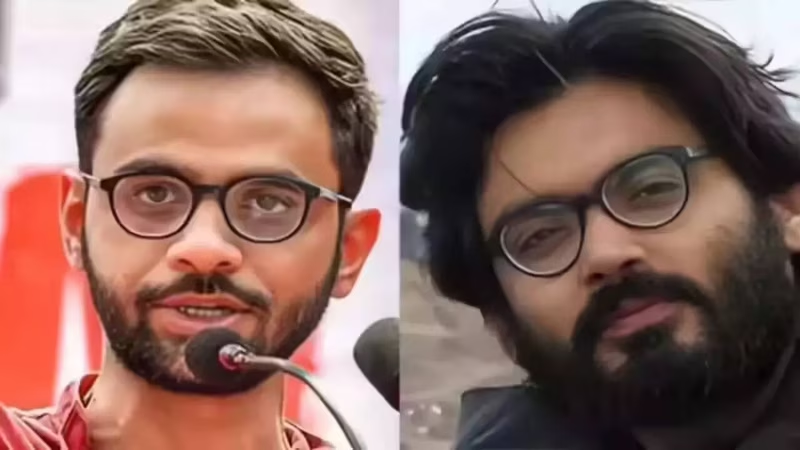
The 2020 Delhi riots remain one of India’s most politically charged and legally complex cases—and a recent Supreme Court order has reignited intense scrutiny. In a decisive move, the apex court denied bail to activists Umar Khalid and Sharjeel Imam, explicitly stating they stand on a “different footing” compared to other accused individuals in the Delhi riots case .
The distinction isn’t arbitrary. It’s rooted in a voluminous Delhi Police chargesheet that portrays Khalid as the alleged “central node” of a premeditated conspiracy and Imam as his key ideological ally—both accused of using inflammatory speeches, encrypted communications, and strategic coordination to incite communal violence that left 53 people dead and hundreds injured.
But what exactly did the chargesheet claim? And why did the Supreme Court find the evidence compelling enough to treat them uniquely? This article unpacks the legal, evidentiary, and constitutional dimensions of a case that sits at the crossroads of free speech, national security, and criminal conspiracy.
Table of Contents
- Background: The 2020 Delhi Riots
- Delhi Riots Case: What the Chargesheet Alleges
- Why SC Placed Khalid and Imam on ‘Different Footing’
- Key Evidence Cited by Delhi Police
- Legal Debate: Conspiracy vs. Dissent
- Previous Bail Rulings and Judicial Trends
- What Happens Next?
- Conclusion: A Test for India’s Legal Balancing Act
- Sources
Background: The 2020 Delhi Riots
The violence erupted in February 2020 in Northeast Delhi, amid nationwide protests against the Citizenship Amendment Act (CAA). What began as peaceful demonstrations escalated into communal clashes between pro- and anti-CAA groups. Over three days, neighborhoods burned, homes were destroyed, and lives were lost—mostly from minority communities .
Delhi Police later filed multiple FIRs and eventually consolidated key accused under a single Special Cell investigation, invoking stringent laws like UAPA (Unlawful Activities Prevention Act) and sections of the IPC related to rioting, murder, and criminal conspiracy.
Delhi Riots Case: What the Chargesheet Alleges
The police’s 17,000-page chargesheet makes sweeping claims about a “larger conspiracy” to destabilize the capital. Among dozens of accused, two names stand out:
- Umar Khalid: Described as the “central figure” who allegedly conceptualized the “idea of chakka jam (road blockade) as a tool to provoke state response.”
- Sharjeel Imam: Portrayed as Khalid’s “protégé” and “ideological amplifier,” whose speeches—including the infamous “chakka jamao” call at Aligarh Muslim University—are cited as direct incitement.
According to the document, both coordinated with student leaders, social media influencers, and local organizers to “escalate protests into violence” under the guise of democratic dissent.
Why SC Placed Khalid and Imam on ‘Different Footing’
In its January 2026 order, the Supreme Court emphasized that while many accused had limited or peripheral roles, Khalid and Imam were allegedly “deeply embedded in the conspiracy’s architecture.”
Justice B.R. Gavai, writing for the bench, noted: “The material on record attributes to them a role that is qualitatively different—suggesting planning, motivation, and orchestration, not mere participation” .
This distinction is crucial under UAPA, where bail is exceptionally hard to obtain if the court believes prima facie that the accused’s actions threatened national security or public order.
Key Evidence Cited by Delhi Police
The chargesheet relies on a mix of digital, testimonial, and circumstantial evidence:
- Phone Intercepts: Over 200 call detail records (CDRs) allegedly show repeated coordination between Khalid, Imam, and other activists in the days leading up to the violence.
- Social Media & Speech Clips: Videos of Imam’s speeches urging “chakka jam” and Khalid’s meetings with protest organizers are presented as motivational triggers.
- Witness Statements: Several prosecution witnesses claim they were instructed by Khalid’s associates to “occupy strategic locations” on February 23, 2020.
- Financial Transactions: Though not conclusively proven, the chargesheet hints at unaccounted funds used for logistics.
However, defense lawyers argue this evidence shows association—not criminal intent—and that speeches are protected under Article 19(1)(a) of the Constitution.
Legal Debate: Conspiracy vs. Dissent
Critics, including human rights groups like Amnesty International, warn that the Delhi riots case risks criminalizing political dissent . They point to the Supreme Court’s own 2022 ruling in the Teesta Setalvad case, which cautioned against using UAPA to “suppress legitimate protest.”
Yet the state counters that when speech crosses into incitement—especially in a volatile context—it loses constitutional protection. The landmark Shreya Singhal vs. Union of India judgment drew this line clearly: advocacy is free; incitement is not.
Previous Bail Rulings and Judicial Trends
This isn’t the first time Khalid and Imam have been denied bail. Lower courts and the Delhi High Court have consistently rejected their applications, citing the “gravity of allegations” and “potential to influence witnesses.”
What’s notable is the Supreme Court’s willingness to uphold these denials—even as it granted bail to 10 other accused in the same case in late 2025, reinforcing the “different footing” narrative.
What Happens Next?
The trial is ongoing in a designated UAPA court in Delhi. With Khalid and Imam in custody since 2020, their legal teams are expected to file fresh bail pleas or challenge the UAPA charges under Section 43D(5)—a high legal bar.
Meanwhile, the case has become symbolic: for some, it’s a necessary stand against hate-driven violence; for others, a cautionary tale of state overreach. [INTERNAL_LINK:uapa-law-india-explained] offers deeper insight into the legal framework being applied.
Conclusion: A Test for India’s Legal Balancing Act
The Delhi riots case isn’t just about two individuals—it’s a stress test for India’s democracy. Can the legal system distinguish between heated rhetoric and criminal conspiracy? Can it protect both public order and free expression? The Supreme Court’s “different footing” doctrine may provide a legal answer, but the societal debate is far from over.
Sources
- Times of India. “Delhi riots case: SC placed Khalid, Sharjeel on ‘different footing’; what chargesheet said.” https://timesofindia.indiatimes.com/city/delhi/sc-placed-khalid-sharjeel-on-different-footing-what-police-chargesheet-said/articleshow/126359537.cms
- Amnesty International India. “Delhi Riots: A Year of Injustice.” https://amnesty.org.in
- Supreme Court of India. “Umar Khalid vs. State of NCT of Delhi, SLP (Crl) No. 11075/2025.”
- PRS Legislative Research. “The Unlawful Activities (Prevention) Act, 1967: Key Features and Issues.” https://prsindia.org