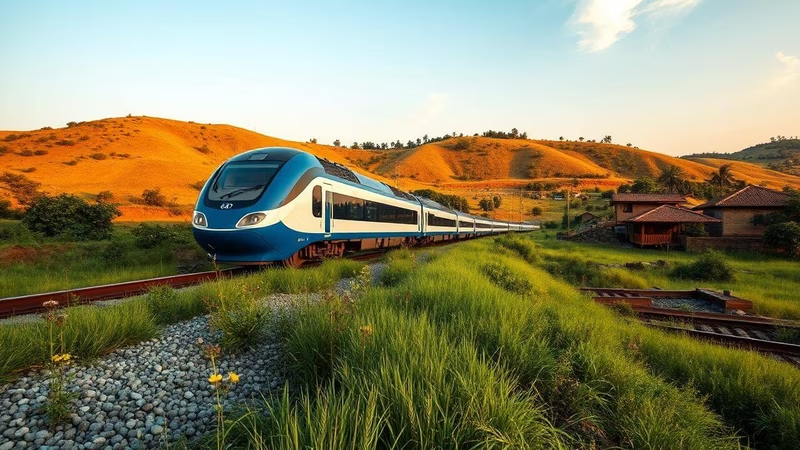
All aboard the future of clean transit! India’s first hydrogen train is now in its final preparation phase, marking a historic step toward decarbonizing one of the world’s largest rail networks. Spearheaded by the Haryana government in collaboration with Indian Railways, this pilot project on the Jind–Sonipat route is fully equipped and awaiting only the final go-ahead from central authorities .
Unlike conventional diesel locomotives that belch black smoke, this advanced train runs on hydrogen fuel cells—emitting nothing but water vapor. With a dedicated hydrogen production plant already operational and interiors designed for comfort and quiet, the project isn’t just symbolic; it’s a working blueprint for the future of sustainable mobility in India.
Table of Contents
- The Hydrogen Train Project at a Glance
- Why India’s First Hydrogen Train Matters
- Key Features of the Jind–Sonipat Hydrogen Train
- The Technology Behind the Hydrogen Train
- Global Context: How India Compares
- Challenges and Opportunities Ahead
- What Comes Next After the Launch?
- Conclusion: A Quiet Revolution on Tracks
- Sources
The Hydrogen Train Project at a Glance
The pilot initiative is being implemented on the 64-kilometer non-electrified route between Jind and Sonipat in Haryana—a strategic choice. Non-electrified routes are typically serviced by diesel locomotives, which are not only noisy but also major contributors to air pollution and greenhouse gas emissions.
To support the train, a state-of-the-art hydrogen generation plant has been set up locally, ensuring a secure and sustainable fuel supply. The entire system—from production to propulsion—is designed to be self-contained, minimizing logistical complexity and maximizing environmental benefits.
Why India’s First Hydrogen Train Matters
Indian Railways operates over 13,000 passenger trains daily, with thousands still running on diesel . While full electrification is the long-term goal, hydrogen offers a viable bridge for the 15–20% of routes that may remain unelectrified for years due to terrain, cost, or operational constraints.
The hydrogen train project is more than an engineering feat—it’s a climate commitment. By replacing diesel on even a few key routes, India can significantly cut CO₂ emissions, improve air quality in rural and semi-urban areas, and align with its net-zero pledge by 2070.
Key Features of the Jind–Sonipat Hydrogen Train
This isn’t just another train—it’s a next-generation passenger experience. Here’s what sets it apart:
- Zero Emissions: The only byproduct is pure water vapor—no CO₂, no particulate matter.
- Silent Operation: Hydrogen fuel cells run quietly, offering a smoother, more peaceful ride compared to diesel engines.
- Extended Range: With a full hydrogen tank, the train can travel up to 1,000 kilometers without refueling—ideal for medium-distance routes.
- Modern Amenities: Air-conditioned coaches, digital displays, USB charging ports, and ergonomic seating enhance passenger comfort.
- Local Fuel Source: On-site hydrogen production reduces dependence on imported diesel and strengthens energy security.
The Technology Behind the Hydrogen Train
At its core, the train uses a hydrogen fuel cell system that combines hydrogen (stored in high-pressure tanks) with oxygen from the air to generate electricity. This powers the traction motors and onboard systems, with excess energy stored in lithium-ion batteries for acceleration and regenerative braking.
The process is highly efficient and emits only water. According to the International Energy Agency (IEA), green hydrogen—produced using renewable electricity—can reduce lifecycle emissions by over 90% compared to diesel . While India’s current plant may use grid power, future phases aim to integrate solar or wind energy for truly green hydrogen.
Global Context: How India Compares
India isn’t alone in this race. Germany launched the world’s first hydrogen passenger train, the Coradia iLint, in 2018, and countries like France, the UK, and Japan are now testing similar systems . However, India’s approach is uniquely scalable—it’s not just importing technology but adapting it for cost-effective, high-volume deployment across a vast network.
Unlike Europe’s shorter commuter lines, India’s railway system demands robust, long-range solutions—making this Haryana pilot a critical testbed for the Global South.
Challenges and Opportunities Ahead
Despite its promise, the hydrogen train model faces hurdles:
- High Initial Costs: Fuel cells and hydrogen infrastructure remain expensive, though prices are falling.
- Refueling Infrastructure: Scaling beyond one route requires a nationwide hydrogen logistics network.
- Public Awareness: Misconceptions about hydrogen safety must be addressed through transparent communication.
Yet the opportunities are immense. Success on the Jind–Sonipat route could pave the way for deployment in states like Rajasthan, Madhya Pradesh, and the Northeast—regions with extensive unelectrified tracks and high solar potential for green hydrogen production.
What Comes Next After the Launch?
Once officially launched, the train will undergo a 6–12 month operational trial. Data on performance, maintenance, fuel consumption, and passenger feedback will inform a national rollout strategy. [INTERNAL_LINK:green-hydrogen-mission-india] could also integrate this project into its broader clean energy ecosystem.
If all goes well, Indian Railways may place bulk orders for hydrogen multiple units (HMUs) by 2027—potentially replacing hundreds of diesel locomotives.
Conclusion: A Quiet Revolution on Tracks
India’s first hydrogen train is more than a technological showcase—it’s a statement of intent. In a nation where trains are the lifeblood of daily life, this innovation offers a path to cleaner air, quieter journeys, and energy independence. As the final countdown begins, the world watches to see if India can turn this pilot into a paradigm shift for sustainable rail travel across the developing world.
Sources
- Times of India. “India’s first hydrogen train Haryana pilot on Jind–Sonipat route enters final stage; launch expected soon – key features.” https://timesofindia.indiatimes.com/business/infrastructure/indias-first-hydrogen-train-haryana-pilot-on-jindsonipat-route-enters-final-stage-launch-expected-soon-key-features/articleshow/126372645.cms
- Indian Railways Annual Report 2024–25. Ministry of Railways, Government of India.
- International Energy Agency (IEA). “The Future of Hydrogen.” https://www.iea.org/reports/the-future-of-hydrogen
- Railway Gazette International. “Germany’s Coradia iLint hydrogen train enters regular service.”