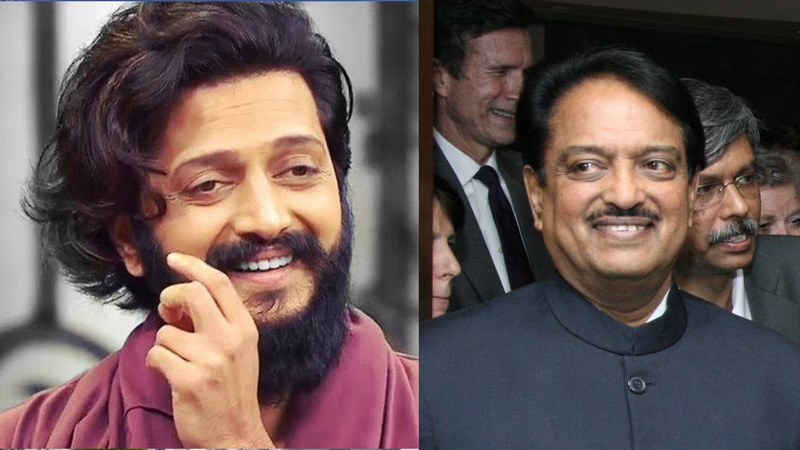
In a rare and deeply personal political intervention, actor Riteish Deshmukh has hit back hard at Maharashtra BJP president Ravindra Chavan, who recently declared at an election rally that the legacy of former Chief Minister Vilasrao Deshmukh would be “wiped out” from Latur. Riteish, visibly moved, responded with a poetic yet firm rebuke: “What is etched cannot be erased.”
The exchange—steeped in regional pride, political rivalry, and familial honor—has ignited a fierce debate across Maharashtra about how legacy is defined, who gets to claim it, and whether decades of public service can truly be undone by electoral rhetoric. For Riteish, a Bollywood star who has largely stayed away from overt political commentary, this moment marks a significant shift: from son of a statesman to defender of his father’s enduring imprint on Latur and the state.
Table of Contents
- The Controversial Remark That Sparked the Feud
- Riteish Deshmukh BJP Response: An Emotional Defense of Legacy
- Who Was Vilasrao Deshmukh? The Man Behind the Legend
- Latur: Why This City Is the Battleground of Memory
- Political Context: BJP’s Strategy in Marathwada
- Public and Expert Reactions: Whose Legacy Really Matters?
- Conclusion
- Sources
The Controversial Remark That Sparked the Feud
Speaking at a BJP election rally in Latur ahead of the 2026 Maharashtra Assembly elections, state party chief Ravindra Chavan made a bold declaration aimed at the Congress-NCP alliance: “The era of Vilasrao Deshmukh is over. His influence in Latur will be wiped out.”
The comment, intended as a show of BJP’s growing dominance in the Marathwada region, was perceived by many as a direct attack on the memory of a widely respected leader who served as Maharashtra CM twice and held key Union ministries. For the Deshmukh family—particularly Riteish, who hails from Latur—the phrasing felt not just political, but deeply disrespectful.
Riteish Deshmukh BJP Response: An Emotional Defense of Legacy
Breaking his usual silence on partisan politics, Riteish took to social media with a heartfelt post that quickly went viral:
“Leaders who serve the people don’t vanish when they leave office. Their work stays in hospitals built, colleges founded, roads laid, and hearts touched. What is etched in the soil of Latur cannot be erased by words spoken on a stage. My father’s legacy isn’t in banners or rallies—it’s in the lives he changed.”
His statement avoided naming Chavan directly but left no doubt about its target. More importantly, it reframed the debate: legacy isn’t about political control—it’s about lasting impact.
Who Was Vilasrao Deshmukh? The Man Behind the Legend
Vilasrao Deshmukh (1955–2012) wasn’t just a politician—he was a symbol of Marathwada’s rise in state politics. Born in a modest farming family in Latur district, he rose to become:
- Two-time Chief Minister of Maharashtra (1999–2003, 2004–2008)
- Union Minister for Heavy Industries, Science & Technology, and Rural Development
- Architect of key infrastructure projects in Latur, including the Government Medical College and multiple irrigation schemes
Even critics acknowledged his grassroots connect. His administration was credited with stabilizing Latur after the devastating 1993 earthquake, turning recovery into long-term development .
Latur: Why This City Is the Battleground of Memory
Latur isn’t just the Deshmukh family’s hometown—it’s their political fortress. For decades, the family has dominated local elections, with Vilasrao’s son Ajit Deshmukh also serving as an MLA. The BJP’s push to “wipe out” this influence is part of a broader strategy to break Congress’s hold in Marathwada, a region historically resistant to saffron politics.
But as Riteish’s response highlights, emotional loyalty runs deeper than electoral math. As one Latur resident told The Indian Express: “Vilasrao baba gave us identity. No party can delete that.”
Political Context: BJP’s Strategy in Marathwada
The “wiped out” comment fits a pattern of aggressive rhetoric from the BJP as it seeks to expand beyond its urban strongholds. By targeting legacy figures like Vilasrao Deshmukh, the party aims to signal a generational shift—positioning itself as the future, and Congress as the past.
However, this approach carries risk. Dismissing beloved local icons can backfire, especially in rural Maharashtra where personal respect often outweighs party loyalty. Analysts warn that Chavan’s remark may have galvanized Deshmukh loyalists rather than intimidated them .
Public and Expert Reactions: Whose Legacy Really Matters?
Reactions have been swift and divided:
- Congress leaders praised Riteish’s “dignified” response and called the BJP’s comment “desperate.”
- BJP supporters argued that politics is about the future, not “worshipping the dead.”
- Political scientists note that such clashes reveal a deeper truth: in India, legacy is personal, local, and fiercely protected.
“You can win elections,” said Dr. Priya Mehta, a political sociologist at Savitribai Phule Pune University, “but you can’t legislate memory.”
[INTERNAL_LINK:maharashtra-elections-2026-key-battlegrounds] Explore other critical constituencies shaping Maharashtra’s 2026 electoral map.
Conclusion
The Riteish Deshmukh BJP exchange is about more than one rally or one remark. It’s a microcosm of a larger struggle: how India remembers its leaders, and who gets to control that narrative. Riteish’s simple yet profound retort—“What is etched cannot be erased”—has resonated far beyond Latur because it speaks to a universal truth: true legacy isn’t written in party manifestos, but in the everyday lives of the people served. In the end, that’s a history no politician can wipe out.
Sources
- Times of India: Riteish Deshmukh hits back at BJP chief’s ‘wiped out’ remark on father
- The Hindu: BJP’s Latur Remark Sparks Political Row
- Indian Express: Riteish Deshmukh on Vilasrao Deshmukh’s Legacy: ‘It’s in the People’
- PRS Legislative Research: Profile of Vilasrao Deshmukh – Political Contributions
- [INTERNAL_LINK:marathwada-political-history] The Rise of Regional Leadership in Marathwada