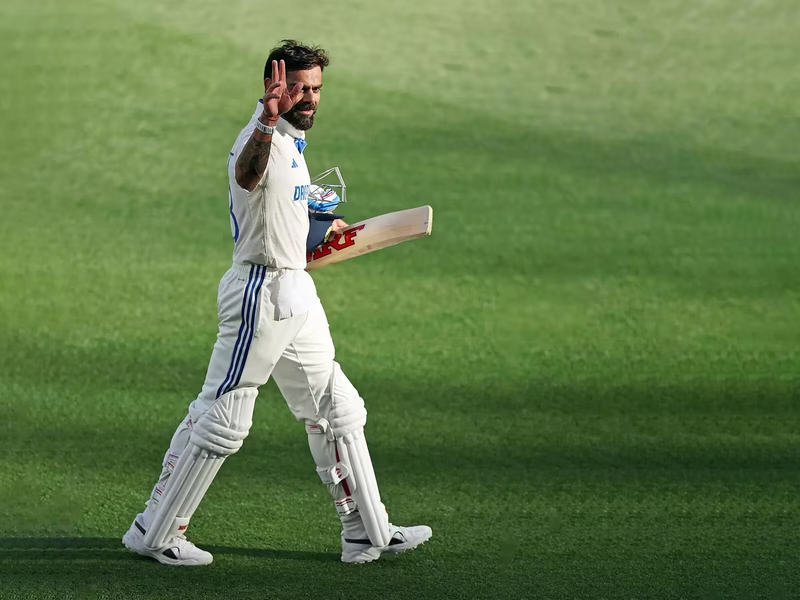
The cricket world is still reeling from Virat Kohli’s announcement—but not everyone is offering tributes. Veteran commentator and former Indian batsman Sanjay Manjrekar has launched a scathing critique of Kohli’s Test retirement, calling it a premature surrender from the game’s toughest format. In a now-viral commentary clip, Manjrekar bluntly stated: “He chose the easiest format,” referring to Kohli’s decision to continue playing ODIs while stepping away from Test cricket .
Manjrekar’s frustration stems from more than just sentiment. He points to Kohli’s elite fitness, recent form fluctuations, and—most pointedly—the timing of his exit, which comes just days after England legend Joe Root smashed a majestic century against formidable opposition. To Manjrekar, this juxtaposition highlights what he sees as a missed opportunity: a champion bowing out during a lean patch instead of fighting through it, as true greats of the red-ball game have done for generations.
Table of Contents
- Manjrekar’s Argument: Why Kohli’s Retirement Stings
- Virat Kohli Test retirement and the ODI Paradox
- The Joe Root Factor: A Stark Contrast
- Fitness, Form, and the Mental Challenge of Test Cricket
- Fan and Expert Reactions to Manjrekar’s Take
- Conclusion: Different Eras, Different Choices
- Sources
Manjrekar’s Argument: Why Kohli’s Retirement Stings
For Manjrekar, Test cricket isn’t just another format—it’s the ultimate test of a cricketer’s character, technique, and resilience. In his view, Kohli—still only in his mid-30s and renowned for his gym-honed physique—was uniquely positioned to overcome a temporary dip in form.
“At his age, with his fitness levels, Virat could have easily worked his way back,” Manjrekar argued. “Test cricket rewards patience and perseverance. Walking away because you’re not scoring hundreds every other match… that sets a dangerous precedent” .
His critique isn’t personal; it’s philosophical. He believes modern players are increasingly prioritizing shorter formats not just for financial reasons, but because they demand less sustained mental and physical endurance.
Virat Kohli Test retirement and the ODI Paradox
What baffles Manjrekar most is the inconsistency in Kohli’s decision. “If you’re retiring from the hardest format due to fatigue or form, why continue in ODIs?” he asked. “ODIs are physically demanding too—but they don’t test your technique against the new ball under seamer-friendly English conditions, or your patience against spin on a turning Chennai track.”
This “ODI paradox” has sparked debate among fans and experts alike:
- ODIs are faster-paced, but less grueling over five days.
- Test cricket requires deeper technical refinement, especially against high-quality pace and spin attacks.
- By staying in ODIs, Kohli signals he’s still competitive—but Manjrekar sees this as cherry-picking convenience over challenge.
[INTERNAL_LINK:virat-kohli-career-stats-test-vs-odi] Compare Kohli’s performance metrics across formats to understand the strategic shift.
The Joe Root Factor: A Stark Contrast
Manjrekar’s comments came hot on the heels of Joe Root’s masterful 121 against South Africa in Cape Town—a knock full of grace, grit, and textbook technique . Root, also in his mid-30s and having faced his own form slumps, chose to dig deeper, not walk away.
“Here’s a player of equal stature, going through similar phases, yet he’s producing when it matters most,” Manjrekar noted. “It makes you wonder—what if Kohli had given himself just one more series?”
The comparison isn’t meant to diminish Kohli’s legacy but to highlight a divergent philosophy: retreat versus resilience.
Fitness, Form, and the Mental Challenge of Test Cricket
Let’s be clear: Kohli hasn’t been at his peak in Tests recently. His last Test century came over 18 months ago, and his average has dipped below 45 in the last two years—a stark fall from his career mark of 49+ .
But history is full of greats who endured droughts:
- Sachin Tendulkar went 17 Tests without a century between 2006–2008 before roaring back.
- Steve Smith returned from a 12-month ban to average over 60 in his next 20 Tests.
- Rahul Dravid reinvented his technique multiple times to stay competitive past 35.
Manjrekar’s lament is that Kohli—whose work ethic is legendary—didn’t give himself that same grace period to rediscover his red-ball rhythm.
Fan and Expert Reactions to Manjrekar’s Take
The reaction has been polarized:
- Supporters of Manjrekar say he’s defending the sanctity of Test cricket in an age of T20 glamour.
- Kohli loyalists argue that players have the right to choose their career paths—and that Kohli has given over 15 years of service to Indian cricket.
- Neutral observers suggest that Manjrekar’s “easiest format” comment oversimplifies the physical toll of modern cricket’s packed calendar.
Former captain Sourav Ganguly offered a middle ground: “Virat has earned the right to decide. But Sanjay’s point about Test cricket’s value is worth listening to” .
Conclusion: Different Eras, Different Choices
Sanjay Manjrekar’s frustration with Virat Kohli Test retirement isn’t just about one player—it’s about the soul of the game. As T20 leagues and bilateral ODI series dominate calendars, Test cricket’s future relies on stars who are willing to embrace its unique demands, even in adversity.
Kohli’s legacy remains untouchable. But Manjrekar’s critique serves as a timely reminder: greatness isn’t just about records—it’s also about how you respond when the game gets tough. Whether you agree with him or not, the conversation he’s sparked is vital for the future of the longest format.
Sources
- Times of India: ‘He chose the easiest format’: Manjrekar blasts Kohli’s Test retirement
- ESPNcricinfo: Joe Root’s Century in Cape Town – Match Report
- ICC Player Rankings: Official ICC Test Batting Rankings
- Wisden Almanack: Historical Analysis of Test Cricket Legends
- [INTERNAL_LINK:test-cricket-future-india] Is Test Cricket Dying in India? The Real Challenges Ahead