Air So Thick, Justice Can’t Breathe: SC’s Explosive Rebuke to Pollution Authorities
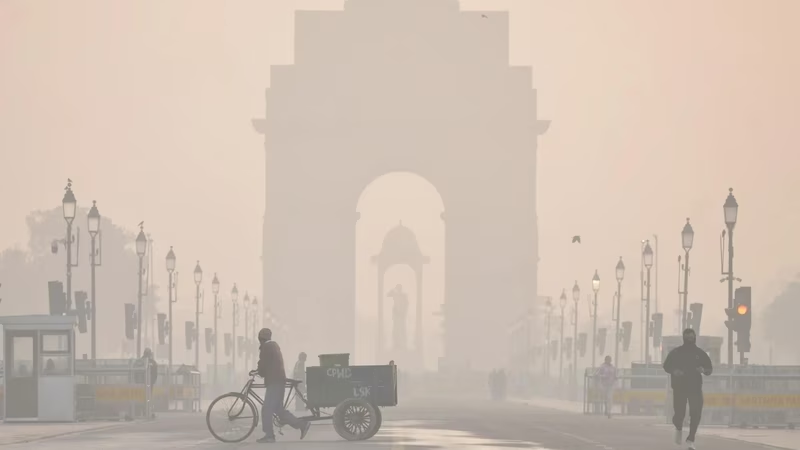
Delhi’s residents have long endured October to January as a season of toxic air—when the sky turns grey, schools shut, and breathing feels like a gamble. But this time, the Supreme Court has had enough. In a blistering hearing, the nation’s highest court didn’t just express concern—it delivered a judicial slapdown to the Commission for Air Quality Management (CAQM), accusing it of “failing to do its duty” in tackling the relentless Delhi air pollution crisis .
With the capital’s air quality stubbornly stuck in the “poor” category (AQI 250–350), the court rejected the CAQM’s request for a two-month adjournment on implementing critical anti-pollution measures. Instead, it issued a non-negotiable directive: convene a panel of independent experts within two weeks and submit a detailed report identifying both immediate triggers and long-term structural solutions. No more delays. No more excuses.
Table of Contents
- What the Supreme Court Actually Said
- The State of Delhi Air Pollution in Early 2026
- Why the CAQM Is Under Fire
- What the 14-Day Expert Report Must Include
- A History of Broken Promises on Delhi’s Air
- What Delhi Residents Can Do While Waiting
- Conclusion: Is This the Tipping Point?
What the Supreme Court Actually Said
The bench, led by Chief Justice of India, minced no words. “You were created to solve this problem, not to pass the buck,” the court told CAQM officials . It highlighted that despite being established in 2021 with expanded powers and funding, the commission has failed to curb pollution levels that routinely breach WHO safety guidelines by 10–15 times.
Key judicial directives include:
- Convene an expert committee within 14 days comprising scientists from IITs, NEERI, and public health specialists.
- Identify primary pollution sources—beyond the usual suspects like stubble burning—to include construction dust, vehicular emissions, and industrial clusters.
- Propose enforceable, long-term solutions with clear accountability mechanisms.
- Reject any further adjournments on pending orders, including restrictions on BS-III petrol and BS-IV diesel vehicles.
The State of Delhi Air Pollution in Early 2026
Despite winter ending, Delhi’s AQI remains alarmingly high. Recent data from the Central Pollution Control Board (CPCB) shows:
- Average PM2.5 levels at 180 µg/m³—over 3.5 times the WHO’s 24-hour safe limit of 50 µg/m³.
- Multiple monitoring stations in Anand Vihar, Wazirpur, and RK Puram consistently reporting AQI above 300 (“very poor”).
- Children’s hospitals reporting a 40% spike in respiratory admissions since December .
Experts warn that without structural intervention, every post-monsoon season will bring another cycle of public health emergency.
Why the CAQM Is Under Fire
Created under the Commission for Air Quality Management in NCR and Adjoining Areas Act, 2021, the CAQM was meant to replace the fragmented EPCA (Environment Pollution (Prevention & Control) Authority) with a more powerful, unified body. Yet its performance has drawn criticism:
- Lack of enforcement: Failed to penalize major polluters like thermal plants and construction firms.
- Delayed action: Waited until AQI hit “severe” before implementing GRAP (Graded Response Action Plan) measures.
- Poor coordination: Struggled to align Punjab, Haryana, and UP on stubble management strategies.
As one environmental lawyer put it: “The CAQM has more authority than its predecessor—but less urgency.”
What the 14-Day Expert Report Must Include
The Supreme Court’s order isn’t vague. The expert committee must deliver actionable intelligence, including:
- A source apportionment study quantifying contributions from vehicles, industry, dust, waste burning, and regional factors.
- A cost-benefit analysis of long-term interventions like electric public transport, green buffers around cities, and industrial relocation.
- A monitoring and compliance framework with real-time data transparency and citizen grievance redressal.
- Recommendations for legislative or regulatory amendments if current laws are insufficient.
The report will be made public and form the basis for future judicial orders—meaning CAQM can no longer hide behind procedural delays.
A History of Broken Promises on Delhi’s Air
This isn’t the first time the judiciary has intervened:
- 1998: SC ordered conversion of Delhi’s public buses to CNG.
- 2016: Creation of EPCA after another smog crisis.
- 2021: Dissolution of EPCA and formation of CAQM with “more teeth.”
Yet pollution levels have barely improved in two decades. According to the World Health Organization (WHO), Delhi remains one of the world’s most polluted capitals . The court’s frustration is rooted in this cycle of action, inaction, and re-action.
What Delhi Residents Can Do While Waiting
While systemic change is pending, citizens aren’t powerless:
- Use the Sameer app or AQICN.org to monitor real-time air quality.
- Wear N95 masks on high-pollution days.
- Install indoor air purifiers with HEPA filters.
- Report illegal waste burning via the CAQM Green Delhi app.
- Advocate for local tree plantation and carpooling initiatives.
[INTERNAL_LINK:delhi-air-pollution-solutions-home] for DIY air quality tips.
Conclusion: Is This the Tipping Point?
The Supreme Court’s sharp rebuke of the CAQM marks a potential turning point in India’s battle against Delhi air pollution. By demanding scientific rigor, rejecting delays, and insisting on accountability, the judiciary is forcing a shift from reactive firefighting to proactive governance.
But the real test lies ahead. Will the CAQM rise to the occasion and deliver a transformative expert report? Or will this become another chapter in Delhi’s tragic saga of policy paralysis? For 20 million residents who breathe this air every day, the answer is a matter of life and health—and now, thanks to the Supreme Court, it must come within 14 days.