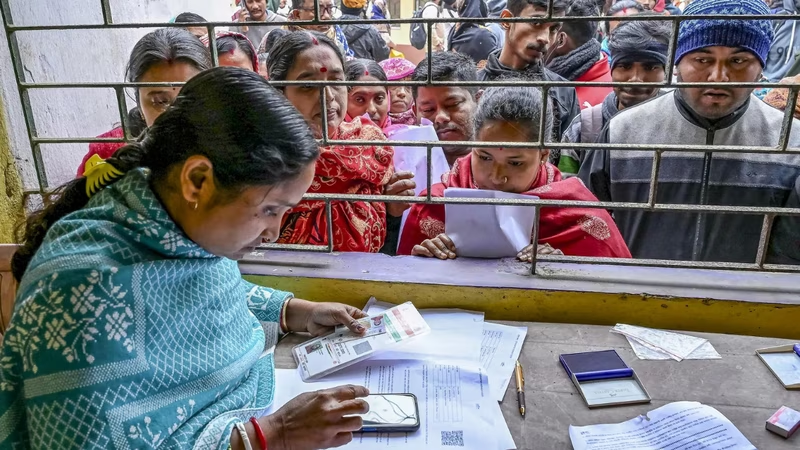
A Silent Electoral Earthquake in Uttar Pradesh
Imagine waking up one day to discover you’re no longer eligible to vote—not because you broke the law, but because a government database flagged you as “missing,” “moved,” or worse, “deceased.” This isn’t dystopian fiction. It’s the reality for nearly 2.89 crore citizens of Uttar Pradesh following the release of the state’s draft electoral roll after a Special Intensive Revision (SIR) drive .
Of those removed, a jaw-dropping 46.23 lakh people have been officially declared dead—a figure that has sparked both bureaucratic scrutiny and public anxiety. With the final voter list set to be published on March 6, 2026, millions now face a race against time to verify their status and avoid being disenfranchised in upcoming elections. This unprecedented scale of UP voter list removal raises urgent questions: Is this a necessary housekeeping exercise or a systemic overreach?
Table of Contents
- What Is the UP SIR Drive and Why Was It Launched?
- Inside the UP Voter List Removal: Who Was Cut and Why?
- How to Check Your Voter Status Online (Step-by-Step Guide)
- Concerns and Controversies: Errors, Disenfranchisement, and Data Accuracy
- Historical Context: Has This Happened Before?
- What to Do If Your Name Was Removed by Mistake
- Conclusion: A Call for Vigilance and Verification
What Is the UP SIR Drive and Why Was It Launched?
The Special Intensive Revision (SIR) is a periodic exercise mandated by the Election Commission of India (ECI) to clean up electoral rolls by removing inaccurate or outdated entries. In Uttar Pradesh—a state with over 15 crore registered voters—this is a monumental task.
The primary goals of the SIR include:
- Removing names of voters who have died.
- Deleting duplicate entries (e.g., same person registered in multiple constituencies).
- Excluding voters who have migrated outside the constituency or country.
- Correcting errors in names, addresses, or demographic details.
According to the ECI, this cleanup is essential to maintain the integrity of elections and prevent fraudulent voting . But when the scale reaches nearly 3 crore exclusions, the margin for error becomes a national concern.
Inside the UP Voter List Removal: Who Was Cut and Why?
The Election Commission’s data reveals a detailed breakdown of the 2.89 crore exclusions:
- 46.23 lakh voters marked as “deceased” based on death certificates from municipal and panchayat records.
- Over 1.2 crore voters removed due to “shifting” or “not found at registered address” during field verification.
- Nearly 95 lakh duplicate entries identified through Aadhaar and EPIC (Electoral Photo Identity Card) cross-matching.
- The remainder excluded for “incomplete documentation” or “unverified residency.”
While these categories sound logical, ground reports suggest inconsistencies. In some districts, entire families were removed because field officers couldn’t locate them during a single daytime visit—despite them living at the same address for decades.
How to Check Your Voter Status Online (Step-by-Step Guide)
Don’t wait for someone to tell you you’ve been removed. Verify your status now using these official methods:
- Visit the ECI’s Electoral Search Portal.
- Enter your EPIC number (found on your voter ID card) or search by name, date of birth, and state.
- If your name appears, note your serial number and polling station.
- If it’s missing, click “File a Claim” to submit Form 6 for inclusion.
- Track your application status using the “Track Application” option on the National Voters’ Services Portal (NVSP).
You can also use the Voter Helpline App (available on Android and iOS) for a mobile-friendly check. The deadline for corrections is February 28, 2026; the final roll publishes on March 6.
Concerns and Controversies: Errors, Disenfranchisement, and Data Accuracy
Civil society groups and opposition parties have raised alarms about the potential for mass disenfranchisement. “When you remove 3 crore voters in one go, you’re bound to sweep out legitimate citizens,” said Dr. Anjali Bhardwaj, an RTI activist .
Key concerns include:
- Automated errors: Over-reliance on death certificate databases that may include clerical mistakes.
- Field verification gaps: Booth-level officers (BLOs) often lack time or resources to conduct thorough checks, especially in rural areas.
- Digital divide: Elderly or low-income voters may not know how to check their status online, leaving them vulnerable to silent exclusion.
The ECI insists that due process was followed and that citizens have ample time to appeal. But with elections likely in 2027, the stakes couldn’t be higher.
Historical Context: Has This Happened Before?
Large-scale purges aren’t new. In 2019, Assam’s National Register of Citizens (NRC) excluded 19 lakh people, causing a humanitarian crisis. While UP’s exercise is under the ECI—not the NRC—it echoes similar fears about bureaucratic opacity.
However, the ECI emphasizes that this is a routine democratic process, not a citizenship test. As per the Election Commission of India’s official guidelines, every excluded voter has the right to appeal .
What to Do If Your Name Was Removed by Mistake
If you discover your name is missing:
- Don’t panic. You still have time to correct it.
- Visit your nearest Booth Level Officer (BLO) or Common Service Centre (CSC).
- Submit Form 6 for inclusion with proof of residence (Aadhaar, ration card, utility bill).
- For “deceased” errors, provide an affidavit and identity proof to prove you’re alive—a grim but necessary step.
- Follow up weekly until your name is restored.
[INTERNAL_LINK:voter-id-correction-process-up] for a detailed state-specific guide.
Conclusion: A Call for Vigilance and Verification
The UP voter list removal is a double-edged sword: essential for electoral integrity, yet perilous in its execution. While removing fake or deceased voters strengthens democracy, accidentally excluding living citizens weakens it.
The onus now lies on every eligible voter in Uttar Pradesh to act. Check your name. Verify your details. File a claim if needed. Because in a democracy, the right to vote isn’t just a privilege—it’s your voice. And if your name isn’t on that list by March 6, 2026, that voice may fall silent.